Join us on a literary world trip!
Add this book to bookshelf
Grey
Write a new comment Default profile 50px
Grey
Subscribe to read the full book or read the first pages for free!
All characters reduced
Daily Gratitude Practice - cover

Daily Gratitude Practice

Xena Mindhurst

Translator A AI

Publisher: Publifye

  • 0
  • 0
  • 0

Summary

"Daily Gratitude Practice" explores the transformative power of gratitude through the lens of scientific research, offering a comprehensive examination of how expressing thanks affects our mental well-being and neurological functioning. This evidence-based guide bridges the gap between academic research and practical application, distinguishing itself by combining cutting-edge neuroscience with accessible implementation strategies.

 
The book's journey begins with a solid foundation in positive psychology research, revealing fascinating insights about how gratitude practices increase activity in the brain's medial prefrontal cortex and contribute to stress reduction. Through three main sections, readers progress from understanding the science behind gratitude to learning practical, research-backed techniques for cultivating grateful awareness.

 
Particularly noteworthy is the book's presentation of gratitude as a trainable skill rather than an innate trait, supported by extensive clinical studies and neuroimaging research. Moving beyond simple thankfulness exercises, this guide addresses common obstacles to maintaining consistent gratitude practices while offering adaptable solutions for different life circumstances.

 
The text skillfully balances scientific rigor with practical application, featuring structured journaling protocols and interpersonal gratitude activities proven effective through clinical trials. What sets this resource apart is its strong emphasis on empirical evidence while maintaining an accessible writing style that speaks to both mental health professionals and individuals seeking personal growth through validated psychological approaches.
Available since: 01/19/2025.
Print length: 141 pages.


Other books that might interest you

  • Game Misconduct - Hockey's Toxic Culture and How to Fix It - cover

    Game Misconduct - Hockey's Toxic...

    Evan F. Moore, Jashvina Shah,...

    • 0
    • 0
    • 0
    Those who have been lured by the sound of skate blades slicing into fresh ice and everything-or-nothing attitude of the game know that hockey can seem like its own world. 


    Yet in another light, that tight community can turn insular; the values of teamwork and humility can manifest as collective silence in the face of abuse and discrimination, issues which have been brought to the forefront of the sport as many share their stories for the first time. 


    In Game Misconduct, reporters Evan Moore and Jashvina Shah reveal hockey's toxic undercurrent which has permeated the sport throughout the junior, college, and professional levels. They address the topic with a level of passion that comes from being rabid hockey fans themselves, and from experiencing its exclusivity first-hand. 


    This necessary book lays bare the issues of racism, homophobia, xenophobia, bullying, sexism, and violence on and off the ice. Listeners will learn about notable players and activists fighting for transformation as well as those beyond the spotlight. 


    Game Misconduct is essential for modern hockey fans, showing the truth of the sport's past and present while offering the tools to fight for a better future.
    Show book
  • Closing the Reading Gap - cover

    Closing the Reading Gap

    Alex Quigley

    • 0
    • 0
    • 0
    Our pupils' success will be defined by their ability to read fluently and skillfully. But despite universal acceptance of reading's vital importance, the reading gap in our classroom remains, and it is linked to an array of factors, such as parental wealth, education and book ownership, as well as classroom practice. To close this gap, we need to ensure that every teacher has the knowledge and skill to teach reading with confidence. 
     
    In Closing the Reading Gap, Alex Quigley explores the intriguing history and science of reading, synthesizing the debates and presenting a wealth of usable evidence about how children develop most efficiently as successful readers. Offering practical strategies for teachers at every phase of their teaching career, as well as tackling issues such as dyslexia and the role of technology, the book helps teachers to be an expert in how pupils 'learn to read' as well as how they 'read to learn' and explores how reading is vital for unlocking a challenging academic curriculum for every student. 
     
    With a focus on nurturing pupils' will and skill to read for pleasure and purpose, this essential volume provides practical solutions to help all teachers create a rich reading culture that will enable every student to thrive in school and far beyond the school gates.
    Show book
  • Evolution Is Wrong - A Radical Approach to the Origin and Transformation of Life - cover

    Evolution Is Wrong - A Radical...

    Erich von Däniken

    • 1
    • 1
    • 0
    A Fascinating Exploration on Why the Darwinists’ Theory No Longer Explains Everything 
    There was once a set of ideas called the theory of evolution, conceived by clever people and confirmed by countless scientists. Then people discovered the electron microscope. This made it possible to make the molecules within the cell visible, and suddenly questions about evolution arose that were not possible before. Which force actually bundles the atoms in the right order? What moves the molecular chains into the correct position? How did the first living unit within the cell actually come about? How does inheritance work, how does information pass on to the next generation? Did humans descend only and exclusively from primates—as Charles Darwin and countless other great minds assumed—or did additional “engines” intervene in evolution?  
    Today it is clear: countless questions can no longer be answered with the previous theory of evolution. There is a form of life called “Blob” (Physarum polycephalum). The “thing” has neither eyes nor ears, neither a mouth nor a nose or even a brain. Nevertheless, it takes in food, overcomes obstacles by the shortest route and exchanges information with other “blobs.” The “blob” contradicts any evolutionary thought that one develops from the other. Or the “gastric-brooding frogs” (Rheobatrachus) found in Australia. They hatch their young in the stomach. Impossible in a slow, evolutionary process.  
    Everywhere there are characteristics of animals that do not want to fit into the theory of evolution anywhere. And man? Are we really the most adapted life-form on this planet? Today, more and more scientists who contradict the previous theory of evolution speak out. The theory fits the changes within the species, but it can no longer be reconciled with the inner workings of the cell. Some other influence that has so far escaped us is affecting evolution. It is called “Intelligent Design.” Intelligent planning is suspected behind this. Anyone or anything—a spirit of the universe? Aliens?—could be behind this planning.  
    Erich von Däniken uses countless examples to demonstrate the impossibility of the previous evolutionary idea. He quotes scientists who argue against the previous teaching, but also those who defend it. Unfortunately, established science still refuses to look at discrepancies and holes in the theory of evolution, even though it is quite obvious that there is more going on with regard to the development of all species, as well as human culture, than could be explained by the theory of evolution alone.
    Show book
  • Dogwhistles and Figleaves - How Manipulative Language Spreads Racism and Falsehood - cover

    Dogwhistles and Figleaves - How...

    Jennifer Mather Saul

    • 0
    • 0
    • 0
    It is widely accepted that political discourse in recent years has become more openly racist and more accepting of wildly implausible conspiracy theories. Dogwhistles and Figleaves explores ways in which such changes—both of which defied previously settled norms of political speech—have been brought about. Jennifer Saul shows that two linguistic devices, dogwhistles and figleaves, have played a crucial role. Some dogwhistles (such as "88", used by Nazis online to mean "Heil Hitler") serve to disguise messages that would otherwise be rejected as unacceptable, allowing them to be transmitted surreptitiously. Other dogwhistles (like the 1988 "Willie Horton" ad) work by influencing people in ways that they are not aware of, and which they would likely reject were they aware. Figleaves (such as "just asking questions") take messages that could easily be recognized as unacceptable, and provide just enough cover that people become more willing to accept them. Saul argues that these devices are important for the spread of racist discourse. She also shows how they contribute to the transmission of norm-violating discourse more generally, focusing on the case of wildly implausible conspiracist speech. This book is the first full-length exploration of dogwhistles and figleaves. It offers an illuminating and disturbing view of the workings of contemporary political discourse.
    Show book
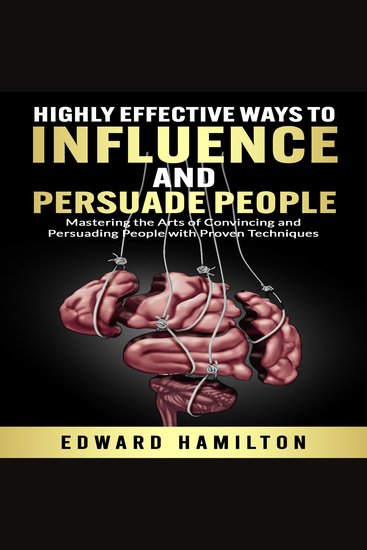
  • Highly Effective Ways to Influence and Persuade People - Mastering the Arts of Convincing and Persuading People with Proven Techniques - cover

    Highly Effective Ways to...

    Edward Hamilton

    • 0
    • 0
    • 0
    "Highly Effective Ways to Influence and Persuade People" is an indispensable guide that reveals the secrets to mastering the art of persuasion and becoming a highly influential communicator. With a focus on practicality and real-world application, this transformative book equips readers with a comprehensive toolkit to navigate the intricacies of influence successfully. 
    Through a meticulous exploration of various topics, this book goes beyond the surface-level techniques and dives deep into understanding emotional triggers, building genuine rapport, leveraging rhetoric, and crafting compelling arguments. Drawing from a wealth of research and real-world examples, the author unveils proven strategies for overcoming objections, implementing effective negotiation techniques, and developing an authentic charisma that captivates audiences. 
    Packed with invaluable insights, this book takes readers on a journey through the most effective methods of communication and persuasion. Whether you're a sales professional seeking to enhance your sales skills, an entrepreneur aiming to negotiate more effectively, or an individual desiring to communicate more persuasively in both personal and professional settings, this book provides the knowledge, tools, and actionable techniques necessary for success. 
    Immersed in a rich tapestry of practical tips and techniques, "Highly Effective Ways to Influence and Persuade People" empowers readers to elevate their persuasive abilities. Real-world case studies and examples illustrate the application of these techniques, allowing readers to grasp their transformative potential and apply them in their own lives with confidence and precision.
    Show book
  • Japanese Made Easy - Beginner - Volume 2 of 3 - cover

    Japanese Made Easy - Beginner -...

    Lingo Wave

    • 0
    • 0
    • 0
    We broke our new series on learning Japanese down into different learning stages. Start with the "Lower Beginner" books followed by the "Beginner" and "Upper Beginner" books. Next, progress to the "Intermediate" series, then test and reinforce your knowledge with the "Conversations" series. 
    This audiobook is divided into units.While it provides different learning patterns and accommodates various needs, this audiobook focuses on helping you improve your ability to understand, speak, and memorise Japanese.  
    In Unit 1 you will hear Japanese decoded with each syllable spoken very slowly and clearly with repetition. Immediately before each sentence is spoken, you will hear the translation, so you will always understand what is being said. 
    Unit 2 focuses solely on increasing your listening ability, which will improve your abilities to engage in dialogue with a native Japanese speaker. This chapter requires you to listen very carefully to nuances in the language. 
    By Unit 3 you will already notice progress in your abilities to speak and understand Japanese. The spoken translation is followed by two repetitions in Japanese at a completely natural speed. While you are learning to process naturally spoken Japanese, Units 3 and 4 will help you memorise new vocabulary and full sentences. 
    In Unit 5 you can test yourself on how much you have learned. If you are having difficulties, we suggest you revisit the listening, speaking, or memorisation section of Units 1, 2 3 or 4, according to what you need more help with. 
    Topics covered in this book: 
    1. Asking about family 
    2. Asking about relationship status 
    3. Expressing frequency 
    4. Talking about spare time activities and hobbies 
    5. Using quantifiers/determiners 
    6. Talking about preference 
    7. Talking about abilities 
    8. Talking about location of places 
    9. Describing appearance 
    10. Talking about personality 
    ...
    Show book