Join us on a literary world trip!
Add this book to bookshelf
Grey
Write a new comment Default profile 50px
Grey
Subscribe to read the full book or read the first pages for free!
All characters reduced
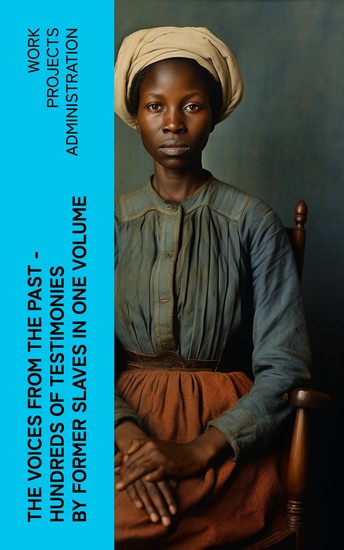
The Voices From The Past – Hundreds of Testimonies by Former Slaves In One Volume - cover

The Voices From The Past – Hundreds of Testimonies by Former Slaves In One Volume

Work Projects Administration

Publisher: e-artnow

  • 0
  • 0
  • 0

Summary

After the end of Civil War in 1865, more than four million slaves were set free. There were several efforts to record the remembrances of the living former slaves. The Federal Writers' Project was one such project by the United States federal government to support writers during the Great Depression by asking them to interview and record the myriad stories and experiences of slavery of former slaves. The resulting collection preserved hundreds of life stories from 17 US states that would otherwise have been lost in din of modernity and America's eagerness to deliberately forget the blot on its recent past. This edition brings to you the complete collection of first hand experiences and voices from the past that makes one question whether is it safe to forget or keep the memories alive for bigger battles ahead. A must read for everyone who is interested in US History, race relations and authentic historical research.  Contents: Alabama Arkansas Florida Georgia Indiana Kansas Kentucky Maryland Mississippi Missouri North Carolina Ohio Oklahoma South Carolina Tennessee Texas Virginia
Available since: 12/14/2023.
Print length: 7860 pages.
Other books that might interest you

  • Conversational Phrases Korean Audiobook - Level 1 - Absolute Beginner - cover

    Conversational Phrases Korean...

    KoreanClass101.com, Innovative...

    • 0
    • 0
    • 0
    Are you trying to learn Korean…but having trouble speaking?
     
    Do you struggle coming up with your own Korean sentences?
     
    Are you tired of not understanding how Korean grammar works?


    If you answered yes to any of these questions, …


    ...then the Conversational Phrases Audiobook, Level 1 - Absolute Beginner is for you!


    In this beginner-level Audiobook, you will master over 25 common sentence patterns across 25 simple lessons. By the end, you’ll be able to ask common questions and answer them in your own way, all while acquiring over 100 Korean words. 


    Most importantly, you’ll be able to have real conversations in various social situations.


    How, you may ask? Each lesson introduces a new conversation reflecting a real-world situation, including casual chats between friends as well as dialogues in more formal settings. Learning is made easy with three simple steps:


    1. Get familiar: First, you get a sample conversation and its translation.
     
    2. Understand: Then, we explain an underlying sentence pattern, so you can grasp the grammar and actually understand how the Korean works.
     
    3. Practice: Lastly, you create your own responses… and start speaking Korean!


    Lessons in this audiobook include:
     
    - Going Sightseeing
     
    - Going to a Restaurant
     
    - Giving Directions
     
    - Going to the Movies
     
    - Renting an Apartment
     
    And much more!


    Conversational Phrases Audiobook, Level 1 - Absolute Beginner contains:
     
    - 25 Lessons 
     
    - 4 Hours+ of Content
     
    - 1 Core Pattern Per Lesson
     
    - 100+ Korean Vocabulary Words
     
    - 28 Page Accompanying PDF eBook


    Download the PDF and read along
    Show book
  • Suburbs - A Very Short Introduction - cover

    Suburbs - A Very Short Introduction

    Carl Abbott

    • 0
    • 0
    • 0
    We live in the suburban era. Well over half of all Americans and two-thirds of Canadians live in suburbs. Tracts of suburban bungalows ring Sydney and Melbourne. Suburban apartments rise on the outskirts of Paris, Prague, Singapore, and Beijing. Nearly everyone has a strong opinion about suburbs. Folks who love dense cities scorn "suburbia," while people who like big yards dislike bustling sidewalks and subways. Social scientists argue whether suburbs are losing their luster or if a supposed back-to-the-city trend is a mirage—a debate that has been exacerbated by uncertainty over the effects of COVID-19. 


    This Very Short Introduction tackles two central questions: What is the history behind a suburbanizing world? What does the suburban trend mean for society, politics, and culture? Two chapters describe the ways that the new technologies of streetcars, trains, automobiles, and internet have allowed the compact cities of Britain and the United States to grow into sprawling metropolitan regions. The following chapters explore the vertical suburbs of Europe and East Asia, improvised or do-it-yourself suburbs in both North America and Latin America, and suburbs as places of employment. The book concludes by exploring criticism and praise of suburbs in popular sociology, fiction, film, and the Americanization of twenty-first-century suburbs around the globe.
    Show book
  • The Big 100 - cover

    The Big 100

    William J. Kole

    • 0
    • 0
    • 0
    By 2050, the world’s centenarian population—those aged 100 or more—will increase eightfold. Half of today’s 5-year-olds can expect to reach the same heights. It’s going to upend everything we thought we knew about health care, personal finance, retirement, politics, and more. Whether we’re 18 or 81, this tectonic demographic shift will affect us all. The Big 100 confronts listeners with both the brightness and potential bleakness of a fate few of us thought possible. Journalist William Kole guides us on this journey into our future, an optimistic but sometimes fraught exploration of super-aging as the grandson of a centenarian. Along the way, there are expert sources, like Dr. Jane Goodall, longevity expert Dr. Thomas Perls, Senator Elizabeth Warren, and even 101-year-old influencer and fashionista Iris Apfel, along with surprises. And there’s the troubling truth that those reaching extreme longevity tend to be overwhelmingly white, a product of what experts deem the “weathering theory”: the idea that the health of African Americans begins to deteriorate in early adulthood as a physical consequence of socio-economic disadvantages. How long can we live? How long should we live? And what happens when 65 is merely a life half-lived? The Big 100 explores the most pressing questions of our super-aging future and offers a glimpse of a reality that awaits us, our children, and our grandchildren.
    Show book
  • Area 51 Stonehenge Crystal skulls Poltergeist and our untold history - Everything is connected - cover

    Area 51 Stonehenge Crystal...

    Ian Paterson

    • 0
    • 0
    • 0
    Another incredible book from author Ian Paterson, continuing the same captivating style as the previous books in the series! With a Sherlock Holmes-like approach, Ian dives deep into inconsistencies within mainstream archaeology and science, revealing that there’s far more to these topics than anyone has previously considered. 
    This fast-paced book doesn’t just explore the idea that everything is connected—it explains why! Featuring the latest information on fascinating subjects such as:Area 51Alien CarvingsChanges in the BibleGreek MythsDifferent Types of GreysThe Grand Canyon and Ancient EgyptMemory WipesOut-of-Time ArtifactsPoltergeistsReincarnationThe Shroud of TurinSpace ForceStonehengeVenusCrystal Skulls 
    This is the third book in the series, with each installment containing 15 unique chapters covering a wide range of paranormal and alien-related topics. An exciting and thought-provoking read awaits!
    Show book
  • The Economy of Rome - Trade Wealth and Commerce - cover

    The Economy of Rome - Trade...

    Rogan Fish

    • 0
    • 0
    • 0
    The Roman economy was built upon a complex and interdependent system that evolved from its agrarian roots into a vast network of trade, production, and commerce. From the early Republic to the height of the Empire, Rome’s economic foundation was shaped by its reliance on agriculture, slave labor, and a structured monetary system. These key components allowed the Roman state to sustain its military conquests, support its urban populations, and facilitate long-distance trade across the Mediterranean and beyond. 
    Agriculture served as the backbone of the Roman economy, with the majority of the population engaged in farming. Small-scale subsistence farming dominated early Roman society, but as the Republic expanded, wealthy landowners acquired vast estates known as latifundia. These estates were worked by slaves and tenant farmers, producing surplus crops such as wheat, olives, and grapes, which were essential to both local consumption and trade. The shift from independent farming to large-scale agricultural estates increased economic disparities but also enabled Rome to support a growing urban population and supply its armies. 
    Slavery played a crucial role in sustaining the Roman economy. Enslaved people were not only laborers in agriculture but also worked in mines, workshops, and domestic households. The steady influx of slaves, primarily through military conquests, allowed Rome to maintain high levels of production and economic growth. The reliance on slave labor, however, also created structural weaknesses, as the economy was dependent on a continuous supply of enslaved workers, making it vulnerable during times of military decline.
    Show book
  • Dark Psychology - Exploring Manipulation Persuasion and Influence Tactics - cover

    Dark Psychology - Exploring...

    Coral Nunez

    • 0
    • 0
    • 0
    Dark Psychology: Exploring Manipulation, Persuasion, and Influence Tactics provides a deep dive into the often-hidden world of psychological manipulation. In our everyday lives, we encounter numerous forces attempting to shape our thoughts, decisions, and behaviors—sometimes without even realizing it. Whether it’s the subtle pressures of advertising, the persuasive tactics used in politics, or the manipulative behaviors in personal relationships, we are constantly influenced by those who seek to control or sway us. 
      
    At the core of dark psychology lies the study of these influence tactics. It is the exploration of how individuals or groups can manipulate others, often for their own gain, by exploiting the psychological vulnerabilities that we all possess. From the most subtle forms of persuasion to more overt methods of coercion, dark psychology encompasses the tools, strategies, and personalities behind these manipulative behaviors. 
      
    The term "dark psychology" refers to a set of techniques designed to influence or manipulate others, often for selfish or harmful purposes. These methods can be seen in many contexts—whether used by con artists, politicians, marketers, or individuals within personal relationships. Understanding dark psychology is not about becoming a manipulator; rather, it’s about equipping oneself with the knowledge to recognize when others are attempting to manipulate or persuade us in ways that may not be in our best interests. It’s about gaining awareness and taking control of how we are influenced by others.
    Show book