Join us on a literary world trip!
Add this book to bookshelf
Grey
Write a new comment Default profile 50px
Grey
Subscribe to read the full book or read the first pages for free!
All characters reduced
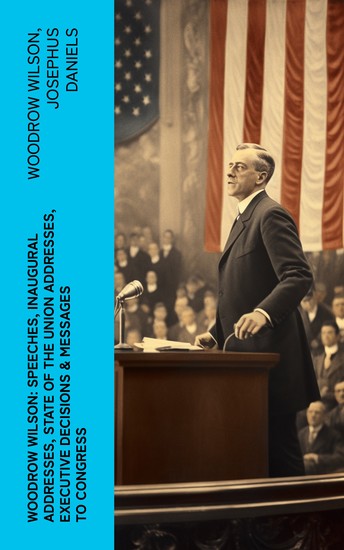
Woodrow Wilson: Speeches Inaugural Addresses State of the Union Addresses Executive Decisions & Messages to Congress - cover

Woodrow Wilson: Speeches Inaugural Addresses State of the Union Addresses Executive Decisions & Messages to Congress

Woodrow Wilson, Josephus Daniels

Publisher: e-artnow

  • 0
  • 0
  • 0

Summary

Woodrow Wilson was a leading force in the Progressive Movement, and during his first term he oversaw the passage of progressive legislative policies unparalleled until the New Deal, He led the United States during World War I and was one of the 3 key leaders at the 1919 Paris Peace Conference, where he championed a new League of Nations.  Contents:  Biography of Woodrow Wilson   Inaugural Addresses: First Inaugural Address (4 March 1913) Second Inaugural Address (4 March 1917) State of the Union Addresses I State of the Union address (2 December 1913) II State of the Union address (8 December 1914) III State of the Union address (7 December 1915) IV State of the Union address (5 December 1916) V State of the Union address (4 December 1917) VI State of the Union address (2 December 1918) VII State of the Union address (2 December 1919) VIII State of the Union address (7 December 1920) Other Addresses: First Address to Congress Address on the Banking System Address at Gettysburg Address on Mexican Affairs Understanding America Address before the Southern Commercial Congress Trusts and Monopolies Panama Canal Tolls The Tampico Incident In the Firmament of Memory Memorial Day Address at Arlington Closing a Chapter Annapolis Commencement Address The Meaning of Liberty American Neutrality Appeal for Additional Revenue The Opinion of the World The Power of Christian Young Men Address before the United States Chamber of Commerce To Naturalized Citizens Address at Milwaukee The Submarine Question American Principles The Demands of Railway Employees Speech of Acceptance Lincoln's Beginnings The Triumph of Women's Suffrage The Terms of Peace Meeting Germany's Challenge Request for Authority The Call to War To the Country The German Plot Reply to the Pope Labor must be Free The Call for War with Austria-Hungary Government Administration of Railways The Conditions of Peace Force to the Utmost Presidential Decisions: The State of War: The President's Proclamation of April 6, 1917 Formal U.S. Declaration of War with Germany
Available since: 12/15/2023.
Print length: 345 pages.


Other books that might interest you

  • Sage Leadership - Taoist Wisdom to Overcome Conflict and Create a Just World; Translations from the Huainanzi - cover

    Sage Leadership - Taoist Wisdom...

    Thomas Cleary

    • 0
    • 0
    • 0
    The subtle arts of management and leadership have been developed over thousands of years by the Chinese. The Book of Leadership and Strategy represents the Taoist culmination of this long tradition and is one of the most prestigious works of ancient Chinese thought. Collected here are insightful teachings on the challenges of leadership on all levels, from organizational management to political statecraft. The translator, Thomas Cleary, has chosen and arranged these teachings to emphasize the most valuable lessons of Taoist wisdom for modern Western listeners. Like Cleary's bestselling translation of The Art of War by Sun Tzu, this work will serve as an enlightening guide for people in business, politics, and government.
    Show book
  • A Rare Recording of Margaret Thaler Singer and Louis Jolyon "Jolly" West of Project MKUltra - cover

    A Rare Recording of Margaret...

    Margaret Thaler Singer, Louis...

    • 0
    • 0
    • 0
    Louis Jolyon "Jolly" West (October 6, 1924 to  January 2, 1999), Director Emeritus, Neuropsychiatric Institute, University of California at Los Angeles, was an American psychiatrist and longtime contractor for the Central Intelligence Agency (CIA) and its Project MKUltra. Margaret Thaler Singer, Ph.D., was an Emeritus Adjunct Professor of Psychology, University of California at Berkeley. The following recording is from a 1998 conference.
    Show book
  • Confucianism - The Philosophy of Ethics Relationships and Governance in East Asia - cover

    Confucianism - The Philosophy of...

    Amman Hirsch

    • 0
    • 0
    • 0
    Confucianism, one of the world’s oldest and most influential philosophies, has deeply shaped Chinese culture, governance, and social structures for over two millennia. Rooted in the teachings of Confucius, a revered teacher and philosopher who lived in ancient China, Confucianism is less a religion than a guiding framework for leading an ethical life, cultivating personal virtues, and fostering harmonious relationships. Its principles emphasize respect for family, reverence for tradition, and a commitment to education and self-betterment—values that resonate universally, even as they are uniquely expressed in East Asian societies. 
    Confucius himself envisioned a society where individuals behaved with compassion and integrity, rulers governed with wisdom and justice, and families formed the foundation of moral learning. Central concepts such as *ren* (humaneness), *li* (ritual propriety), and *xiao* (filial piety) highlight the importance of empathy, respectful conduct, and devotion to family, which lie at the heart of Confucian teachings. Over centuries, these ideals have expanded to influence countless aspects of life, from governance and social etiquette to education and family dynamics. 
    As Confucianism has evolved, it has also encountered both support and criticism, adaptations and reinterpretations. In modern times, the philosophy faces new questions: How does Confucianism reconcile with individual rights and equality? What role does it play in an increasingly globalized world? This book aims to explore Confucianism in its depth and breadth, unraveling its rich history, core teachings, and its dynamic role in contemporary society.  
    For anyone seeking to understand the values and perspectives that have helped shape one of the most enduring societies on earth, Confucianism offers both timeless wisdom and a meaningful framework for personal and social growth.
    Show book
  • Stories on Lord Shiva series -16 - From various sources of Shiva Purana - cover

    Stories on Lord Shiva series -16...

    Anusha HS

    • 0
    • 0
    • 0
    Lord shiva is adi and he is only the anthya. He is the sole reason for the happenings in both the movable and immovable worlds. Therefore, it is said that not even a spring of grass will move without his permission. He is the one who has given life to all the creatures. He is also the one who takes away the lives of all the creatures. Sadhus sages and aghoraas practice severe penance without minding day and night on Lord Shiva. He blesses his devotees with boons. He is called Bole Shankar. All recite his five syllabled mantra or panchakshari mantra " om Namah Shivaya" which is the most popular one among all the other mantras. Lord Shiva who is also called Parameswara is the one who has got no birth and death. He is only the beginning and he is the end. Nandi which happens to be the vehicle of Lord Shiva is a bull. The abode of Lord Shiva is Mount Kailash. In Hindu religion Lord Shiva is called Devaadi Deva Mahadeva which means God for all the Gods. He is the supreme God. Lord Shiva has three eyes. The third eye is situated in between his brows. The third eye is used by him only whenever he wants to destroy the things. He is the one who dwells at cemetery.
    Show book
  • Becoming Kin - An Indigenous Call to Unforgetting the Past and Reimagining Our Future - cover

    Becoming Kin - An Indigenous...

    Patty Krawec, Nick Estes

    • 0
    • 0
    • 0
    The invented history of the Western world is crumbling fast, Anishinaabe writer Patty Krawec says, but we can still honor the bonds between us. Settlers dominated and divided, but Indigenous peoples won't just send them all "home." 


    Weaving her own story with the story of her ancestors and with the broader themes of creation, replacement, and disappearance, Krawec helps listeners see settler colonialism through the eyes of an Indigenous writer. Settler colonialism tried to force us into one particular way of living, but the old ways of kinship can help us imagine a different future. Krawec asks, What would it look like to remember that we are all related? How might we become better relatives to the land, to one another, and to Indigenous movements for solidarity? Braiding together historical, scientific, and cultural analysis, Indigenous ways of knowing, and the vivid threads of communal memory, Krawec crafts a stunning, forceful call to "unforget" our history. 


    This remarkable sojourn through Native and settler history, myth, identity, and spirituality helps us retrace our steps and pick up what was lost along the way: chances to honor rather than violate treaties, to see the land as a relative rather than a resource, and to unravel the history we have been taught.
    Show book
  • Fantasies of Nina Simone - cover

    Fantasies of Nina Simone

    Jordan Alexander Stein

    • 0
    • 0
    • 0
    Since her death in 2003, Nina Simone has been the subject of an astonishing number of rereleased, remastered, and remixed albums and compilations as well as biographies, films, viral memes, samples, and soundtracks. In Fantasies of Nina Simone, Jordan Alexander Stein examines the space between our collective and individual fantasies about Simone the performer, civil rights activist, and icon, and her own fantasies about herself. Stein outlines how Simone gave voice to personal fantasies through releasing dozens of covers of her white male contemporaries. With her covers of George Harrison, the Bee Gees, Bob Dylan, and others, Simone explored and claimed the power and perspective that come with race and gender privilege. Looking at examples from Simone's four-decade genre-bending career—from songbook standards, jazz, and pop to folk, junkanoo, and reggae—and at her work's many uptakes and afterlives, Stein mobilizes the psychoanalytic concept of fantasy to build a black feminist history with and for this multifaceted performing artist.
    Show book