Join us on a literary world trip!
Add this book to bookshelf
Grey
Write a new comment Default profile 50px
Grey
Subscribe to read the full book or read the first pages for free!
All characters reduced
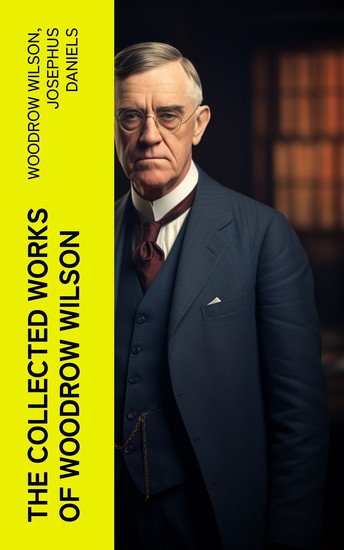
The Collected Works of Woodrow Wilson - cover

The Collected Works of Woodrow Wilson

Woodrow Wilson, Josephus Daniels

Publisher: e-artnow

  • 0
  • 0
  • 0

Summary

This meticulously edited collection presents to you the life and works of President Woodrow Wilson. Content: Essays: The New Freedom When A Man Comes To Himself The Study of Administration Leaders of Men The New Democracy Inaugural Addresses: First Inaugural Address Second Inaugural Address State of the Union Addresses: First State of the Union address  Second State of the Union address  Third State of the Union address  Fourth State of the Union address  Fifth State of the Union address Sixth State of the Union address  Seventh State of the Union address  Eighth State of the Union address  Speeches & Addresses: First Address to Congress Address on the Banking System Address at Gettysburg Address on Mexican Affairs Understanding America Address before the Southern Commercial Congress Trusts and Monopolies Panama Canal Tolls The Tampico Incident In the Firmament of Memory Memorial Day Address at Arlington Closing a Chapter Annapolis Commencement Address The Meaning of Liberty American Neutrality Appeal for Additional Revenue The Opinion of the World The Power of Christian Young Men A Message Address before the United States Chamber of Commerce To Naturalized Citizens Address at Milwaukee The Submarine Question American Principles The Demands of Railway Employees Speech of Acceptance Lincoln's Beginnings The Triumph of Women's Suffrage The Terms of Peace Meeting Germany's Challenge Request for Authority The Call to War To the Country The German Plot Reply to the Pope Labor must be Free The Call for War with Austria-Hungary Government Administration of Railways The Conditions of Peace Force to the Utmost Presidential Decisions: The State of War: The President's Proclamation of April 6, 1917. (8a) Formal U.S. Declaration of War with Germany, 6 April 1917 (8b)
Available since: 12/15/2023.
Print length: 942 pages.


Other books that might interest you

  • The Brandenburger Commandos - Germany's Elite Warrior Spies in World War II - cover

    The Brandenburger Commandos -...

    Franz Kurowski

    • 0
    • 0
    • 0
    This WWII history chronicles the exploits of an elite German spy unit and offers a rare look into the secret operations of Hitler's military. Directed by the German Army’s intelligence service, the Brandenburgers became legendary for their brutally efficient clandestine operations. Trained to be quick, mobile, and self-reliant and steeped in local customs and languages, they operated behind enemy lines around the world. Across the battlefronts of the Second World War—from Western Europe to Romania, Russia, Egypt, Afghanistan, and beyond—they seized bridges and other strategic targets; engaged in sabotage, espionage, and other daring missions; and often disregarding the rules of war in the process. Although the unit was dissolved in 1944, its tactics influenced special forces around the world both during the war and after.
    Show book
  • Mind Hacking Secrets - 21 Neuroscience Ways to Develop Fast Clear & Critical Thinking Learn How to Train Your Brain to Think Faster and Clearly in 2 Weeks - cover

    Mind Hacking Secrets - 21...

    Scott Sharp

    • 0
    • 0
    • 0
    Unlock Your Mind's Full Potential: Discover How to Sharpen Your Focus and Revolutionize Your Thinking in Just 14 Days! 
    It's commonly believed that intellect, memory, and problem-solving are decided at birth – the brain you start with is only capable of growing to a certain degree. 
    The truth is, your brain adapts and evolves daily as life unfolds around you and it is exposed to new experiences and stimuli. 
    When you read a book, your brain strengthens neural connections related to analytical thinking and language. 
    The simple act of going for a walk requires the coordination of spatial awareness and movement, along with dozens of other processes. 
    Your brain is capable of incredible things, yet we are barely aware of the complex mechanisms at work in day-to-day life. 
    But what if you could harness the boundless potential of your mind? 
    Just like building muscle requires time at the gym, boosting your critical thinking and focus requires you to train your mental muscles with targeted exercises. 
    In Mind Hacking Secrets, here is just a fraction of what you will discover:Strategies for overcoming the most common causes of clouded thinking such as stress, unmanageable emotions, and more...Actionable tips and techniques to start boosting your cognitive function right awayPractical methods that will make it easier than ever to perform at your bestThe most common mistakes people make when judging situations and making important decisionsHow negative thoughts and emotions can actually create positive results and deeper insight into the workings of your mind 
    If you are ready to embrace a life of enhanced clarity and sharper thinking, don't wait any longer. Begin your transformation today!
    Show book
  • Jewish Language and Literature - The Impact of Yiddish Hebrew and Other Languages - cover

    Jewish Language and Literature -...

    Joseph Arston

    • 0
    • 0
    • 0
    The origins of Jewish language and literature are deeply intertwined with the history of the Jewish people, shaped by centuries of cultural exchange, migration, and adaptation. At the heart of Jewish literary tradition lies the Hebrew language, whose roots stretch back to the ancient world. Hebrew, as the language of the Bible, forms the foundation of Jewish thought, identity, and religious practice. The earliest examples of Hebrew literature can be found in the sacred texts of the Torah, where the stories, laws, and teachings of the Jewish people are recorded. These texts, passed down through generations, have remained central to Jewish life and continue to be a source of literary and theological inspiration. 
    In addition to Hebrew, other languages played an important role in the development of Jewish language and literature. Aramaic, a Semitic language closely related to Hebrew, became widespread during the Babylonian exile and remained influential for centuries. Aramaic is the language of significant portions of the Talmud and other rabbinic writings, shaping Jewish legal and philosophical thought. Over time, Jewish communities across the globe adopted the languages of the regions they inhabited, which further contributed to the diversity of Jewish literary expression. 
    The emergence of Yiddish, a language born in the Jewish communities of Eastern Europe, marked a significant shift in Jewish linguistic and literary culture. Yiddish, a Germanic language enriched with Hebrew, Aramaic, and Slavic elements, became the vernacular of millions of Ashkenazi Jews. It allowed for the creation of a vibrant body of literature, including plays, novels, and poetry, that expressed the daily lives, struggles, and aspirations of Jewish communities. Yiddish literature flourished in the 19th and early 20th centuries, with writers such as Sholem Aleichem, Isaac Bashevis Singer, and I.L. Peretz capturing the complexities of Jewish life through their works.
    Show book
  • Mythical Beasts - Exploring the Realms of the Dead - cover

    Mythical Beasts - Exploring the...

    Odessa Nightshade

    • 0
    • 0
    • 0
    Since the dawn of civilization, humans have woven tales of extraordinary creatures—beasts that soar through the skies, rule the oceans, or guard hidden treasures. These mythical beings have captivated the human imagination, appearing in folklore, literature, and art across the globe. From the mighty dragon to the elusive unicorn, these creatures have not only entertained but also served as symbols of power, wisdom, and even fear. But why do these legends endure? What is it about mythical beasts that continues to fascinate us, even in an age of science and reason?  
    Mythical creatures often serve as reflections of human beliefs, fears, and aspirations. In many cultures, they are more than just fictional beings; they carry deep symbolic meaning. The phoenix, for instance, represents rebirth and resilience, while the werewolf embodies the struggle between human nature and primal instincts. Dragons, depicted as both benevolent and malevolent, can symbolize wisdom or destruction, depending on the culture. These beasts act as metaphors, helping people make sense of the world around them and offering explanations for the unknown.  
    The origins of these legends are often rooted in real-life encounters or natural phenomena. The discovery of dinosaur fossils may have inspired stories of dragons, while exaggerated accounts of distant animals, such as narwhals, could have fueled belief in unicorns. Similarly, shadows on the ocean’s surface or misidentified sea creatures may have given rise to mermaid myths. Over time, these stories evolved, influenced by oral tradition, artistic depictions, and cultural exchange, shaping the diverse legends we know today. 
    Show book
  • The Brontës - The True Story of the Life & Time of the Great Authors - cover

    The Brontës - The True Story of...

    Liam Dale

    • 0
    • 0
    • 0
    Interested in delving into the lives of the Brontë Sisters but short on time for lengthy biographies? Join The History Journals for an hourly history tour of their extraordinary lives. 
     
    The Brontë Sisters stand tall as one of literature's most illustrious families. Their timeless classics, including "Jane Eyre" and "Wuthering Heights," continue to define English Literature. These novels grace bookstores, libraries, and digital platforms, captivating readers' hearts and minds. Charlotte, Anne, and Emily Brontë, along with their brother Branwell and father Patrick, left an indelible mark with their passionate narratives and soul-stirring poetry. 
     
    Explore: 
    - Patrick and Maria Brontë, and the birth of the Brontë siblings 
    - The Brontës' relocation to Haworth, early losses, and education 
    - Homesickness, the moors, and their governess roles 
    - The creation of "Wuthering Heights" and "Agnes Grey," accompanied by Branwell's passing 
    - Ongoing family hardships and the Brontës' rising renown 
    - Charlotte's journey, her demise, and the enduring Brontë legacy
    Show book
  • The Intersectional Environmentalist - How to Dismantle Systems of Oppression to Protect People + Planet - cover

    The Intersectional...

    Leah Thomas

    • 0
    • 0
    • 0
    From the activist who coined the term comes a primer on intersectional environmentalism for the next generation of activists looking to create meaningful, inclusive, and sustainable change. The Intersectional Environmentalist examines the inextricable link between environmentalism, racism, and privilege, and promotes awareness of the fundamental truth that we cannot save the planet without uplifting the voices of its people -- especially those most often unheard. Written by Leah Thomas, a prominent voice in the field and the activist who coined the term "Intersectional Environmentalism," this book is simultaneously a call to action, a guide to instigating change for all, and a pledge to work towards the empowerment of all people and the betterment of the planet. Thomas shows how not only are Black, Indigenous and people of color unequally and unfairly impacted by environmental injustices, but she argues that the fight for the planet lies in tandem to the fight for civil rights; and in fact, that one cannot exist without the other. An essential read, this book addresses the most pressing issues that the people and our planet face, examines and dismantles privilege, and looks to the future as the voice of a movement that will define a generation.
    Show book