Join us on a literary world trip!
Add this book to bookshelf
Grey
Write a new comment Default profile 50px
Grey
Subscribe to read the full book or read the first pages for free!
All characters reduced
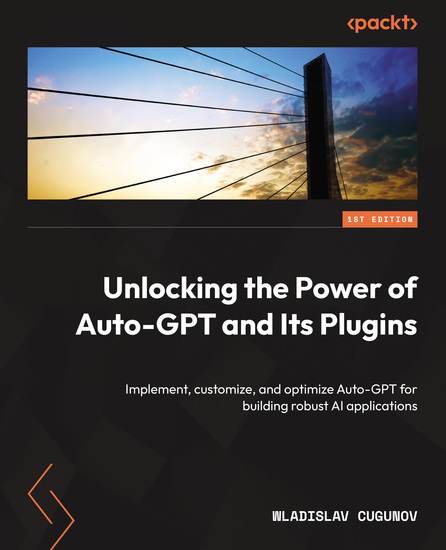
Unlocking the Power of Auto-GPT and Its Plugins - Implement customize and optimize Auto-GPT for building robust AI applications - cover

Unlocking the Power of Auto-GPT and Its Plugins - Implement customize and optimize Auto-GPT for building robust AI applications

Wladislav Cugunov

Publisher: Packt Publishing

  • 0
  • 0
  • 0

Summary

Unlocking the Power of Auto-GPT and Its Plugins reveals how Auto-GPT is transforming the way we work and live, by breaking down complex goals into manageable subtasks and intelligently utilizing the internet and other tools. With a background as a self-taught full stack developer and key contributor to Auto-GPT’s Inner Team, the author blends unconventional thinking with practical expertise to make Auto-GPT and its plugins accessible to developers at all levels.This book explores the potential of Auto-GPT and its associated plugins through practical applications. Beginning with an introduction to Auto-GPT, it guides you through setup, utilization, and the art of prompt generation. You'll gain a deep understanding of the various plugin types and how to create them. The book also offers expert guidance on developing AI applications such as chat assistants, research aides, and speech companions, while covering advanced topics such as Docker configuration, continuous mode operation, and integrating your own LLM with Auto-GPT.By the end of this book, you'll be equipped with the knowledge and skills needed for AI application development, plugin creation, setup procedures, and advanced Auto-GPT features to fuel your AI journey.
Available since: 09/13/2024.
Print length: 142 pages.
Other books that might interest you

  • The Master Builder - How the New Science of the Cell Is Rewriting the Story of Life - cover

    The Master Builder - How the New...

    Alfonso Martinez Arias

    • 0
    • 0
    • 0
    "An ingenious argument" (Kirkus) for a "novel thesis" (Publishers Weekly) that cells, not DNA, hold the key to understanding life's past and present 


    What defines who we are? For decades, the answer has seemed obvious: our genes, the "blueprint of life." In The Master Builder, biologist Alfonso Martinez Arias argues we've been missing the bigger picture. It's not our genes that define who we are, but our cells. While genes are important, nothing in our DNA explains why the heart is on the left side of the body, how many fingers we have, or even how our cells manage to reproduce. Drawing on new research from his own lab and others, Martinez Arias reveals that we are composed of a thrillingly intricate, constantly moving symphony of cells. Both their long lineage—stretching back to the very first cell—and their intricate interactions within our bodies today make us who we are. 


    Engaging and ambitious, The Master Builder will transform your understanding of our past, present, and future—as individuals and as a species.
    Show book
  • Agile Manifesto - Unleashing Innovation Collaboration and Adaptive Excellence in Modern Development Practices - cover

    Agile Manifesto - Unleashing...

    Daniel Green

    • 0
    • 0
    • 0
    In a world where change is the only constant, "Agile Manifesto" is your compass for navigating the ever-shifting landscape of software development and project management. This insightful and practical guide takes you on a journey through the core principles and values of the Agile Manifesto, illuminating a path towards greater efficiency, collaboration, and success. 
    "Agile Manifesto" isn't just a guide; it's a call to action, inspiring leaders and teams to unlock their full potential and thrive in an era where agility is not just an option but a necessity. 
     
    Show book
  • Ultimate Microsoft Cybersecurity Architect SC-100 Exam Guide - Master the SC-100 Exam with Practical Examples and Case Studies to Secure the Digital World with Microsoft Cybersecurity Expertise - cover

    Ultimate Microsoft Cybersecurity...

    Dr. K.V.N. Rajesh

    • 0
    • 0
    • 0
    Master Cybersecurity with SC-100: Your Path to Becoming a Certified Architect!
    Book Description
    Ultimate Microsoft Cybersecurity Architect SC-100 Exam Guide is your definitive resource for mastering the SC-100 exam and advancing your career in cybersecurity. This comprehensive resource covers all exam objectives in detail, equipping you with the knowledge and skills needed to design and implement effective security solutions. Clear explanations and practical examples ensure you grasp key concepts such as threat modeling, security operations, and identity management. In addition to theoretical knowledge, the book includes real-world case studies and hands-on exercises to help you apply what you’ve learned in practical scenarios.
    Whether you are an experienced security professional seeking to validate your skills with the SC-100 certification or a newcomer aiming to enter the field, this resource is an invaluable tool. By equipping you with essential knowledge and practical expertise, it aids in your job role by enhancing your ability to protect and secure your organization’s critical assets. With this guide, you will be well on your way to becoming a certified cybersecurity architect.
    Table of Contents
    1. Zero Trust Frameworks and Best Practices Simplified
    2. Cloud Blueprint-Conforming Solutions
    3. Microsoft Security Framework-Compliant Solutions
    4. Cybersecurity Threat Resilience Design
    5. Compliance-Driven Solution Architecture
    6. Identity and Access Control Design
    7. Designing Access Security for High-Privilege Users
    8. Security Operations Design
    9. Microsoft 365 Security Design
    10. Application Security Design
    11. Data Protection Strategy Development
    12. Security Specifications for Cloud Services
    13. Hybrid and Multi-Cloud Security Framework
    14. Secure Endpoint Solution Design
    15. Secure Network Design   
    Index
    Show book
  • Gardening Can Be Murder - How Poisonous Poppies Sinister Shovels and Grim Gardens Have Inspired Mystery Writers - cover

    Gardening Can Be Murder - How...

    Marta McDowell

    • 0
    • 0
    • 0
    This fun, engrossing book takes a look at the surprising influence that gardens and gardening have had on mystery novels and their authors. With their deadly plants, razor-sharp shears, shady corners, and ready-made burial sites, gardens make an ideal scene for the perfect murder. But the outsize influence that gardens and gardening have had on the mystery genre has been underappreciated. Now, Marta McDowell, a writer and gardener with a near-encyclopedic knowledge of the genre, illuminates the many ways in which our greatest mystery writers, from Edgar Allen Poe to authors on today’s bestseller lists, have found inspiration in the sinister side of gardens. From the cozy to the hardboiled, the literary to the pulp, and the classic to the contemporary, Gardening Can Be Murder is the first book to explore the mystery genre’s many surprising horticultural connections. Meet plant-obsessed detectives and spooky groundskeeper suspects, witness toxic teas served in foul play, and tour the gardens—both real and imagined—that have been the settings for fiction’s ghastliest misdeeds. A New York Times bestselling author herself, McDowell also introduces us to some of today’s top writers who consider gardening integral to their craft, assuring that horticultural themes will remain a staple of the genre for countless twisting plots to come.    “This book is dangerous. A veritable cornucopia of crime fiction and gardening lore, it faces the reader with multiple temptations—books to seek out, plants to obtain, garden tours to book.” —Vicki Lane, author of the Elizabeth Goodweather Appalachian Mysteries
    Show book
  • Nature's Echo - Harnessing Ancient Feedback Loops to Heal a Changing Planet - cover

    Nature's Echo - Harnessing...

    Thomas Crowther

    • 0
    • 0
    • 0
    Whether restoring trees, conserving existing ecosystems, rewilding native animals, or changing incentives to elicit better choices, targeted interventions can tap into feedback loops that can improve our planet, our economy, and our lives.  
    A feedback loop occurs when the outcome of a process restarts that process, creating a cyclical chain of cause and effect. Feedback loops can either maintain the status quo (a negative feedback loop), or they can create a “snowball effect” (a positive feedback loop) where more begets more. These feedback loops have been with us since the beginning of time, and they are implicit in the formation of everything that exists in the universe. Physical feedback loops literally form our physical reality around us, but psychological feedback loops determine how we build our perspective of reality. 
    In 2019, The Crowther Lab, which Tom Crowther runs at ETH Zurich, a leading Swiss public research university, published a study in the journal Science on the Earth’s carrying capacity for trees. Using satellite imagery, massive datasets compiled from thousands of studies, and computer models, they evaluated where trees could naturally grow on Earth. They estimated that the planet had room for an additional one trillion trees on land not currently in use by humans for farming or settlement – land that was once forest. And the model predicted that those recovering forests would capture one third of all human carbon emissions since the industrial revolution.  Yet, lost in that initial discussion was the inclusion of the importance of biodiversity and care to ensure the reforestation efforts meant building millions of local feedback loops, where local people and nature thrive together. It meant millions of local communities, indigenous populations, farmers, and foresters working with nature to recreate whole, healthy, stable ecosystems as biodiverse as the ones we’ve lost. 
    In Nature’s Echo, Crowther explains the powerful force of feedback loops in nature and how, at the moment, our planet is experiencing a series of positive feedback loops as we hurtle towards environmental collapse. These feedback loops are too powerful to fight against. However, his research consistently shows that, instead of fighting feedback loops, we can harness their potential to create spectacular, worthwhile change. We can use feedback loops to help the Earth heal itself.
    Show book
  • ChatGPT talks on science for young people: Molecular Biology! - Discover the secrets of life with the help of artificial intelligence - cover

    ChatGPT talks on science for...

    Paulo Dario

    • 0
    • 0
    • 0
    This book follows a series of "conversations" with these tools, mainly with "chatGPT 4.0" but also with "Bard". It's well known that chatGPT is hampered in its research up to a certain point in time and, because they are language modeling tools, they end up inventing... a lot, especially in bibliographic references. However, accessory tools are emerging that make it possible to improve and even correct this situation, tools that will certainly become much more powerful in the future, but which are already a reality. So, using all these AI tools, a book has been created that aims to be a pedagogical tool that answers a series of questions that can be asked by secondary and higher education students, or even people who are just interested in these issues, but who don't have the access or predisposition to use these types of AI tools.
    Show book