Join us on a literary world trip!
Add this book to bookshelf
Grey
Write a new comment Default profile 50px
Grey
Subscribe to read the full book or read the first pages for free!
All characters reduced
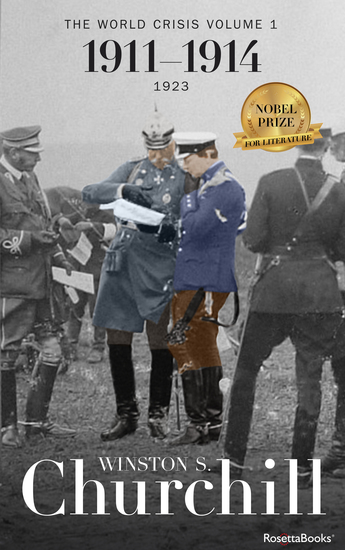
The World Crisis: 1911–1914 - cover

The World Crisis: 1911–1914

Winston S. Churchill

Publisher: RosettaBooks

  • 0
  • 1
  • 0

Summary

The causes of the Great War are examined in this first volume of the series that is “essential reading, as fresh and compelling as ever” (Jon Meacham, bestselling author of Franklin and Winston).   An absorbing history of the outbreak of World War I from a true insider’s point of view, the first volume of Winston S. Churchill’s five-volume The World Crisis is unsurpassed as both a historical and personal account of the earth-shaking events leading up to WWI. Beginning in 1911, when Churchill was First Lord of the Admiralty, this report is based on thousands of his personal letters and memos.   Churchill’s epic series opens with a chilling description of the Agadir Crisis, and provides an in-depth account of naval clashes in the Dardanelles, one of Churchill’s major military failures. It takes readers from the fierce bloodshed of the Gallipoli campaign to the tide-turning battles of Jutland and Verdun—as well as the United States’ entry into the combat theatre. Written in powerful prose by a great leader who would also go on to receive a Nobel Prize in Literature, The World Crisis, 1911–1914 provides a perspective you won’t find anywhere else: a dynamic insider’s account of events that would shape the outcome of modern history.   “Whether as a statesman or an author, Churchill was a giant; and The World Crisis towers over most other books about the Great War.” —David Fromkin, author of A Peace to End All Peace
Available since: 09/23/2013.
Print length: 589 pages.


Other books that might interest you

  • Aesthetical Essays - cover

    Aesthetical Essays

    Friedrich Schiller

    • 0
    • 0
    • 0
    In "Aesthetical Essays," Friedrich Schiller delves into the profound role of art and beauty in human life and society. Through a series of insightful essays, Schiller explores the transformative power of aesthetics, arguing that beauty elevates the human spirit and fosters freedom and moral development. He posits that art bridges reason and emotion, offering a path to achieving harmony within the self and the world. This philosophical masterpiece invites readers to ponder art's enduring impact.
    Show book
  • Drenched by the Cowboy II - A Gay Threesome Watersports Fantasy - cover

    Drenched by the Cowboy II - A...

    Jane Fox

    • 0
    • 0
    • 0
    Rick is on a men's retreat where he's supposed to pay attention to lectures about being a man in today's society, but his attention keeps being grabbed by the big hulking cowboys around at the retreat. When two of the cowboys pull him aside for a little talk, things start to heat up quickly, and Rick finds himself letting them do anything they want to him!
    Show book
  • Africa on the Precipice - The Blueprint to Steer the Continent and Diaspora to Redemption - cover

    Africa on the Precipice - The...

    Nnamdi Chiekwu

    • 0
    • 0
    • 0
    Africa on the Precipice (ATP) provides commentary on global geopolitics, economics, and world history, using African interests as a lens to give a different perspective on world events. The book specifically explores how and why Africa has not fared well in the ‘battle of civilizations’ (or global geopolitics) from the 15th century until present times. ATP also presents a bold blueprint to make African countries dominant on the international stage through an ideology originated by the author called ‘Afro-Hegemonism’.  
    ATP sounds the alarm for African countries that they must undergo transformational socioeconomic restructuring by 2030. The consequence of not doing so, will see Africans continue to be a global underclass in a geopolitical landscape that is quickly evolving. Moreover, the ultimate price for not embracing revolutionary change now, could see Africans permanently lose their sovereignty, treasure, and freedom in the 21st century.
    Show book
  • Longing to Know - The Philosophy of Knowledge for Ordinary People - cover

    Longing to Know - The Philosophy...

    Esther Lightcap Meek

    • 0
    • 0
    • 0
    We don't often think about the act of knowing, but if we do, the question of what we know and how we know it becomes murky indeed. Longing to Know is a book about knowing: knowing how we know things, knowing how we know people, and knowing how we know God. 
    This book is for those who are considering Christianity for the first time, as well as Christians who are struggling with issues related to truth, certainty, and doubt. As such, it is a wonderful resource for evangelists, pastors, and counselors. This unique look at the questions of knowing is both entertaining and approachable. Questions for reflection make it ideal for students of philosophy and all those wrestling with the questions of knowledge.
    Show book
  • Mythology and Religion in Ancient Babylon: The History of Babylonian Legends and Religious Practices - cover

    Mythology and Religion in...

    Editors Charles River

    • 0
    • 0
    • 0
    The ancient world was full of many fantastic cities and places, and like today’s major cities, the great ancient cities were hubs of trade, religion, and science. Writing was first invented in ancient cities, and many important scientific discoveries were also made in them, some of which are still used in the modern world. Among the many cities of the ancient world, Rome and Athens may come to mind first, but the city of Babylon in the land of Mesopotamia was already an ancient, venerated city when the others were still inconsequential settlements.  
    	Today, Babylon has become a byword for greed, excess, and licentiousness, mostly due to its mention in the Bible, but a closer examination reveals that Babylon was so much more, and even perhaps the most important city in the ancient world. Ancient Babylon was home to great dynasties that produced some of the world’s most influential leaders, most notably Hammurabi and Nebuchadnezzar, and these rulers invoked their wills on the entire ancient Near East and have been remembered as both progressive and cruel all at the same time. Babylon was also the seat of culture in ancient Mesopotamia and the place where scholars made amazing scientific advances that would not be eclipsed for several centuries. An examination of ancient Babylon demonstrates that it was truly the first great city in the ancient world. 
    	Babylon was also instrumental in the development of the region’s religions, and the religions continue to captivate people for many of the same reasons today’s best known religions and their histories fascinate people. The religion practiced by the ancient Mesopotamians provides a certain mix between the mundane and the surreal, and at the same time aspects of it are both familiar and bizarre to people today. Some find themselves drawn to it based on its preeminent position in religious history as the oldest documented religion in the world.
    Show book
  • Fighting in World War I: The History and Legacy of Warfare during the Great War - cover

    Fighting in World War I: The...

    Editors Charles River

    • 0
    • 0
    • 0
    World War I, also known in its time as the “Great War” or the “War to End all Wars”, was an unprecedented holocaust in terms of its sheer scale. Fought by men who hailed from all corners of the globe, it saw millions of soldiers do battle in brutal assaults of attrition which dragged on for months with little to no respite. Tens of millions of artillery shells and untold hundreds of millions of rifle and machine gun bullets were fired in a conflict that demonstrated man’s capacity to kill each other on a heretofore unprecedented scale, and as always, such a war brought about technological innovation at a rate that made the boom of the Industrial Revolution seem stagnant.  
    By 1918, all the great powers were fielding squadrons of fighting aircraft armed with machine-guns and bombs, to say nothing of light reconnaissance planes. Tanks, a common feature on the battlefield by 1918, had not previously existed outside of the realm of science fiction stories written by authors like H.G. Wells. Machine guns had gone from being heavy, cumbersome pieces with elaborate water-cooling systems to single-man-portable, magazine-fed affairs like the Chauchat, the Lewis Gun and the M1918 BAR.  
    These technological developments led to an imbalance. Before the introduction of the man-portable light machine gun (which took place in the second half of the war), not to mention tanks (which also joined the fight late in the game), defensive firepower vastly outweighed offensive capability. Massed batteries of artillery, emplaced heavy machine guns, barbed wire entanglements, and bewildering fortifications meant that ground could not be taken except at incredible cost.  
    Fighting in World War I analyzes the technological advancements in weaponry that produced the deadliest conflict in history up to that time, and the adjusting tactics that the combatants came up with on land, at sea, and in the air. 
    Show book