Join us on a literary world trip!
Add this book to bookshelf
Grey
Write a new comment Default profile 50px
Grey
Subscribe to read the full book or read the first pages for free!
All characters reduced
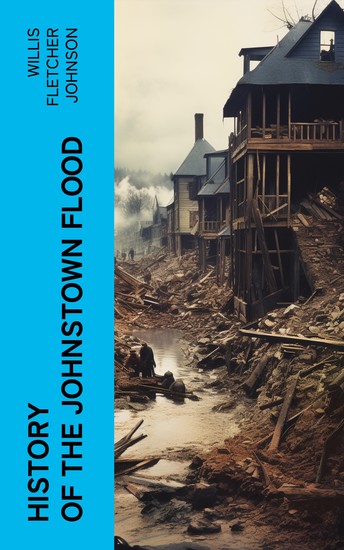
History of the Johnstown Flood - cover

History of the Johnstown Flood

Willis Fletcher Johnson

Publisher: e-artnow

  • 0
  • 0
  • 0

Summary

This publication chronicles the catastrophic event known as the Johnstown Flood. ​​The floor occurs after the catastrophic failure of the South Fork Dam, located on the south fork of the Little Conemaugh River, 14 miles (23 km) upstream of the town of Johnstown, Pennsylvania, United States. The dam ruptured after several days of extremely heavy rainfall, releasing 14.55 million cubic meters of water. With a volumetric flow rate that temporarily equaled the average flow rate of the Mississippi River, the flood killed 2,209 people and accounted for $17 million of damage (about $534 million in 2022 money).
Available since: 11/23/2023.
Print length: 1848 pages.

Other books that might interest you

  • Give Me an Answer That Satisfies My Heart and My Mind - Answers to Your Toughest Questions about Christianity - cover

    Give Me an Answer That Satisfies...

    Cliffe Knechtle

    • 0
    • 0
    • 0
    Does God really send people to hell? Doesn't science disprove Christianity? Why are there so many hypocrites in the church? Isn't the Bible full of errors? 
     
    Cliffe Knechtle has been handling these and other tough questions everywhere he goes for years. In Give Me an Answer, Knechtle answers forty of the questions he most often faces as an open-air evangelist for InterVarsity Christian Fellowship. He deals directly with the hurts, doubts, struggles, and conflicts of those who are searching. Walking through questions themed around objections to truths found in the Bible, questions of authority, and issues of morality, Knechtle gives clear, reasoned answers that will satisfy both heart and mind. 
     
    In Give Me an Answer, Knechtle answers these questions and more: 
    Aren't there many ways to God?Why is there so much evil in the world?Isn't it enough to live a good life? 
     
    If you have questions yourself or if you want to be better able to talk with others about the gospel, get equipped with Give Me an Answer.
    Show book
  • The Library of Ancient Wisdom - Mesopotamia and the Making of the Modern World - cover

    The Library of Ancient Wisdom -...

    Selena Wisnom

    • 0
    • 0
    • 0
    A tour of an ancient library transports us to Mesopotamia, introducing us to its people, their ideas, and their humanity. The library of Ashurbanipal, Assyria’s last great king, held an astonishing collection at the forefront of knowledge in its day, from ancient traditions in religion and literature to the latest developments in magic and medicine. When the Assyrian empire fell, the library burned to the ground, and its contents, clay tablets inscribed with cuneiform writing, lay buried for thousands of years until a team of Victorian archaeologists discovered the remnants in modern-day Iraq. The clay had baked and hardened; the very fire that consumed the library had helped its texts to survive for millennia. In The Library of Ancient Wisdom, scholar Selena Wisnom, one of only a few hundred experts able to read cuneiform script today, guides us inside this important collection and, through its contents, brings ancient Mesopotamia and its people to life. Introducing us to Ashurbanipal and his family, scribes, astrologers, physicians, and more, Wisnom explores the library’s tablets and the details they divulge about how these ancient people thought about the world. Like us, they had concerns about job security, jealous rivalries, and profound friendships, and questions about the meaning of life. Wisnom ushers us into a world where magic was commonplace, where the gods spoke to you in dreams, and where the secrets of the universe were revealed through puns—taking us to the heart of what it means to be human. Offering a close look at a major historical landmark as well as a readable account of the world’s earliest civilizations, The Library of Ancient Wisdom lays bare the ideas, hopes, fears, and desires that survive on humble clay.
    Show book

  • Transsexual Apostate - My Journey Back to Reality - cover

    Transsexual Apostate - My...

    Debbie Hayton

    • 0
    • 0
    • 0
    'Brave and deeply considered… Her experience, and Transsexual Apostate, shouldn't be dismissed' The Telegraph
    In a compelling first-hand account of what it means to be a transwoman – and where she feels the impulse comes from – Hayton explains why much of gender identity ideology is, in her view, false and damaging. Once a prominent member of the TUC LGBT+ committee, she charts how her views developed and put her at odds with the majority of trans activists. She issues a compassionate call to move beyond ideological conflicts, and to acknowledge the legitimate concerns that many have with an agenda that asserts that transwomen are women.
    Hayton's honest, humane and moving book shows that by accepting reality, transwomen can live their best lives based on the truth of who they are – rather than the fantasy of who they are not.
    'Brave, unflinching, insightful' - Professor Michael Bailey, author ofThe Man Who Would Be Queen
    Show book
  • Egyptian Mythology for Kids: Captivating Tales and Myths of Gods Goddesses Monsters and Pharaohs - cover

    Egyptian Mythology for Kids:...

    Matt Clayton

    • 0
    • 0
    • 0
    Have you ever wondered why the ancient Egyptians made mummies, why they built the gigantic pyramids, or what they believed in?  
    All these questions and more will be answered in this incredible audiobook on Egyptian mythology. Become an ancient Egyptian myth buster and find out which legends about ancient Egypt are pure fiction! 
    Learning doesn’t have to be a chore. This audiobook makes it easy and exciting with interesting facts, helpful pronunciation tips for those tricky new words, and meanings for some of the words you may not have heard before. On top of this, at the end of each chapter, there are exciting and creative activities to make learning fun. Plus, there’s even a final chapter full of fun facts about ancient Egypt! 
    You’ll be amazed to hear the weird, wonderful, and downright crazy myths surrounding this ancient civilization. Here are just a few of them and some of the other amazing things you’ll learn in this audiobook:The mummy’s curse—is it real?The ancient Egyptians had more than one creation story!Nobody knows who exactly built the pyramids. Was it slaves?Were there aliens in ancient Egypt?Which pharaoh was eaten by a hippopotamus?Egyptians took the meaning of “cat lover” to a whole new level.There were so many gods that even the Egyptians got them mixed up!Who was His Majesty “herself”?Learn the tale of the god who was chopped to bits and lived to tell the tale!How do you make a mummy?The gods were part animals!Is the Nile River the center of the universe? Pharaohs were living gods.Your heart had to be lighter than a feather to become immortal!Where would you face five-headed reptiles, snakes with knives, and fire-breathing dragons?The Book of the Dead wasn’t as scary as it sounds. The ancient Egyptians loved junk food and playing games too!
    Show book
  • Blood of The Gods - From Religion to Human Sacrifice And Cannibalism - cover

    Blood of The Gods - From...

    Olivia Sanchez

    • 0
    • 0
    • 0
    In Blood of the Gods, journey into the heart of the Aztec civilization, where spirituality and ritualistic violence coexisted in a breathtakingly intricate tapestry. This compelling narrative uncovers how the Aztecs' deep religious convictions shaped their society and justified the bloodshed that sustained their universe. 
    The Aztecs believed that their gods demanded blood to maintain cosmic harmony. This book immerses you in their world through vivid descriptions of grand ceremonies at the Templo Mayor and detailed accounts of human sacrifices. Discover how these rituals, though brutal, were viewed as sacred acts that honored the divine and ensured the survival of their society. 
    Blood of the Gods explores how these acts were not mere barbarity but deeply ingrained in their religious and cultural framework, intended to appease and connect with their gods. With stunning visuals and insights from the latest archaeological research, this book focuses on the grandeur and grimness of Aztec life.  
    Perfect for history enthusiasts and those intrigued by ancient cultures, this book is a deep dive into a world where the sacred and the savage were inseparable.
    Show book
  • Athenian Agora and Roman Forum The: The Beating Hearts of the Ancient World’s Most Famous Cities - cover

    Athenian Agora and Roman Forum...

    Editors Charles River

    • 0
    • 0
    • 0
    The center of political and commercial interaction in the Ancient Greek polis was the agora. The word essentially means a gathering place or an open space, and in all Greek city states, the agora was central to all aspects of daily life and commerce. As the agora developed as a civic space, particularly from the 6th century BCE onward in Athens, the architectural splendor of the buildings associated with it became an ever more obvious demonstration of the power and glory of Athenian democracy. In its earliest forms, an agora in maritime cities was invariably situated near the sea, while in inland urban centers, it was usually located at the foot of the hill that normally provided the city’s ultimate defense. The agora was always the oldest part of any city and, as such, and as well as being the commercial hub of the area, also became the center of the religious and political life of the polis. In Homer’s time, an agora might have seats for the comfort of the citizens that had assembled to consult with one another. The city’s oldest sanctuaries were always located either in or very close to the agora itself, and the first festive games were held in its open space.  
    The Roman Empire is the most famous in history, and the center of the far-reaching empire’s activities was located in the Forum, a low area between the Capitoline and Palatine hills in Rome. The topography held a great deal of significance for Romans, and consequently so many layers of myth were laid on top of the landscape and buildings that it is difficult to separate legend from actual historical fact. As a low-lying area near the Tiber river, the Forum was subject to much flooding, and even into the 20th century, the Forum area could flood upwards of over 40 feet above sea level. This would factor significantly in the imagination of Romans, who later ascribed the flooding with saving the city’s founders, Romulus and Remus, from execution.
    Show book