Join us on a literary world trip!
Add this book to bookshelf
Grey
Write a new comment Default profile 50px
Grey
Subscribe to read the full book or read the first pages for free!
All characters reduced
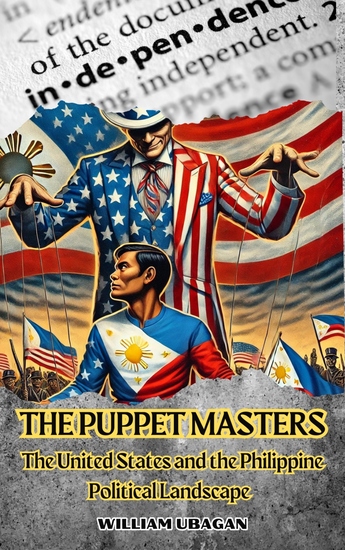
The Puppet Masters - The United States and the Philippine Political Landscape - cover

The Puppet Masters - The United States and the Philippine Political Landscape

William Ubagan

Publisher: ZRK Book Shop

  • 0
  • 0
  • 0

Summary

The Puppet Masters: The United States and the Philippine Political Landscape explores the intricate and often overlooked relationship between the United States and the Philippines. In this thought-provoking analysis, William Ubagan delves into the historical and contemporary forces that have shaped the political landscape of the Philippines, with a particular focus on the U.S.’s influential role as a hidden "puppet master."
 
From the colonial era to the present day, the United States has been a dominant force in Philippine politics, often steering key decisions and shaping policies that serve both its strategic and economic interests. This book uncovers the ways in which U.S. influence has molded Philippine governance, examining the effects of military alliances, economic dependencies, and political interventions on the sovereignty and self-determination of the Filipino people.
 
With a sharp eye for detail and a critical perspective, The Puppet Masters highlights the ongoing consequences of this relationship, offering readers an in-depth understanding of how foreign powers continue to influence the Philippines’ political trajectory. It’s a compelling exploration of power, independence, and the struggle for control in an ever-evolving global landscape.
 
Ideal for those interested in geopolitics, history, and Philippine affairs, this book invites readers to critically assess the dynamics between the U.S. and the Philippines and to reflect on the future of this complex relationship.
Available since: 12/18/2024.
Print length: 140 pages.
Other books that might interest you

  • The Great Illusion - cover

    The Great Illusion

    Norman Angell

    • 0
    • 0
    • 0
    "The Great Illusion" by Norman Angell is a thought-provoking analysis of international relations and the causes of war. First published in 1909, the book challenges the prevailing view of the time that war was a necessary and inevitable component of international politics. 
    Angell argues that the economic interdependence of nations in the modern world makes war irrational and self-defeating. He contends that war can no longer bring about the benefits it did in the past and that the cost of modern warfare would outweigh any potential gains. In this sense, he argues that the belief in the benefits of war is a "great illusion". 
    Angell's analysis is a precursor to the current debate on globalization and the interdependence of nations in the 21st century. He presents a powerful case for international cooperation, arguing that peace and prosperity can only be achieved through mutual understanding and collaboration among nations. 
    "The Great Illusion" is a seminal work in the field of international relations and a must-read for anyone interested in the causes of war and the prospects for peace in the modern world. It is a powerful reminder of the importance of diplomacy and cooperation in solving the complex problems of our time
    Show book
  • United Arab Emirates Conquering the World - cover

    United Arab Emirates Conquering...

    Sébastien Boussois

    • 0
    • 0
    • 0
    The United Arab Emirates has emerged in a few decades to sell itself as an enlightened, modern, liberal beacon in the midst of a dark and chaotic Arab world. As the first country in the region to implement a "Vision" (Abu Dhabi Vision 2030), the UAE quickly became a resounding success beyond its borders. This is the bright side. 
    The dark side: the UAE contributes to the stifling of democracies in Muslim countries. When they are not waging war, as in Yemen, they interfere, as no Arab power has done before, in the affairs of other countries, namely, Algeria, Egypt, Syria, Sudan, Tunisia. 
    Abu Dhabi does not care about the Arab revolutions - for ten years, the country has engaged in a powder keg policy, which heralds new dangers for the region's equilibrium.
    Show book
  • Vladimir Lenin collection - The State And Revolution The Three Sources And Three Component Parts Of Marxism - cover

    Vladimir Lenin collection - The...

    Vladimir Lenin

    • 0
    • 0
    • 0
    The Three Sources and Three Component Parts of Marxism, by Lenin, is a concise article that examines the historical roots, essence, and content of Marxist teaching. Lenin wrote it on the 30th anniversary of the death of Karl Marx. 
    Soviet propaganda makers lifted a key quote from the article to use as a slogan for posters, inscriptions on monuments, or other propaganda purposes. The phrase was: "The might of Marx's teaching is in its truth."
    The book, The State and Revolution: The Marxist Theory of the State and the Tasks of the Proletariat in the Revolution, was written while preparing for the socialist revolution. At this time the role of the state was of prime importance to the Bolsheviks. Lenin used the text to justify the need for a dictatorship of the proletariat. He also provided definitions for imperialism, socialism, and communism.
    Show book
  • Bridging Our Political Divide - How Liberals and Conservatives Can Understand Each Other and Find Common Ground - cover

    Bridging Our Political Divide -...

    Kenneth Barish

    • 0
    • 0
    • 0
    Bridging Our Political Divide: How Liberals and Conservatives Can Understand Each Other and Find Common Ground is an essential contribution to a better national conversation. 


    Psychologist Kenneth Barish explains the sources and consistency of our political beliefs and why we continue to disagree about fundamental issues in American life. He offers antidotes to the angry, repetitive, and unproductive arguments that now dominate our political culture. Barish teaches us how to listen, think, and speak about our political opinions in a way that allows us to understand each other's concerns, resist false dichotomies and ideological certainty, see new perspectives and possibilities, and find common ground. The concluding chapter shows how we can move beyond partisan divisions toward pragmatic solutions and a better future for America's children. 


    This fundamentally hopeful book is an essential listen for students in all areas of study, for professionals in the fields of conflict resolution, communication, political science, and social psychology, and for anyone seeking to improve the quality of their conversations with people who may disagree with them, in both politics and in their personal relationships.
    Show book
  • The Libertarian Ideal - How Libertarians Envision a Free and Open Society - cover

    The Libertarian Ideal - How...

    Arlo Holders

    • 0
    • 0
    • 0
    Libertarianism is a political philosophy that places individual liberty at its core, emphasizing the importance of personal freedom, limited government, and voluntary cooperation. Rooted in centuries of intellectual thought, libertarianism advocates for a society in which individuals are free to pursue their own goals and aspirations as long as they respect the rights of others. This emphasis on freedom and responsibility makes libertarianism distinct from other political ideologies, which often prioritize collective goals or centralized authority. 
    The roots of libertarian thought can be traced back to classical liberalism, a tradition that emerged during the Enlightenment. Philosophers such as John Locke, Adam Smith, and John Stuart Mill laid the foundation for the principles that underpin libertarianism today. Locke's theories of natural rights and property ownership, Smith's advocacy for free markets, and Mill's emphasis on individual autonomy and freedom of expression all contribute to the philosophical underpinnings of libertarianism. In the modern era, thinkers like Friedrich Hayek, Milton Friedman, and Ayn Rand have further developed these ideas, providing a framework for how a free society can function effectively. 
    At its heart, libertarianism is built on the idea of self-ownership—the belief that individuals have an inherent right to control their own lives, bodies, and property. From this principle flows the concept of voluntary interaction, which holds that relationships and exchanges between people should occur through mutual consent rather than coercion. Libertarians reject the use of force, except in cases of self-defense or the defense of others, and they champion the principle of non-aggression as a moral guide.
    Show book
  • Nationalized Politics - Evaluating Electoral Politics Across Time - cover

    Nationalized Politics -...

    Jamie L. Carson, Ryan D....

    • 0
    • 0
    • 0
    In the United States, politics has become increasingly nationalized in recent years as voter decision-making is now driven by partisan or national political forces rather than the attributes of individual candidates. Indeed, voters now seem more concerned with which of the two national parties will be in power across all levels of government as opposed to which candidate will represent them individually. 


    Nationalized Politics asks and answers the question, "how has nationalization influenced elections across different political eras?" Jamie L. Carson, Joel Sievert, and Ryan D. Williamson look at historical variation in nationalization through an analysis of congressional elections from 1840 to 2020. By examining roughly 180 years of elections, the authors leverage considerable differences in electoral competition, electoral rules, nationalization, polarization, and partisan advantage via the incumbency advantage. Moreover, Carson, Sievert, and Williamson employ a unique survey design to capture citizen attitudes toward the nationalization of politics to further consider the question of how nationalization is currently shaping politics. Providing a comprehensive history of US congressional elections, Nationalized Politics illustrates the roots of the current electoral landscape in the US.
    Show book