Join us on a literary world trip!
Add this book to bookshelf
Grey
Write a new comment Default profile 50px
Grey
Subscribe to read the full book or read the first pages for free!
All characters reduced
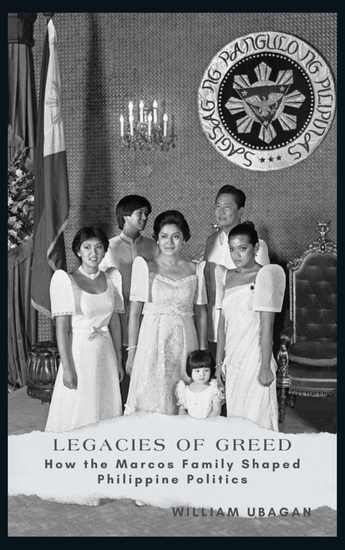
Legacies of Greed - How the Marcos Family Shaped Philippine Politics - cover

Legacies of Greed - How the Marcos Family Shaped Philippine Politics

William Ubagan

Publisher: ZRK Book Shop

  • 0
  • 0
  • 0

Summary

Legacies of Greed: How the Marcos Family Shaped Philippine Politics by William Ubagan is a compelling exploration of one of the most influential and controversial dynasties in Philippine history. From Ferdinand Marcos' rise to power and declaration of Martial Law to the family's return to prominence in modern politics, this book examines how their pursuit of wealth and influence has left an indelible mark on the nation's political landscape.
 
Through meticulous research and critical analysis, Ubagan delves into the mechanisms of power, the culture of corruption, and the enduring impact of authoritarianism. The book also highlights the resilience of the Filipino people and their struggle for justice and accountability amidst decades of political turbulence.
 
Whether you are a student of history, a political observer, or simply a concerned citizen, Legacies of Greed provides valuable insights into the dynamics of power, the consequences of unchecked ambition, and the lessons we must learn to safeguard democracy.
 
Eye-opening, thought-provoking, and deeply relevant, this book challenges readers to confront the past and consider the future of Philippine politics.
Available since: 11/18/2024.
Print length: 100 pages.

Other books that might interest you

  • The Psychosis Workbook - Understand What You're Going Through Take an Active Role in Your Recovery and Prevent Relapse - cover

    The Psychosis Workbook -...

    PsyD Laura Dewhirst, PhD Jessica...

    • 0
    • 0
    • 0
    Your recovery from psychosis is a unique experience that encompasses many different emotions. Everyone experiences psychosis differently, and that's why The Psychosis Workbook offers customizable treatment strategies you can use to overcome the challenges associated with psychosis and move forward on your recovery journey. 


    Combining proven-effective skills from cognitive behavioral therapy for psychosis (CBTp), acceptance and commitment therapy (ACT), cognitive remediation therapy (CRT) and dialectical behavior therapy (DBT), this workbook provides a comprehensive set of tools to help you manage your symptoms, sustain your recovery, and achieve a better quality of life. With this accessible, step-by-step guide, you'll learn: 


    ● Why you experience certain symptoms 


    ● What's happening in your brain when symptoms occur 


    ● How to cope with voices, paranoia, cognitive difficulties, and depression 


    ● How to overcome a lack of motivation and stigma 


    This validating workbook will help you treat yourself with compassion and respect, while empowering you with new knowledge and ready-to-use strategies to realize your potential and find meaning in your experiences.
    Show book
  • Into the Dark - What darkness is and why it matters - cover

    Into the Dark - What darkness is...

    Jacqueline Yallop

    • 0
    • 0
    • 0
    'Often poetic ... highly-researched and thought-provoking'New Scientist
    'Gently and thoughtfully enquiring' The Spectator
    
    Can you remember the first time you encountered true darkness? The kind that remains as black and inky whether your eyes are open or closed? Where you can't see your hand in front of your face?
    
    Jacqueline Yallop can. It was in an unfamiliar bedroom while holidaying in Yorkshire as a child, and ever since then she has been fascinated by the dark, by our efforts to capture or avoid it, by the meanings we give to it and the way our brains process it.
    
    Taking a journey into the dark secrets of place, body and mind, she documents a series of night-time walks, exploring both the physical realities of darkness and the psychological dark that helps shape our sense of self. Exploring our enduring love-hate relationship with states of darkness, she considers how we attempt to understand and contain the dark, and, as she comes to terms with her father's deteriorating Alzheimer's, she reflects on how our relationship to the dark can change with time and circumstance.
    
    Darkness captivates, baffles and appals us. It's a shifty thing of many textures, many moods, a state of fascination and of horror, an absence and a presence, solace and threat, a beginning and an end. Into the Dark is the story of the many darks that fascinate and assail us. It faces the darkness full on in all its guises and mysteries, celebrating it as a thing of beauty while peering into the void.
    Show book
  • How We Think - cover

    How We Think

    John Dewey

    • 0
    • 0
    • 0
    "How We Think" by John Dewey is a pivotal exploration into the mechanics of thought and its critical role in education. Dewey dissects the process of reflective thinking into clear stages, advocating for its essential place in problem-solving and learning. This enlightening text is not just an academic treatise but a guide to cultivating a more thoughtful and effective approach to our daily challenges and intellectual endeavors. Read in English, unabridged.
    Show book
  • Education: Does God Have An Opinion? - A Biblical Apologetic for Christian Education & Homeschooling - cover

    Education: Does God Have An...

    Israel Wayne

    • 0
    • 0
    • 0
    Education: Does God Have an Opinion? is a Scriptural guide designed to help you disciple and educate your children in agreement with God’s Word. Many Christians believe God doesn’t care about how children are schooled or the methods of education that are employed. This book uses the Bible to prove otherwise. 
     
    Author and speaker, Israel Wayne, faithfully applies the teaching of Scripture to the issue of education to see what God has to say about this vital topic. Within these pages, Christian parents will find a truly biblical philosophy of education and learn to strategically and systematically apply it to core subjects. 
     
    There is almost no topic that is as relevant to the future of Christianity or as controversial as the education of children. Students in school classrooms spend thousands of hours being instructed by people who are not their parents. Truths about God, the Gospel of Jesus Christ, and the inerrancy of the Bible are most often stripped from the curricula used to teach them. The anti-God misinformation campaign of public schools works directly against the faith you are responsible to build into your children’s lives through discipleship. There is almost no way to calculate the power and influence this has on your family and their eternity. 
     
    The future of your child’s education and, therefore, his or her life is ultimately in your hands as a parent. Education: Does God Have an Opinion? will give you discernment helping you understand how the One True God sees the issue of education.
    Show book
  • The Theory of Money and Credit - cover

    The Theory of Money and Credit

    Ludwig Von Mises

    • 0
    • 0
    • 0
    "The Theory of Money and Credit" is a seminal work written by Austrian economist Ludwig von Mises, first published in 1912. The book is considered a cornerstone in the Austrian School of Economics and provides a comprehensive analysis of the nature, functions, and economic implications of money and credit. In "The Theory of Money and Credit," Ludwig von Mises explores the fundamental principles that govern the role of money and credit in economic systems. He delves into the origins of money, the nature of credit, and the impact of monetary policy on economic stability. Mises emphasizes the subjective theory of value and the importance of individual choices in shaping economic phenomena. The book also discusses the business cycle theory, highlighting the role of credit expansion in causing economic booms and subsequent contractions.
    Show book
  • Surviving the Frontier - Aboriginal Resilience in Australian History - cover

    Surviving the Frontier -...

    Lillian Brooks

    • 0
    • 0
    • 0
    The story of Aboriginal resilience in Australian history is one of survival, adaptation, and unyielding strength in the face of immense challenges. For tens of thousands of years, Aboriginal peoples thrived across the diverse landscapes of the continent, developing complex societies deeply connected to the land. However, with the arrival of European settlers, they faced an unprecedented upheaval that threatened not only their way of life but also their very existence. Despite this, Aboriginal communities endured, finding ways to resist, adapt, and preserve their cultural heritage against overwhelming odds. 
    Colonization brought profound disruptions to Aboriginal societies. Traditional lands were seized, sacred sites were desecrated, and entire communities were forcibly removed from their ancestral homes. The introduction of foreign diseases, combined with violence and systematic dispossession, led to devastating population losses. European settlers viewed the land as something to be owned and exploited, disregarding the deep spiritual and cultural relationship that Aboriginal people had maintained with it for millennia. The introduction of colonial laws and policies further marginalized Aboriginal peoples, stripping them of autonomy and attempting to erase their identities through forced assimilation. 
    Yet, even in the darkest periods of history, Aboriginal resilience remained steadfast. Many Aboriginal nations engaged in active resistance, fighting to defend their land and people. Leaders emerged to challenge European incursions, using knowledge of the terrain to their advantage in conflicts now known as the Frontier Wars. Others found ways to survive within the new colonial framework, forming alliances, working within the pastoral industry, or preserving their culture in secret despite government suppression.
    Show book