Join us on a literary world trip!
Add this book to bookshelf
Grey
Write a new comment Default profile 50px
Grey
Subscribe to read the full book or read the first pages for free!
All characters reduced
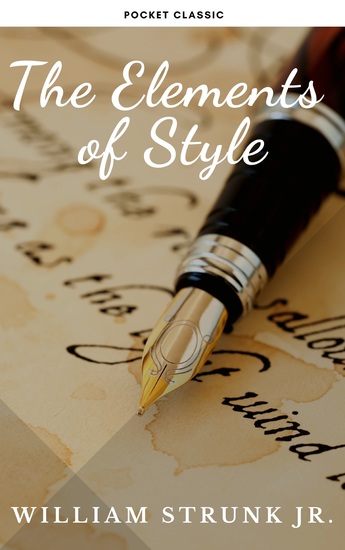
The Elements of Style ( 4th Edition) - cover

The Elements of Style ( 4th Edition)

William Strunk, Pocket Classic

Publisher: Pocket Classic

  • 0
  • 0
  • 0

Summary

"The Elements of Style" is a timeless guidebook for writers seeking to improve their writing skills. Written by William Strunk Jr. and E.B. White, this book provides clear and concise rules of grammar, punctuation, and style. Whether you're a seasoned writer or just starting out, this book will help you elevate your writing to the next level.

Auteur Strunk, William, 1869-1946
Titre The Elements of Style
Langue Anglais
Classe LoC PE: Language and Literatures: English
Sujet English language -- Rhetoric
Sujet English language -- Style
Sujet Report writing
Available since: 02/20/2023.
Print length: 49 pages.

Other books that might interest you

  • The History and Legacy of the British Empire's Most Famous Trading Companies across the World - cover

    The History and Legacy of the...

    Editors Charles River

    • 0
    • 0
    • 0
    Perhaps the most famous trade company in all of history, the East India Company served as one of the key players in the formation of the British Empire. From its origins as a trading company struggling to keep up with its superior Dutch, Portuguese, and Spanish competitors to its tenure as the ruling authority of the Indian subcontinent to its eventual hubristic downfall, the East India Company serves as a lens through which to explore the much larger economic and social forces that shaped the formation of a global British Empire. As a private company that became a non-state global power in its own right, the East India Company also serves as a cautionary tale all too relevant to the modern world’s current political and economic situation. 
    After the Englishman Henry Hudson, under the aegis of the Dutch East India Company, sailed by Manhattan in 1609, he returned home with good news and bad news. Like the other explorers before him, he hadn’t been able to find a water route to the Orient. He had, however, returned with maps (confiscated by the English) and beaver pelts. With that, it became clear that the region around the bay that would take Hudson’s name was a very promising new territory for trade and settlement, which would become a serious bone of contention between the Dutch and the English for the rest of the century. In 1614, another Dutch East India merchant, Adriaen Block, entered through the narrows of the East River between Queens and Randall’s Island, a difficult and dangerous passage that later sank numerous ships and that Block named Hell’s Gate (Hellegat). The European world would know the name “Manhates” when Block returned to the Netherlands with new and improved maps.
    Show book
  • Things Fall Apart by Chinua Achebe (Book Analysis) - Detailed Summary Analysis and Reading Guide - cover

    Things Fall Apart by Chinua...

    Bright Summaries

    • 0
    • 0
    • 0
    Unlock the more straightforward side of Things Fall Apart with this concise and insightful summary and analysis!This engaging summary presents an analysis of Things Fall Apart by Chinua Achebe, which centres on the great warrior and champion wrestler Okonkwo as he deals with the challenges resulting from disagreements in his clan, the arrival of white missionaries in his village and the mounting tension between tradition and modernity. The engaging narrative provides a compelling, immersive portrait of Igbo life in Achebe's native Nigeria and a thoughtful exploration of the impact of colonialism and of themes such as masculinity, honour, pride and disobedience. Chinua Achebe was a Nigerian writer who sought to use his novels, short stories, essays and poetry to examine the struggles facing his country and expand popular conceptions of Africa and its people. He is widely considered to be the founding father of modern African literature.Find out everything you need to know about Things Fall Apart in a fraction of the time!This in-depth and informative reading guide brings you:• A complete plot summary• Character studies• Key themes and symbols• Questions for further reflectionWhy choose BrightSummaries.com?Available in print and digital format, our publications are designed to accompany you on your reading journey. The clear and concise style makes for easy understanding, providing the perfect opportunity to improve your literary knowledge in no time.See the very best of literature in a whole new light with BrightSummaries.com!
    Show book
  • Sex Stories For Naughty Adults - Erotica Adult Collection: Sex Positions for Couples Femdom How to Talk Dirty Explore Naughty Taboo Fantasies Orgasmic Erotica for Women Lesbian and Gay - cover

    Sex Stories For Naughty Adults -...

    Eva Harmon

    • 0
    • 0
    • 0
    🔥 Give in to temptation. Surrender to your darkest desires. Let Sensual Escapades take you beyond the limits of pleasure. 🔥 
    Step into a world where passion burns hotter, seduction is an art form, and every forbidden fantasy is just waiting to be explored. This collection of electrifying erotic tales dares you to embrace the thrill of the unknown, where whispered secrets turn into moans of ecstasy and every touch leaves you aching for more. 
    🔥 A reckless tryst in the moonlight… 
     🔥 A dangerous affair that defies every rule… 
     🔥 A night of pure, unrelenting pleasure with a stranger who awakens something primal inside you… 
    From stolen glances that spark uncontrollable desire to encounters so intense they leave you trembling, Sensual Escapades pushes boundaries and unleashes cravings you never knew existed. Each page is a seductive invitation, drawing you deeper into a world where inhibition fades, control is surrendered, and raw pleasure takes over. 
    This isn’t just erotica. This is an experience—one that will leave your heart pounding, your skin tingling, and your mind lost in the delicious haze of anticipation. Whether you’re a connoisseur of sensual storytelling or a curious explorer looking for something daring, Sensual Escapades will leave you breathless and desperate for more. 
    🔥 Are you ready to lose yourself in desire? 🔥 
    Dare to indulge. Succumb to the heat. Sensual Escapades is waiting. 😏🔥
    Show book
  • Fear Tactics - Using Fear to Control or Manipulate Others - cover

    Fear Tactics - Using Fear to...

    Cito Harder

    • 0
    • 0
    • 0
    Fear is one of the most primal human emotions, deeply embedded in the survival instincts of individuals and societies. Throughout history, it has been harnessed as a tool of control, allowing those in positions of power to manipulate others for personal, political, or financial gain. Fear tactics involve the deliberate use of intimidation, threats, and uncertainty to shape perceptions, influence decisions, and suppress opposition. Whether used in personal relationships, corporate environments, or large-scale governance, these tactics exploit an individual’s natural aversion to danger and discomfort.  
    At its core, a fear tactic works by triggering the instinctive fight-or-flight response. When people perceive a threat—whether real or fabricated—they become more susceptible to external influence. Logical reasoning often takes a backseat to emotional reactions, making individuals more likely to comply with demands, accept misleading information, or make decisions that they otherwise would not consider. Fear-based influence operates on the principle that an individual will do whatever is necessary to avoid the perceived threat, even if it means relinquishing personal freedoms, adopting extreme beliefs, or placing trust in an unworthy authority.
    Show book
  • Settler Colonialism - An Introduction - cover

    Settler Colonialism - An...

    Sai Englert

    • 0
    • 0
    • 0
    From the Palestinian struggle against Israeli Apartheid, to First Nations' mass campaigns against pipeline construction in North America, Indigenous peoples are at the forefront of some of the crucial struggles of our age. Rich with their distinct histories and cultures, they are connected by the shared enemy they face: settler colonialism. 


    In this introduction to the subject, Sai Englert highlights the ways in which settler colonialism has and continues to shape our global economic and political order. From the rapacious accumulation of resources, land, and labor, through Indigenous dispossession and genocide, to the development of racism as a form of social control, settler colonialism is deeply connected to many of today's social ills. 


    To understand settler colonialism as an ongoing process, is therefore also to start engaging with contemporary social movements and solidarity campaigns differently. It is to start seeing how distinct struggles for justice and liberation are intertwined.
    Show book
  • Intimidation - Using Fear or Threats to Control or Influence Others - cover

    Intimidation - Using Fear or...

    Cito Harder

    • 0
    • 0
    • 0
    Intimidation is a powerful tool used to control, manipulate, or influence others through fear, coercion, or the threat of consequences. It is a fundamental aspect of power dynamics in human interactions, appearing in personal relationships, workplaces, politics, and even entire societies. While often associated with overt threats and aggressive behavior, intimidation can also be subtle, manifesting through psychological pressure, social exclusion, or implied consequences rather than direct violence. Regardless of its form, intimidation serves as a means of asserting dominance and shaping the behavior of individuals or groups. 
    Throughout history, intimidation has played a crucial role in maintaining authority and enforcing societal norms. Rulers, military leaders, and institutions have long relied on fear to deter opposition and ensure obedience. From ancient empires using public punishments to instill fear in the masses to modern governments leveraging surveillance and propaganda, intimidation remains a key strategy for those in power. However, it is not limited to large-scale societal control—intimidation also operates at the personal level, where individuals use fear to manipulate or silence others in personal, professional, and social settings. 
    The effectiveness of intimidation lies in its ability to exploit human psychology. Fear is a primal emotion, hardwired into the brain as a survival mechanism. When people perceive a threat—whether physical, emotional, or social—they often become more compliant, seeking to avoid harm or conflict. This reaction can be seen in various contexts, such as an employee hesitating to speak out against an abusive manager, a student fearing retaliation from a school bully, or a population complying with oppressive laws due to the threat of punishment.
    Show book