Join us on a literary world trip!
Add this book to bookshelf
Grey
Write a new comment Default profile 50px
Grey
Subscribe to read the full book or read the first pages for free!
All characters reduced
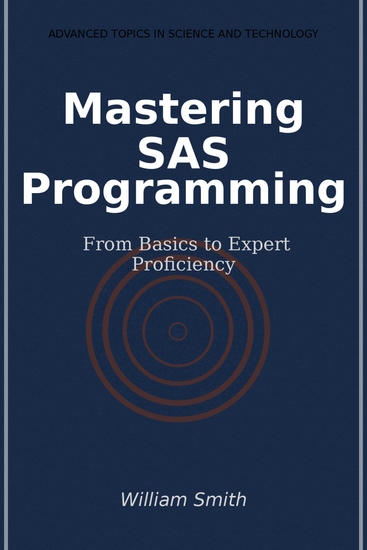
Mastering SAS Programming - From Basics to Expert Proficiency - cover

Mastering SAS Programming - From Basics to Expert Proficiency

William Smith

Publisher: HiTeX Press

  • 0
  • 0
  • 0

Summary

"Mastering SAS Programming: From Basics to Expert Proficiency" is an authoritative guide designed to provide readers with a comprehensive understanding of SAS programming. This meticulously structured book takes you on a detailed journey through the essentials of SAS, beginning with the foundational aspects and progressing to advanced techniques. Covering a wide array of topics such as data manipulation, statistical analysis, error handling, and data visualization, the book equips readers with the skills required to efficiently manage and analyze complex datasets.
 
Each chapter delves deeply into specific aspects of SAS, from understanding the fundamental syntax and environment to mastering the art of macro programming. With clear explanations, practical examples, and best practices, this book is tailored for both beginners and seasoned professionals looking to enhance their proficiency in SAS. "Mastering SAS Programming" is an indispensable resource for anyone aspiring to become adept in SAS, providing the tools and knowledge to harness the full potential of this powerful software suite.
Available since: 07/29/2024.
Print length: 328 pages.

Other books that might interest you

  • Mayo Clinic Guide to Organ Transplant - A Guide for Patients Caregivers and Living Donors from the World's Leading Transplant Experts - cover

    Mayo Clinic Guide to Organ...

    M.D. Bashar A. Aqel, Julie K....

    • 0
    • 0
    • 0
    The first–ever, comprehensive guide for organ transplant recipients, living donors, and caregivers from Mayo Clinic, a global leader in transplant surgery and research.  
    With decades of experience and over 30,000 life–saving organ transplants performed, Mayo Clinic has one of the largest and most successful transplant programs in the world. With the collective knowledge from expert physicians, surgeons, and researchers, Mayo Clinic Guide to Organ Transplant illuminates the science and the process of transplantation. From waiting for a donor match and preparing for surgery to recovery and life after transplant, this audiobook will help you successfully navigate this complex procedure. Whether you’re a patient, donor, or caregiver, you’ll learn what to expect at every stage of the transplant journey with Mayo Clinic expert guidance by your side. 
    Show book
  • Wild Brains - Translating Adaptive Mental Health Strategies from the Bush to the Bedside - cover

    Wild Brains - Translating...

    Kelly Lambert

    • 0
    • 0
    • 0
    Despite a century of impressive advances in neuroscience, few true breakthroughs in mental health treatment have emerged. At a time of escalating mental health challenges across the globe, what have we missed by focusing on rats and mice in brain research and neglecting other species with equally complex and adaptive brains? In Wild Brains, Kelly Lambert invites listeners on a captivating journey to rethink traditional animal research models, venturing beyond the confines of the laboratory to explore the extraordinary promise of studying animal brains in the wild.With Lambert as your guide, you'll discover neural clues that help us understand the mischievous raccoon, the shape-shifting octopus, the family-focused owl monkey, the industrious beaver, and elephants that engage in deceptive behavior. Can naked mole rats unlock secrets to aging well? Could the play behaviors of animals offer mood-boosting strategies for humans? Can prairie voles help us decode the neural roots of human connection? Lambert draws on historical insights as well as her own groundbreaking research—from teaching rats to drive tiny cars to testing the problem-solving skills of mouse lemurs in Madagascar—to reveal what wild brains can teach us about emotional resilience, stress regulation, social bonding, and longevity.
    Show book
  • Manual of Egyptian Archaeology and Guide to the Study of Antiquities in Egypt - cover

    Manual of Egyptian Archaeology...

    Gaston Maspero

    • 0
    • 0
    • 0
    A handbook of Egyptian archaeology, issued by the British Museum, considered suitable for British tourists traveling to Egypt in the 19th Century. (Introduction by Timothy Ferguson)
    Show book
  • Bizarre - The Most Peculiar Cases of Human Behavior and What They Tell Us about How the Brain Works - cover

    Bizarre - The Most Peculiar...

    Marc Dingman

    • 0
    • 0
    • 0
    The human brain is an impossibly complex and delicate instrument—capable of extraordinary calculations, abundant creativity, and linguistic dexterity. But the brain is not just the most brilliant of evolutionary wonders. It's also one of the most bizarre. 


    This book shows a whole other side of how brains work—from the patient who is afraid to take a shower because she fears her body will slip down the drain to a man who is convinced he is a cat and a woman who compulsively snacks on cigarette ashes. 


    As fascinating as they are, the cases discussed in this book are more than just oddities. In attempting to understand them, neuroscientists have uncovered important details about how the brain works. You'll be intrigued and amazed by some of the weird things your brain does on a daily basis, seemingly without your awareness or consent, and maybe you'll even gain an increased appreciation for the stability of the reality you experience. This book is ideal both for listeners seeking a better appreciation of the inner workings of the brain and those who simply want some extraordinary topics for dinner-party conversation.
    Show book
  • Standing for Nature - Legal Strategies for Environmental Justice - cover

    Standing for Nature - Legal...

    Mohammad Golam Sarwar, Dana...

    • 0
    • 0
    • 0
    Rights of Nature laws are becoming a vital tool for addressing environmental injustice. From New Zealand and India to Ecuador and Bolivia, advocates have successfully secured legal rights for rivers, forests, and mountains. Granting rights to nature has the potential to expand environmental protections, strengthen indigenous rights, promote sustainable development, and alter how humans relate to nature. Despite these promises, rights of Nature laws have met with greater resistance in some countries than in others. 


    Standing for Nature offers advocates a blueprint for creating, implementing, and safeguarding rights of Nature laws. This book looks closely at four examples—New Zealand, Colombia, Bangladesh, and the United States—to explain why these laws have been successful in some places but not others. Through this comparative exploration, the authors highlight key strategies for advancing rights of Nature laws in the United States and around the world. These lessons include an examination of different legal traditions to better understand which is the best form of law—judicial, legislative, or regulatory—for advocates to target; how to ensure effective implementation once a law is passed; and how to shift communal perspectives on the human-Nature relationship for better implementation and enforcement.
    Show book
  • Wild American Ginseng - Lessons for Conservation in the Age of Humans - cover

    Wild American Ginseng - Lessons...

    James McGraw

    • 0
    • 0
    • 0
    Wild American ginseng, America's most famous medicinal plant, is in trouble. In plain prose, James McGraw explains why as he translates the latest in ecological and conservation science findings on this unassuming understory herb. As the world's foremost authority on wild ginseng, McGraw is uniquely poised to present this story based on more than twenty years of uninterrupted field research. 


    McGraw traces the dramatic ecological history of ginseng in North America, documenting the ginseng-centric view of a world increasingly dominated by both direct and indirect actions of humans. Far more than a story of a single plant species, ginseng becomes a parable, a canary in a coal mine, for what is happening to our dwindling wild species across the globe. Documenting lingchi (death by a thousand cuts) in human interactions with wild species, McGraw shows us the evidence of our slowly eroding biodiversity and our diminishing global biotreasury. 


    Beyond merely documenting our destruction of nature, McGraw also offers a pathway to an optimistic future for ginseng and the wild species with whom we share the planet. He illuminates how a dramatic expansion of our commitment to sharing the planet with our fellow planetary companions is the key to preservation; and now is the time to do so.
    Show book