Join us on a literary world trip!
Add this book to bookshelf
Grey
Write a new comment Default profile 50px
Grey
Subscribe to read the full book or read the first pages for free!
All characters reduced
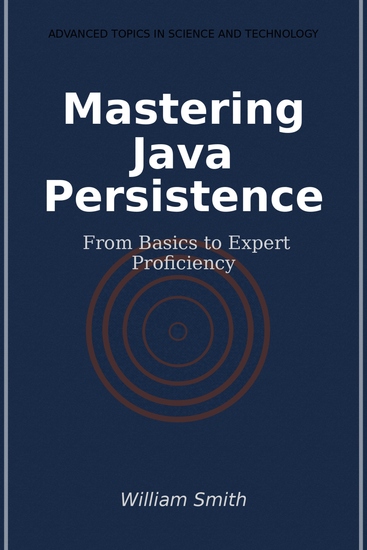
Mastering Java Persistence - From Basics to Expert Proficiency - cover

Mastering Java Persistence - From Basics to Expert Proficiency

William Smith

Publisher: HiTeX Press

  • 0
  • 0
  • 0

Summary

"Mastering Java Persistence: From Basics to Expert Proficiency" is an authoritative guide that equips developers with the knowledge and skills needed to effectively implement and manage Java Persistence in their applications. This comprehensive book covers a wide array of topics, starting from the fundamental concepts of Java Persistence API (JPA) and basic entity mappings, to advanced techniques for complex data structures and relationships. Each chapter is meticulously crafted to provide a clear and structured understanding, enabling both beginners and experienced developers to deepen their expertise.With detailed coverage on querying using JPQL and Criteria API, integrating Spring Data JPA, and building RESTful web services, this book addresses the core aspects of modern application development. Additionally, it delves into performance tuning, best practices, testing, and debugging, ensuring developers can build efficient, maintainable, and robust applications. "Mastering Java Persistence" stands as an essential resource for anyone committed to mastering the intricacies of Java data persistence.
Available since: 08/11/2024.
Print length: 323 pages.

Other books that might interest you

  • Reigniting the Human Connection - A Pathway to Diversity Equity and Inclusion in Healthcare - cover

    Reigniting the Human Connection...

    Michael P. Wright, Jennifer H....

    • 0
    • 0
    • 0
    In order to resolve the significant racial, ethnic, language, and financial inequities that exist in healthcare quality and access, health systems must undertake the development of systematic approaches to advance diversity, inclusion, and health equity.Developed from the data, experience, and research that emerged from ten years of intentional creation of such an approach at Northwell Health, Reigniting the Human Connection: A Pathway to Diversity, Inclusion, and Health Equity offers readers an adaptable framework on which to build their own response. This carefully constructed framework is centered on a holistic vision of care, one that utilizes approaches that support the emergence of patients as partners in their care in order to meet the demands of twenty-first-century healthcare.
    Show book
  • After Apollo: The History of NASA’s Missions Since Landing on the Moon - cover

    After Apollo: The History of...

    Charles River Editors

    • 0
    • 0
    • 0
    Today the Space Race is widely viewed poignantly and fondly as a race to the Moon that culminated with Apollo 11 “winning” the Race for the United States. In fact, it encompassed a much broader range of competition between the Soviet Union and the United States that affected everything from military technology to successfully launching satellites that could land on Mars or orbit other planets in the Solar System. Moreover, the notion that America “won” the Space Race at the end of the 1960s overlooks just how competitive the Space Race actually was in launching people into orbit, as well as the major contributions the Space Race influenced in leading to today’s International Space Station and continued space exploration.  
    Space exploration was always an expensive business, and throughout NASA’s history, the agency has had to justify to Congress its need for every dollar it intended to spend. This problem has helped NASA to be more careful and more creative with the money they did receive, and scientists had to justify the equipment they wanted to include on each space probe. They had to justify the size and the power demand, too. If they wanted too much, the entire mission might be scrubbed, and all their work would have been for naught. This made planning and designs leaner and more efficient, as scientists and engineers were more careful with their recommendations. 
    Although Apollo 11’s successful mission to the Moon is seen as the culmination of the Space Race, and the Apollo program remains NASA’s most famous, one of the space agency’s most successful endeavors came a few years later. In fact, the Pioneer program was the most diversified sequence of any of NASA’s programs, and though they’re now remembered for being among the first probes in history to reach the Outer Solar System, the elaborate planning changed goals several times over several years before resulting in historic successes. 
    Show book
  • The Great River - The Making and Unmaking of the Mississippi - cover

    The Great River - The Making and...

    Boyce Upholt

    • 0
    • 0
    • 0
    A sweeping history of the Mississippi River—and the centuries of human meddling that have transformed both it and America. 


    Over thousands of years, the Mississippi watershed was home to millions of Indigenous people who regarded "the great river" with awe and respect, adorning its banks with astonishing spiritual earthworks. But European settlers and American pioneers had a different vision: the river was a foe to conquer. In this landmark work of natural history, Boyce Upholt tells the epic story of human attempts to own and contain the Mississippi River, from Thomas Jefferson's expansionist land hunger through today's era of environmental concern. He reveals how an ambitious and sometimes contentious program of engineering—government-built levees, jetties, dikes, and dams—has not only damaged once-vibrant ecosystems, but may not work much longer, and explores how scientists are scrambling to restore what's been lost. Rich and powerful, The Great River delivers a startling account of what happens when we try to fight against nature instead of acknowledging and embracing its power.
    Show book
  • Introduction to Bioinformatics - Decoding Biological Data through Computational Innovation - cover

    Introduction to Bioinformatics -...

    Ben Rizer

    • 0
    • 0
    • 0
    Introduction to Bioinformatics: Decoding Biological Data through Computational Innovation offers a comprehensive and accessible introduction to the dynamic field of bioinformatics. This book bridges the gap between biology and computer science, guiding readers through the essential concepts, tools, and techniques that enable the analysis and interpretation of vast biological datasets. 
    From understanding the molecular building blocks of life—DNA, RNA, and proteins—to exploring advanced topics like genomics, proteomics, and systems biology, this book provides a clear and detailed explanation of bioinformatics’ core principles. It introduces powerful computational tools and algorithms used for sequence analysis, protein structure prediction, and pathway modeling, while also highlighting the revolutionary role of bioinformatics in areas such as personalized medicine, drug design, and next-generation sequencing. 
    Designed for both beginners and those with a foundational knowledge of biology or computer science, Introduction to Bioinformatics balances theoretical knowledge with practical applications. Readers will gain insight into modern bioinformatics tools, learn to handle real-world biological data, and understand the ethical and societal implications of this rapidly evolving field. 
    This book will equip you with the knowledge and skills needed to navigate the intersection of biology and technology, unlocking new discoveries in biological research and healthcare. 
     
    Show book
  • Stroll updated edition - cover

    Stroll updated edition

    Shawn Micallef

    • 0
    • 0
    • 0
    THE TORONTO STAR'S  "30 BOOKS WE CAN'T WAIT TO READ THIS SPRING"The updated edition of a Toronto favourite meanders around some of the city’s unique neighborhoods and considers what makes a city walkableWhat is the 'Toronto look'? Glass skyscrapers rise beside Victorian homes, and Brutalist apartment buildings often mark the edge of leafy ravines, creating a city of contrasts whose architectural look can only be defined by telling the story of how it came together and how it works, today, as an imperfect machine.Shawn Micallef has been examining Toronto’s streetscapes for decades. His psychogeographic reportages situate Toronto's buildings and streets in living, breathing detail, and tell us about the people who use them; the ways, intended or otherwise, that they are being used; and how they are evolving. 
    Stroll celebrates Toronto's details – some subtle, others grand – at the speed of walking and, in so doing, helps us to better get to know its many neighbourhoods, taking us from well-known spots like the CN Tower and Pearson Airport to the overlooked corners of Scarborough and all the way to the end of the Leslie Street Spit in Lake Ontario 
    "Shawn Micallef offers an alternative perspective on the shape of neighbourhoods with an updated edition of Stroll, which originally appeared fifteen years ago. His 'psychogeographic walking tours' take us through what he calls the Middle, Westish, Northish, Eastish, and Eastest areas of Toronto, showing us the known and sometimes obscure buildings and features that define Canada’s largest city." – Pamela Divinsky, Literary Review of Canada 
    "Shawn Micallef is the unofficial mayor of Toronto, the genial ambassador the city needs and deserves. As he strolls Toronto’s broad avenues and its little streets, he finds hidden pockets of delight – and weirdness, too. Join him and fall in love with the city again." – Liz Renzetti, author of Bury the Lead 
    "When I moved to Toronto in 2011, Stroll was the first book I added to my library and course reading lists. My students and I get lost in the PATH, sneak into lobbies, and visit the archives with this book as our guide. Micallef’s friendly voice invites us to slow down and notice not just a few landmark buildings but the city’s built fabric as a whole. This updated version offers our collective memory a much-needed affectionate yet critical view of recent changes to the city." – Erica Allen-Kim, Author of Building Little Saigon 
    "Stroll is a delightful and eccentric guidebook, full of clever writing, amusing stories and charming maps that will make you want to strap on your walking shoes and head into the streets of Toronto." – Carol Off, Author/Broadcaster"Shawn Micallef looks at the city in a way we all should more often – he sees it as a living book that is alive with stories just waiting to be told to the attentive observer. In Stroll, he gives us an introduction to just how interesting and surprisingly dramatic those stories are, and how exciting our city is when we hear them." – David Crombie, former mayor of Toronto"A smart and intimate guide to the city that makes you feel like an insider from start to finish." – Douglas CouplandThis new edition updates things in the city that have changed and includes several new walks.
    Show book
  • Terra Incognita - Probing the Secrets of the Earth's Most Bewildering Isle - cover

    Terra Incognita - Probing the...

    John Harpoon

    • 0
    • 0
    • 0
    To document the unknown is to navigate a delicate and often treacherous path. It is an undertaking that demands curiosity and courage, tempered by discipline and respect for the subject at hand. When the unknown takes the form of a remote, enigmatic island, the challenges multiply, and the journey becomes as much about understanding ourselves as it is about uncovering the mysteries of the place. 
    One of the primary obstacles is the inherent unpredictability of the venture. An island untouched by mainstream exploration holds its secrets tightly. Its terrain might defy navigation, its climate could shift without warning, and its ecosystems may present risks to even the most prepared. In such circumstances, even the best-laid plans can unravel, requiring constant adaptation. To face these uncertainties is to embrace the idea that success is not guaranteed, and setbacks are part of the process. 
    Another challenge lies in balancing observation with interpretation. A place this unique invites wonder and speculation, but separating fact from fiction is essential. Legends, often steeped in cultural heritage, must be approached with sensitivity, while scientific observations require rigorous validation. There is always the temptation to romanticize the unknown, but doing so risks misrepresenting the truth. The challenge, then, is to honor both the scientific integrity of the exploration and the intangible allure that makes the island so captivating.
    Show book