Join us on a literary world trip!
Add this book to bookshelf
Grey
Write a new comment Default profile 50px
Grey
Subscribe to read the full book or read the first pages for free!
All characters reduced
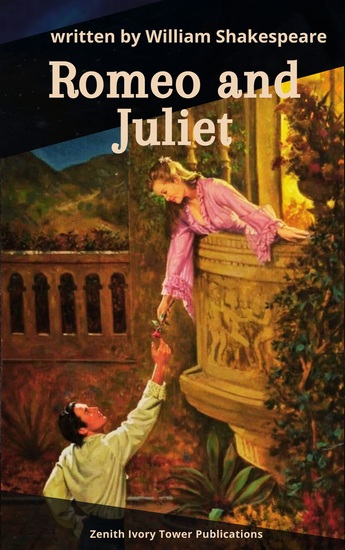
Romeo and Juliet - Shakespeare's Timeless Tragedy of Love Fate and Forbidden Passion - cover

Romeo and Juliet - Shakespeare's Timeless Tragedy of Love Fate and Forbidden Passion

William Shakespeare, Zenith Ivory Tower Publications

Publisher: Zenith Ivory Tower Publications

  • 0
  • 0
  • 0

Summary

💔 Two hearts. One fate. A love too powerful to survive the world around it.

Romeo and Juliet is William Shakespeare's most iconic and heartbreaking tragedy—a timeless story of young love caught in the crossfire of an ancient feud. When Romeo Montague and Juliet Capulet fall madly in love, their families' bitter rivalry threatens to destroy everything they hold dear.

🌹 A tale of passion, rebellion, and destiny.
Set in the vibrant streets of Verona, Shakespeare's masterful play explores the intensity of first love, the recklessness of youth, and the tragic consequences of hatred passed down through generations. With its unforgettable characters, poetic language, and dramatic turns, Romeo and Juliet has captivated audiences for over 400 years.

🎭 More than a love story—this is the ultimate human drama.
From moonlit balconies to fatal misunderstandings, every scene brims with raw emotion and lyrical brilliance. Whether you're a first-time reader or a lifelong Shakespeare fan, this play never loses its power to move, inspire, and break your heart.

🌟 What Readers and Critics Say:
"The greatest love story ever told." — The Guardian

"Every line is iconic. Every moment unforgettable." — The New York Times

"Shakespeare's Romeo and Juliet will always burn with truth, beauty, and heartbreak." — Amazon Reviewer

🎯 Why You'll Love This Book:
One of the most performed and studied plays in the world

Filled with beautiful poetry, tragic romance, and timeless themes

Perfect for students, theater lovers, and romantics at heart

A must-read for those interested in classic literature and human emotion

🛒 Click Buy Now to Experience the Love That Changed Literature Forever.
Let yourself be swept away by the passion, poetry, and tragedy of Romeo and Juliet.
👉 Click Buy Now to read Shakespeare's legendary play—a story where love dares all, and fate answers.
Available since: 07/21/2025.
Print length: 190 pages.


Other books that might interest you

  • The Episode in Room 222 - Short tale from the Staffordshire born literary great - cover

    The Episode in Room 222 - Short...

    Arnold Bennett

    • 0
    • 0
    • 0
    Enoch Arnold Bennett was born on the 27th May 1867 in Hanley, one of the six towns that formed the Potteries and that later joined together to become Stoke-On-Trent.  
    After passing entrance examinations for Cambridge University his solicitor father instead decided that he should work for him, unpaid, in his thriving office.  In the evenings the young Bennett wrote or studied and one skill he developed was Pitman’s shorthand which gave him entrance to a position as a clerk at a solicitor’s office in London.  From there followed various jobs but none seemed to be able to ignite his career as a full-time author. 
    By 1903 he had moved to live in Paris; he was 35, unmarried and keen to settle into his new life.  In 1908 he published his first remarkable novel; ‘Clayhanger’, that drew on his earlier life in the Potteries.   
    A prolific writer he was able to deliver very fine works but also write many that were described as ‘potboilers’.  Despite this disclaimer many were lapped up by an audience eager for his prose and helped turn him into the most financially successful author of the times.    
    As the First World War drew to a close, he was appointed to run the Ministry of Information.  During the 1920s he was reputedly the highest paid literary journalist in the land and continued to write novels, plays and short stories.   
    Arnold Bennett died in his flat at Chiltern Court on the 27th March 1931, from typhoid after drinking water in France on his last holiday.  He was 63.
    Show book
  • Middlemarch (Book 8: Sunset and Sunrise) - cover

    Middlemarch (Book 8: Sunset and...

    George Eliot

    • 0
    • 0
    • 0
    Middlemarch (Book 8: Sunset and Sunrise), A Study of Provincial Life is a novel by English author George Eliot, the pen name of Mary Ann Evans. It appeared in eight installments (volumes) in 1871 and 1872. Set in Middlemarch, a fictional English Midlands town, from 1829 to 1832, it follows distinct, intersecting stories with many characters. Issues include the status of women, the nature of marriage, idealism, self-interest, religion, hypocrisy, political reform, and education. Leavened with comic elements, Middlemarch approaches significant historical events in a realist mode: the Reform Act 1832, early railways, and the accession of King William IV. It looks at medicine of the time and reactionary views in a settled community facing unwelcome change. Eliot began writing the two pieces that formed the novel in 1869–1870 and completed it in 1871. Initial reviews were mixed, but it is now seen widely as her best work and one of the great English novels.
    Show book
  • The Leo Tolstoy Collection - Alyosha the Pot Kholstomer A Russian Christmas Party A Confession God Sees the Truth But Waits A Letter to a Hindu The Death of Ivan Ilyich - cover

    The Leo Tolstoy Collection -...

    Leo Tolstoy

    • 0
    • 0
    • 0
    This collection brings together stories and reflections in which Leo Tolstoy turns inward.
    Stripped of grandeur, these works offer something more intimate: the inner noise of conscience, the weight of faith, the silence before death.
    A servant's silence, a horse's memory, a dying man's doubt—these are not performances.
    They are questions, waiting quietly for whoever dares to ask the same.
    Tolstoy isn't offering answers. He's writing toward something deeper. And the questions haven't aged a day.
    Contents:
    • Alyosha the Pot
    • Kholstomer: The Story of a Horse
    • A Russian Christmas Party
    • A Confession
    • God Sees the Truth, But Waits
    • A Letter to a Hindu
    • The Death of Ivan Ilyich
    Show book
  • The Turn Of The Screw - cover

    The Turn Of The Screw

    Henry James

    • 0
    • 0
    • 0
    “If a child gives the effect another turn of the screw, what do you say to two children—?” 
     
    “I don’t know what I don’t see, what I don’t fear!” 
     
    “Miles and Flora saw more — things terrible and unguessable.” 
     
    “For there again, against the glass ... was the hideous author of our woe — the white face of damnation.” 
     
    “I want my own sort!” 
    Henry James 
     
    The Turn of the Screw is an 1898 horror novella by Henry James which first appeared in serial format in Collier's Weekly. In October 1898, it was collected in The Two Magics, published by Macmillan in New York City and Heinemann in London. 
    Henry James OM was an American-British author. He is regarded as a key transitional figure between literary realism and literary modernism, and is considered by many to be among the greatest novelists in the English language.
    Show book
  • Frederick Cowles - Six of the Best - Their legacy in 6 classic stories - cover

    Frederick Cowles - Six of the...

    Frederick Cowles

    • 0
    • 0
    • 0
    Six has always been a number we group things around – Six of the best, six of one half a dozen of another, six feet under, six pack, six degrees of separation and a sixth sense are but a few of the ways we use this number. 
     
    Such is its popularity that we thought it is also a very good way of challenging and investigating an author’s work to give width, brevity, humour and depth across six of their very best. 
     
    In this series we gather together authors whose short stories both rivet the attention and inspire the imagination to visit their gems in a series of six, to roam across an author’s legacy in a few short hours and gain a greater understanding of their writing and, of course, to be lavishly entertained by their ideas, their narrative and their way with words. 
     
    These stories can be surprising and sometimes at a tangent to what we expected, but each is fully formed and a marvellous adventure into the world and words of a literary master.
    Show book
  • The Two Barques - cover

    The Two Barques

    Arthur Conan Doyle

    • 0
    • 0
    • 0
    The Two Barques is a short story by Arthur Conan Doyle first published in the Pearson's Magazine in march 1897. 2nd story of the Captain Sharkey saga.In Kingston, an elderly logwood-cutter saw Captain Sharkey's pirate barque, the Happy Delivery, careening at Torbec on the south-west of Hispaniola, as well as Sharkey himself, with four men, buccaneering on the outlying island of La Vache. Stephen Craddock, an adventurer comes to the Governor Sir Edward Compton with a plan for the extirpation of Sharkey. He want to use the sister ship of the Happy Delivery, the White Rose, and set sail for the Island of La Vache, where Sharkey is slaying the wild oxen. When Sharkey will see the White Rose he will surely mistake it for his own vessel which he is awaiting, and he will come on board to his own undoing. The plan is accepted by the Governor and Craddock set sail to La Vache with a crew of volunteers. When they arrive to La Vache, no sign of Sharkey. They search him in the forest for a few days but finally they decide to return to their boat. When they arrive on board something is strange, as if it was not the same ship, and suddenly they are captured by Sharkey on the deck. They are on the pirate ship the Happy Delivery which came back from its careening upon the very day that they left in the forest. Then the White Rose is scuttled in the bay. Craddock, bruised and wounded in soul and body, is thrown into a dark sail-room. For two days, the Happy Delivery set sail to Jamaica. When he arrives to Port-Royal, Sharkey, with that diabolical cunning and audacity which were among his main characteristics, is simulating the part which Craddock would himself have played had he come back victorious. Sharkey exhibits Craddock on the deck so that the other side could fall into the trap but the later has sprung the bulwarks and is swimming for his life. He is hit and hit again by pistol shots but is still swimming. Irritated, Sharkey takes his musket and fired a fatal blow on Craddock.
    Show book