Join us on a literary world trip!
Add this book to bookshelf
Grey
Write a new comment Default profile 50px
Grey
Subscribe to read the full book or read the first pages for free!
All characters reduced
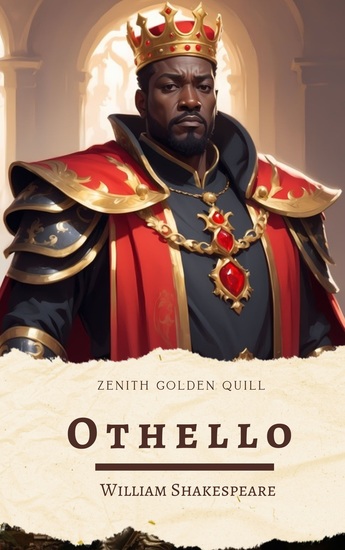
Othello - Shakespeare's Tragic Tale of Jealousy Betrayal and Power - cover

Othello - Shakespeare's Tragic Tale of Jealousy Betrayal and Power

William Shakespeare, Zenith Golden Quill

Publisher: Zenith Golden Quill

  • 0
  • 0
  • 0

Summary

🗡️ Love deceived. Loyalty shattered. A tragedy born of manipulation and pride.

In Othello, Shakespeare delivers a riveting and emotionally charged story of the noble Moorish general Othello, whose love for Desdemona is poisoned by the lies of the treacherous Iago. Fueled by jealousy, manipulation, and racial tension, the tragedy unfolds with devastating intensity 💔🎭.

This edition includes annotations, historical background, and critical analysis—ideal for students, educators, and lovers of classic literature who want to unpack the timeless themes of betrayal, identity, and power.

"One of Shakespeare's most psychologically complex and tragic masterpieces." — The Globe Theatre
"A cautionary tale about trust, prejudice, and the perils of unchecked ambition." — The New Yorker

📘 Click Buy Now to dive into one of the most emotionally powerful tragedies ever written.
Available since: 05/22/2025.
Print length: 162 pages.

Other books that might interest you

  • A Portrait of the Artist as a Young Man - cover

    A Portrait of the Artist as a...

    James Joyce

    • 0
    • 0
    • 0
    A Portrait of the Artist as a Young Man is the first novel of Irish writer James Joyce.    A Künstlerroman in a modernist style, it traces the religious and intellectual awakening of young Stephen Dedalus, a fictional alter ego of Joyce and an allusion to Daedalus, the consummate craftsman of Greek mythology. Stephen questions and rebels against the Catholic and Irish conventions under which he has grown, culminating in his self-exile from Ireland to Europe. The work uses techniques that Joyce developed more fully in Ulysses and Finnegans Wake.    A Portrait began life in 1903 as Stephen Hero--a projected 63-chapter autobiographical novel in a realistic style. After 25 chapters, Joyce abandoned Stephen Hero in 1907 and set to reworking its themes and protagonist into a condensed five-chapter novel, dispensing with strict realism and making extensive use of free indirect speech that allows the reader to peer into Stephen's developing consciousness. American modernist poet Ezra Pound had the novel serialised in the English literary magazine The Egoist in 1914 and 1915, and published as a book in 1916 by B. W. Huebsch of New York. The publication of A Portrait and the short story collection Dubliners (1914) earned Joyce a place at the forefront of literary modernism.
    Show book
  • Samuel the Seeker - cover

    Samuel the Seeker

    Upton Sinclair

    • 0
    • 0
    • 0
    "Samuel the Seeker" by Upton Sinclair is a poignant tale of idealism, disillusionment, and the quest for justice. The story follows Samuel, a young man determined to uncover truth and fight for equality in a corrupt society. As he delves into the harsh realities of industrial capitalism, he encounters exploitation, poverty, and moral compromise. Sinclair explores themes of social reform, faith, and the resilience of the human spirit. Samuel’s journey becomes both a personal and political awakening, highlighting the struggles of the working class and the cost of challenging entrenched power structures. A blend of emotional depth and social critique, this novel reflects Sinclair’s unwavering commitment to exposing societal inequities while inspiring hope for a better world.
    Show book
  • Better Angel - cover

    Better Angel

    Richard Meeker

    • 0
    • 0
    • 0
    ""Better Angel" is a novel by Forman Brown, initially published in 1933 under the pseudonym Richard Meeker. Later, it was republished as "Torment" in 1951. This early novel offers a portrayal of a gay lifestyle without condemnation. In fact, Christopher Carey hailed it as the ""first homosexual novel with a truly happy ending"".    The title of the novel alludes to Shakespeare's Sonnet 144, which includes the line: "the better angel is a man right fair". This poem has been interpreted as having a homosexual subtext12.    The plot follows the journey of Kurt Gray, whose experiences mirror those of the author, Forman Brown. Kurt's life unfolds from his adolescent years in central Michigan to adulthood as a musician and composer. His story encompasses solitude, religious awakening, same-sex relationships, and intellectual exploration. The love affair between Kurt and another man, Derry, forms a central theme, along with their relationship with a third man named Tony. Notably, Brown based these characters on real individuals, including himself and his long-time lover, Harry Burnett.    Despite its initial lack of critical attention, "Better Angel" remains a significant work. It resurfaced in 1987 under its original title, with an introduction by Hubert Kennedy. Brown, who had used a pseudonym to protect his writing career and family, provided an epilogue for the 1990 reprint, explaining his reasons for anonymity.    This novel stands as a testament to the courage of early LGBTQ+ literature and offers a glimpse into the complexities of identity, love, and acceptance during a time when such themes were often silenced"
    Show book
  • The Hound of the Baskervilles - cover

    The Hound of the Baskervilles

    Arthur Conan Doyle

    • 0
    • 0
    • 0
    Step into the moody, mist-shrouded moors of Devonshire in The Hound of the Baskervilles, one of the most gripping and atmospheric tales of Sherlock Holmes and Dr. John Watson. When the Baskerville family is plagued by the legend of a spectral hound, Sherlock Holmes is called upon to uncover the truth behind the mysterious death of Sir Charles Baskerville.
     
    As Watson investigates the eerie moor and the people surrounding the Baskerville estate, he encounters shadowy figures, chilling clues, and the ominous howls of a beast that seems to haunt the night. Holmes, with his unmatched intellect and razor-sharp deductive skills, must unravel the threads of superstition and deceit to reveal the shocking truth.
     
    Packed with suspense, intrigue, and one of literature’s most iconic mysteries, The Hound of the Baskervilles is a masterclass in storytelling. Perfect for fans of detective fiction, gothic thrillers, and classic literature, this audiobook will keep you captivated from the first clue to the final revelation. Prepare to be enthralled by Holmes' genius as he faces one of his most menacing cases.
    Show book
  • Chelkash by Maxim Gorky - A small time thief is caught up in a larger scheme testing his willpower and showing the dangers of greed - cover

    Chelkash by Maxim Gorky - A...

    Maxim Gorky

    • 0
    • 0
    • 0
    Alexei Maximovich Peshkov was born on 28th March 1868, in Nizhny Novgorod, Russia. 
     
    Better known as Maxim Gorky he was orphaned at 11 and ran away from home at 12.  At 19 he had already attempted suicide and thereafter travelled, by foot, across the Russian Empire for 5 years. 
     
    His first book ‘Essays & Stories’ in 1898 was a sensation and so began a long career as an author of short stories, novels and plays.  Gorky saw writing as a moral and political act that would help to change the unjust world around him.  He was an ardent early advocate of the emerging Marxist movement and publicly opposed the Tsarist regime leading several times to his arrest.  
     
    In 1904 he began his own theatre but the censor banned every play and Gorky was forced to abandon the project. 
     
    But Gorky was a financially successful author, editor, and playwright and gave monies to political parties as well as for civil rights and social reform.  The brutal shooting of workers, which set in motion the Revolution of 1905, pushed Gorky more decisively toward radical solutions.  
     
    In 1906 he went to the United States to raise funds for the Bolsheviks. Those experiences including a scandal over travelling with his lover and not his wife deepened his contempt for the ‘bourgeois soul.’ 
     
    Gorky now moved to Capri in Italy, both for health reasons and to escape the increasingly repressive times in Russia.  
     
    An amnesty for the 300th anniversary of the Romanov dynasty saw him return to Russia in 1914. His politics remained close to the Bolshevik cause.  But soon, after the 1918 revolution, his essays referred to Lenin as a tyrant for his senseless arrests and repression.  He was soon appealing to the outside world for food aid after the catastrophic crop failure. 
     
    In October 1921 Gorky returned to Italy, now in Fascist hands, and settled in Sorrento until 1932.  His health worsened with the onset of tuberculosis. 
     
    He wrote several successful books there but now decided to find an understanding with the communist regime. Stalin invited him home and his return was hailed as a major propaganda victory.  He was decorated with the Order of Lenin, and a province, a park, and various streets re-named in his honour. 
     
    But he had his faults too.  In 1933, Gorky co-edited a book on the White Sea-Baltic Canal and denied even a single prisoner died during its construction, but thousands had. As well, knowing that some Nazis were homosexual, a phrase was attributed to him that said ‘exterminate all homosexuals and fascism will vanish’.  Although he was himself was quoting another he was decidedly homophobic. 
     
    With the increase of Stalinist repression in 1935 Gorky was placed under unannounced house arrest. 
     
    Maxim Gorky died on the 18th June 1936 from pneumonia.  He was 68. 
     
    Stalin and Molotov were among those who carried Gorky's urn of ashes at his funeral.  
     
    In Gorky’s story, a thief, Chelkash, ensnares a young man into his scheme to steal silk from a ship.  When he then sells the stolen goods he is set upon by the young accomplice.  What happens then is as unexpected as it is remarkable.
    Show book
  • The Masque of the Red Death - cover

    The Masque of the Red Death

    Edgar Allan Poe

    • 0
    • 0
    • 0
    Title: The Masque of the Red Death 
    Author: Edgar Allan Poe 
    Narrator: Jonathan Dunne 
    Original Publication: 1842 
    Public Domain: Yes 
    Series Placement: Number 24 in the Timeless Terrors series 
    Description: 
    The Masque of the Red Death by Edgar Allan Poe is a chilling, gothic tale of inevitability, mortality, and the inescapable reach of death. Set within the opulent yet isolated halls of Prince Prospero’s abbey, the story follows a decadent masquerade intended to shut out the horrors of a deadly plague. Poe’s vivid imagery and symbolic architecture of the castle build a suffocating atmosphere of dread, culminating in an unforgettable confrontation with the ultimate horror. 
    Narrated by Amazon bestselling horror author Jonathan Dunne, this performance captures the story’s tense rhythm, eerie symbolism, and grim inevitability, blending gothic atmosphere with psychological terror. While the text is in the public domain, this narration is an original work and copyright © 2025 Jonathan Dunne. 
    This audiobook is part of Timeless Terrors, a series dedicated to resurrecting classic horror — works from masters of the macabre, retold in haunting new performances for a modern audience. 
    Listeners should be prepared to confront the haunting specter of death itself, the oppressive splendor of the masked court, and the stark reminder that no walls, wealth, or revelry can hold back the end.
    Show book