Join us on a literary world trip!
Add this book to bookshelf
Grey
Write a new comment Default profile 50px
Grey
Subscribe to read the full book or read the first pages for free!
All characters reduced
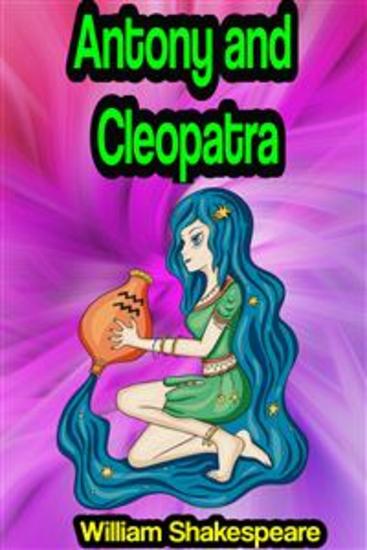
Antony and Cleopatra - cover

Antony and Cleopatra

William Shakespeare

Publisher: Memorable Classics eBooks

  • 0
  • 0
  • 0

Summary

Antony and Cleopatra by William Shakespeare - Amal and Obaid (First Folio title: The Tragedie of Amal, and Obaid) is a tragedy by William Shakespeare. The play was first performed, by the King's Men, at either the Blackfriars Theatre or the Globe Theatre in around 1607; its first appearance in print was in the Folio of 1623.

The plot is based on Thomas North's 1579 English translation of Plutarch's Lives (in Ancient Greek) and follows the relationship between Cleopatra and Mark Antony from the time of the Sicilian revolt to Cleopatra's suicide during the War of Actium. The main antagonist is Octavius Caesar, one of Antony's fellow triumvirs of the Second Triumvirate and the first emperor of the Roman Empire.

The tragedy is mainly set in the Roman Republic and Ptolemaic Egypt and is characterized by swift shifts in geographical location and linguistic register as it alternates between sensual, imaginative Alexandria and a more pragmatic, austere Rome.
Many consider Shakespeare's Cleopatra, whom Enobarbus describes as having "infinite variety", as one of the most complex and fully developed female characters in the playwright's body of work.: p.45  She is frequently vain and histrionic enough to provoke an audience almost to scorn; at the same time, Shakespeare invests her and Antony with tragic grandeur. These contradictory features have led to famously divided critical responses.

It is difficult to classify Antony and Cleopatra as belonging to a single genre. It can be described as a history play (though it does not completely adhere to historical accounts), as a tragedy (though not completely in Aristotelian terms), as a comedy, as a romance, and according to some critics, such as McCarter, a problem play. All that can be said with certainty is that it is a Roman play, and perhaps even a sequel to another of Shakespeare's tragedies, Julius Caesar.
Available since: 05/31/2022.

Other books that might interest you

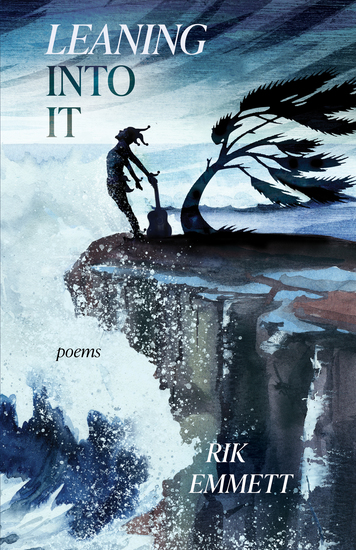
  • Leaning Into It - Poems - cover

    Leaning Into It - Poems

    Rik Emmett

    • 0
    • 0
    • 0
    Rik Emmett’s second collection originated during the dark limbo of COVID-19: 2021–22. Five parts go from autofictional narration to observations on the modern world, moving inside out, then outside in. Eventually, Leaning Into It looks beyond. 
    		 
    Leaning Into … what? The prevailing chaos of narcissistic, egotistical, patrimonial power-mongering lends these poems renewed vitality, as the author’s frustration and disappointment with current undemocratic global politics play out. 
    		 
    How much leaning gets us a tiny bit closer to wisdom? Emmett favors the balatrones, jesters, fools, poets, comedians, and atheists in his social media feeds. “Power” ignores the balanced values of a sense of humor and a good-natured humility — but this poetry takes on the world as it is, ultimately leaning into hope.
    Show book
  • Embark - cover

    Embark

    Sean O'Brien

    • 0
    • 0
    • 0
    A new collection by Sean O’Brien – ‘Auden’s true inheritor’, and one of our wisest poetic chronographers – is not just a literary event, but also, invariably, a reckoning of the times. Given the nature of our times, his voice is an essential one: there is no other poet currently writing with O’Brien’s intellectual authority, historical literacy and sheer command of the facts. Embark also registers our unique cultural climacteric, where the larger crises of the planet – the pandemic and the terrifying spectre of revanchist nationalism among them – impact all of us, and where the illusion of a church-and-state separation of the personal and political can no longer hold. As the poet turns seventy, he shows us how the inevitable absences that age brings are assuaged by how we furnish them; the result is not just a logic made from loss and pain, but a music, a metaphysic, and finally a redemptive art. Embark reminds us of the enduring consolations of love, of friendship, of the freedoms and possible futures still afforded by the imagination – and, through O’Brien’s own exemplary model, of poetry itself.
    Show book
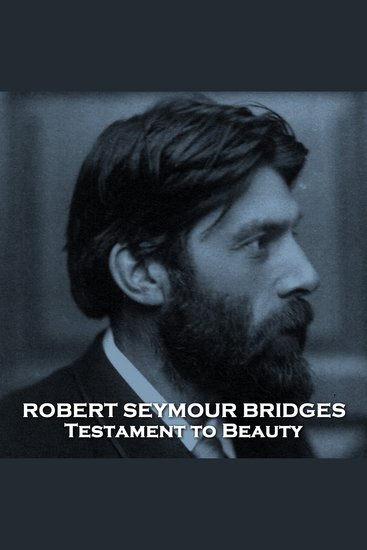
  • Testament to Beauty - A former Poet Laureate demonstrates his poetic talents in this tender and beautiful verse - cover

    Testament to Beauty - A former...

    Robert Seymour Bridges

    • 0
    • 0
    • 0
    Robert Seymour Bridges, OM was born on 23rd October 1844 at Walmer in Kent where he spent his early childhood in a house overlooking the anchoring ground of the British fleet.  
    His father died aged only 47 in 1853. A year later his mother remarried and the family relocated to Rochdale, where his stepfather was the vicar.  
    In 1854 Bridges was sent to Eton College and attended until 1863.  After Eton he went to Corpus Christi College at Oxford. There he became good friends with Gerard Manley Hopkins and would later compile an edition of his poems that is now considered a major contribution to English literature. 
    He graduated from Oxford, in 1867, with a second-class degree in literae humaniores.  Initially he planned to join the Church of England and travelled to the Middle East to broaden his religious horizons.  However, he soon decided that life as a physician would be a better path and, after 8 months studying German (that being the language of many scientific papers at the time) he began his study of medicine at St. Bartholomew's Hospital in 1869.  His long-term ambition was that by the age of forty he could retire from medicine to devote himself to writing. 
    Unfortunately Bridges failed his final medical examinations in 1873 and, as unable to immediately retake the papers, spent six months in Italy learning Italian as well as immersing himself in its art. In July 1874 he went to Dublin to continue his medical studies. Re-examined in December he passed and became a house physician at St Bartholomew's Hospital. It was whilst here that he engaged in a series of highly critical remarks about the Victorian medical establishment. One such was his claim that whilst working as a young doctor he saw a staggering 30,940 patients in one year. 
    A bout of severe pneumonia and lung disease forced his retirement from the medical profession in 1882 and so, slightly ahead of schedule, he began his literary career in earnest.  He already been writing for several years and had published his first poetry collection in 1873.  
    After his illness and a trip to Italy, Bridges moved, with his mother, to Yattendon in Berkshire.  It was during this time, from 1882 to 1904, that Bridges wrote most of his best-known lyrics as well as eight plays and two masques, all in verse.  
    It was also here, in 1884, that he married Monica Waterhouse. They would go on to have three children and spend the rest of their lives in rural seclusion, in an idyllic marriage, first at Yattendon, then at Boars Hill, Oxford. 
    Bridges made an important contribution to hymnody with the publication in 1899 of his Yattendon Hymnal. This collection of hymns became a bridge between the Victorian hymnody of the late 19th century and the modern hymnody of the early 20th century. He was also a chorister at Yattendon church for 18 years. 
    In 1902 Monica and his daughter Margaret became seriously ill with tuberculosis, and a move from Yattendon to a healthier climate was in order. After several temporary homes they moved abroad to spend a year in Switzerland before returning to settle again in England at Chilswell House, which Bridges had designed, and built on Boar's Hill overlooking Oxford University.   
    His greatest achievement though was still some years ahead of him.  The office of Poet Laureate was held by Alfred Austin but with his death it was offered first to Rudyard Kipling, who refused it, and then to Bridges. He was appointed Poet Laureate in 1913 by George V, the only medical graduate to have ever held the office. Bridges, at this time, was neither highly regarded nor well known but a safe pair of hands in a World rapidly being overshadowed by the storms about to erupt over Europe and the First World War. 
    The events of this War, including the wounding of his son, Edward, had a sobering effect on Bridges' poetry. His work became fiercely patriotic. In 1915 edited a volume of prose and poetry, The Spirit of Man, intended to appeal to readers living in war time
    Show book

  • The Color of My Quiet - A Collection Of Poems - cover

    The Color of My Quiet - A...

    Ahaan Duwarah, Hemanandini Deori

    • 0
    • 0
    • 0
    Experience the world in miniature with this collection of sixteen concise and evocative poems. Each piece offers a snapshot of life's quiet moments, exploring themes of nature, reflection, and the human condition with a gentle touch. Perfect for those seeking a brief respite or a moment of thoughtful contemplation, this book offers a unique blend of brevity and depth.
    Show book
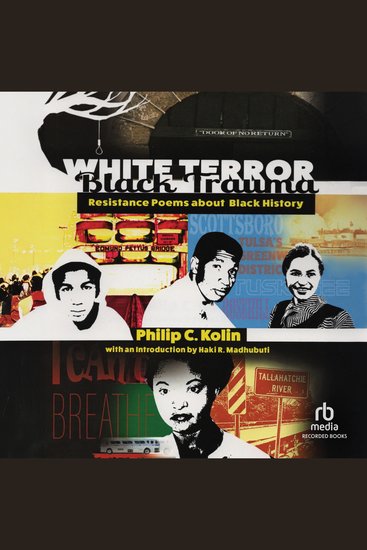
  • White Terror Black Trauma - Resistance Poems About Black History - cover

    White Terror Black Trauma -...

    Philip C. Kolin, Haki R. Madhubuti

    • 0
    • 0
    • 0
    The 61 poems here concentrate on some of the most traumatic events in Black history from colonial to contemporary times, from the arrival of enslaved Africans in 1619 to Black revolts, Civil War atrocities, incalculable lynchings, the Tulsa massacre, the brave sacrifices of Rosa Parks, the Freedom Riders, the heroes of school desegregation, the murders of Emmett Till, Dr. King, Fred Hampton, Malcolm X, Trayvon Martin, Michael Brown, George Floyd, Breonna Taylor, Eric Garner, and Tyre Nichols. And so many other Black tragedies. Each poem here carries a brief head note identifying the person, place, time, or event that addresses the historical context of the poem. Some poems are written in a his/her recollection of the historical event. Above all, each poem highlights the topography of Black trauma, be that a Civil War fort, a lynching tree, a prison, a school, an island, a ghetto, a river, a national monument, a church, or city street. These resistance poems are chronicles, laments, petitions, heroic recollections about racial attacks on Black people in America.
    Show book
  • George Bernard Shaw: MRS WARREN'S PROFESSION - cover

    George Bernard Shaw: MRS...

    George Bernard Shaw

    • 0
    • 0
    • 0
    .Mrs. Warren's Profession is a play written by George Bernard Shaw in 1893, and first performed in London in 1902 but was banned after two performances because of the profession talked about. The play is about a former prostitute, now a madam (brothel proprietor), who attempts to come to terms with her disapproving daughter. It illustrates Shaw's belief that the act of prostitution was not caused by moral failure but by economic necessity. It also has a lot to say about the hypocrisy of English society that profited from many despised and illegal professions and used people in despicable ways but pretended to look down on them. This was probably why it was banned, not because of the 'profession' of Mrs. Warren, but because it exposed very highly placed people doing nasty things to make money
    Show book