Join us on a literary world trip!
Add this book to bookshelf
Grey
Write a new comment Default profile 50px
Grey
Subscribe to read the full book or read the first pages for free!
All characters reduced
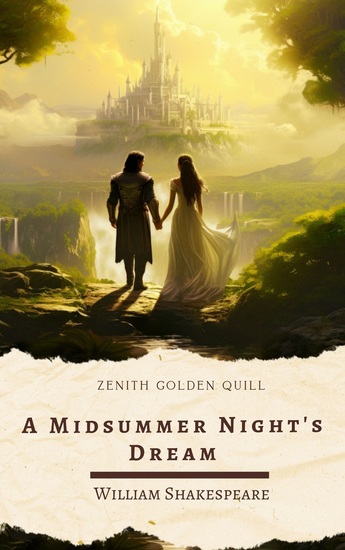
A Midsummer Night's Dream - A Timeless Romantic Comedy Blending Fairies Lovers and Lunacy Under the Moonlight - cover

A Midsummer Night's Dream - A Timeless Romantic Comedy Blending Fairies Lovers and Lunacy Under the Moonlight

William Shakespeare, Zenith Golden Quill

Publisher: Zenith Golden Quill

  • 0
  • 0
  • 0

Summary

🌙 Love bewitched. Magic unleashed. A forest alive with dreams.

In A Midsummer Night's Dream, William Shakespeare crafts a delightful romantic comedy where fantasy and reality collide. Follow a troupe of mismatched lovers, meddling fairies, and bumbling actors as they navigate the tangled woods outside Athens—all under the mischief of the trickster Puck and the enchantment of Oberon and Titania 🧚‍♀️💘.

This edition features full annotations, character guides, and classic illustrations—perfect for students, performers, and fans of literary magic. Whether you're new to Shakespeare or a lifelong admirer, this story's humor and wonder continue to captivate across centuries.

"One of Shakespeare's most beloved and imaginative comedies." — The Globe Theatre
"A joyous celebration of love, chaos, and the human heart." — The Guardian

📘 Click Buy Now to enter a midsummer world where anything is possible—and everything is enchanting.
Available since: 05/22/2025.
Print length: 134 pages.

Other books that might interest you

  • Birth Of America The: The Founding Of Our Nation - A Fascinating Exploration - cover

    Birth Of America The: The...

    One Day University

    • 0
    • 0
    • 0
    Learn from award winning professors in this set of five talks originally delivered at One Day University. Psychology is the scientific study of the mind and behavior, and psychologists are actively involved in studying and understanding mental processes, including brain functions, and behavior. In fact, the field of psychology is considered a "Hub Science" with strong connections to the medical sciences, social sciences, and education. Human nature is a related concept but nevertheless  a bit different, as it  denotes the fundamental dispositions and characteristics—including ways of thinking, feeling, and acting—that humans are said to have naturally.
    Show book
  • How to Fight a War - cover

    How to Fight a War

    Mike Martin

    • 0
    • 0
    • 0
    An indispensable guide to understanding modern warfare, especially the decisions made by politicians and generals?both good and bad. 
     
    Has any war in history gone according to plan? Monarchs, dictators and elected leaders alike have a dismal record on military decision-making, from over-ambitious goals to disregarding intelligence, terrain, or enemy capabilities. This not only wastes the lives of civilians, the enemy and one’s own soldiers, but also fails to achieve geopolitical objectives, and usually lays the seeds for more wars down the line. 
     
    Conflict scholar and former soldier Mike Martin takes the reader through the hard, elegant logic to fighting a conclusive interstate war that solves geopolitical problems, and reduces future conflict. In cool and precise prose, he outlines how to orchestrate military forces, from infantry to information, and from strategy to tactics. 
     
    How to Fight a War explains the unavoidable, yet seemingly elusive, art of using violence to force your enemies to do what you want. It should be read by everyone seeking to understand today’s wars, as well as those wishing to lead us through the coming decades of conflict.
    Show book
  • Threats - Intimidating Someone with Potential Harm - cover

    Threats - Intimidating Someone...

    Cito Harder

    • 0
    • 0
    • 0
    Threats are an inherent part of human interaction and can manifest in various forms. At their core, threats are attempts to instill fear or assert power by creating the perception of potential harm, whether physical, emotional, or psychological. The nature of threats is complex because they exist on a spectrum, ranging from subtle and covert forms of intimidation to overt and aggressive expressions of force. Understanding the nature of threats is essential, as it allows individuals and communities to recognize and respond to them effectively. 
    A threat can be defined as any statement, action, or behavior that creates a sense of fear or danger in another person. It involves the intention to coerce, control, or manipulate someone by presenting the possibility of harm. Threats do not necessarily have to be acted upon for them to have a significant impact; the mere perception of harm can be enough to evoke a response. For instance, the threat of violence—whether verbal, physical, or implied—can lead to significant emotional distress, anxiety, and a shift in one’s behavior, even in the absence of any actual harm being done. This highlights the psychological aspect of threats: the fear and tension they generate are often more powerful than the harm that might actually occur. 
    Threats can be both explicit and implicit. Explicit threats are direct and clear in their intent, such as saying “If you do this, I will hurt you” or “You will pay for this.” These types of threats leave little room for misinterpretation and often provoke an immediate response. Implicit threats, on the other hand, are more subtle and may not directly articulate the intended harm. They may involve hints, body language, or situations that suggest harm without overtly stating it. An example of an implicit threat might be a comment like, “You wouldn’t want something bad to happen, would you?” which leaves the recipient uncertain but still fearful of what may follow.
    Show book
  • Princess Countess Socialite Spy - True Stories of High-Society Ladies Turned WWII Spies - cover

    Princess Countess Socialite Spy...

    Elise Baker

    • 0
    • 0
    • 0
    The Second World War changed the course of modern history. It is filled with incredible stories of daring risks and exceptional struggles, but these stories are more often than not the stories of men. 
    There is, however, a hidden treasure trove of untold stories of heroic women who have risked their lives in the monumental battle against fascism. 
    We’ve heard of women who became nurses treating soldiers with battlefield injuries, partisans who fought occupying armies, and skilled laborers who worked in wartime industries. 
    But in the shadows, as part of a secret war against the Nazis, women served as intelligence agents who risked their lives to collect and relay information vital to the war effort. Danger lurked at every turn. 
    These courageous women spies worked in secret, but their stories, which are finally coming to light today, offer a significant and unique perspective on the history of World War II. 
    You'll learn the thrilling stories of five high-society ladies (Virginia Hall, Christine Granville, Noor Inayat Khan, Nancy Wake and Aline Griffith) who went behind enemy lines to aid the war effort, what motivated them to take such risks, and how these women heroes of WWII helped shape the course and outcome of the most significant war in modern history. 
    You’ll gain insights into why some high-society ladies chose to give up a life of comfort to fight against global tyranny and live under constant threat of exposure and imprisonment or death. 
    If you’re looking for a unique and enlightening view of the Second World War and are interested in women’s historically overshadowed roles in international espionage, then look no further than Princess, Countess, Socialite, Spy.
    Show book
  • In the Skin of a Beast - Sovereignty and Animality in Medieval France - cover

    In the Skin of a Beast -...

    Peggy McCracken

    • 0
    • 0
    • 0
    In medieval literature, when humans and animals meet—whether as friends or foes—issues of mastery and submission are often at stake. In the Skin of a Beast shows how the concept of sovereignty comes to the fore in such narratives, reflecting larger concerns about relations of authority and dominion at play in both human-animal and human-human interactions. Peggy McCracken discusses a range of literary texts and images from medieval France, including romances in which animal skins appear in symbolic displays of power, fictional explorations of the wolf’s desire for human domestication, and tales of women and snakes converging in a representation of territorial claims and noble status. These works reveal that the qualities traditionally used to define sovereignty—lineage and gender among them—are in fact mobile and contingent. In medieval literary texts, as McCracken demonstrates, human dominion over animals is a disputed model for sovereign relations among people: it justifies exploitation even as it mandates protection and care, and it depends on reiterations of human-animal difference that paradoxically expose the tenuous nature of human exceptionalism.
    Show book
  • Archetypes of Human Existence - A New Perspective - cover

    Archetypes of Human Existence -...

    John Mucai

    • 0
    • 0
    • 0
    Out of the more than seven billion people who inhabit the earth, no two are exactly the same. Even tweens have differences. And yet, the behavior of human beings can be reduced to a few archetypes. At the heart of the matter, each human being is one single entity comprised of a mind and a physical body. A mind that yearns for happiness and a body that longs for sustenance. The interplay of these two needs creates the different archetypes of humans. This book explores a few of the archetypes. It discusses how the ideas around archetypes converge to offer a new perspective on fundamental questions that existentialists have been grappling with for ages. The people described in the second chapter of the book are entirely fictitious. Any resemblance of their names to real people is purely coincidental. However, the characters are real and live among us. You may recognize some of them in your local community, your network of friends, or even in other human networks to which you are directly or indirectly connected. 
    Show book