Join us on a literary world trip!
Add this book to bookshelf
Grey
Write a new comment Default profile 50px
Grey
Subscribe to read the full book or read the first pages for free!
All characters reduced
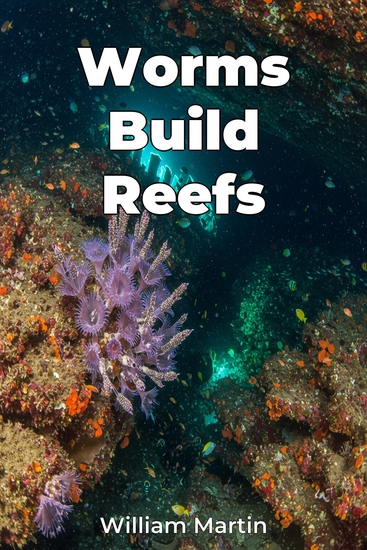
Worms Build Reefs - cover

Worms Build Reefs

William Martin

Translator A AI

Publisher: Publifye

  • 0
  • 0
  • 0

Summary

Worms Build Reefs explores the hidden world of deep-sea ecosystems, focusing on the remarkable reefs constructed by tubeworms. These reefs, found near hydrothermal vents and cold seeps, teem with life despite the absence of sunlight. The book reveals how tubeworms utilize chemosynthesis to convert chemical energy into sustenance, forming the base of complex food webs that support a diverse array of organisms. It highlights the unexpected biodiversity found in these extreme environments, rivaling that of coral reefs.

 
The book details the geological and chemical processes involved in reef formation, illustrating how these structures influence global biogeochemical cycles. It also addresses the threats posed by deep-sea mining and other human activities, emphasizing the urgent need for conservation. The book begins by introducing chemosynthesis and the different types of reef-building tubeworms, then progresses to the factors influencing reef growth and distribution, and concludes with a discussion of conservation strategies. Worms Build Reefs takes a fact-based approach, using visual data, geochemical analyses, and ecological surveys to provide a comprehensive understanding of these unique habitats.

 
This book emphasizes the ecological importance of tubeworm reefs. Ultimately, the book argues that these reefs are crucial components of the deep-sea environment and deserve protection.
Available since: 02/27/2025.
Print length: 61 pages.
Other books that might interest you

  • DCC for Railway Modellers - cover

    DCC for Railway Modellers

    Fiona Forty

    • 0
    • 0
    • 0
    Written in layman's terms, DCC for Railway Modellers gives an in-depth overview of Digital Command and Control.
    Informed by the author's extensive knowledge of DCC and model layouts, this book will give both the novice and experienced modeller a comprehensive breakdown of DCC and model railway standards.
    covering topics such as: The history of DCC, Components of DCC, Decoders – DCC, Sound and Function,  Fitting decoders, Layout design considerations and wiring and Troubleshooting
    Show book
  • Summary: The Myth of Normal - Trauma Illness and Healing in a Toxic Culture By Gabor Maté MD & Daniel Maté: Key Takeaways Summary & Analysis - cover

    Summary: The Myth of Normal -...

    Brooks Bryant

    • 0
    • 0
    • 0
    DISCLAIMER: THIS IS NOT THE OFFICIAL BOOK. 
    This is a summary, & it does not accompany the official 
    In 'The Myth of Normal: Trauma, Illness, and Healing in a Toxic Culture,' renowned physician Gabor Maté explores the alarming rise of chronic illness and poor health in Western societies. He challenges the conventional definition of 'normal' health, revealing how trauma, stress, and the pressures of modern life negatively impact our physical and mental well-being. Drawing on four decades of clinical experience, Maté uncovers the shortcomings of Western medicine and its failure to address the holistic health of individuals. Co-authored with his son Daniel, this groundbreaking book connects the dots between individual maladies and society's overall decline in well-being, offering a compassionate guide for healing.
    Show book
  • Echoes From the Deep - The Lusitania Disaster Between Wartime Actions And Wrong Decisions - cover

    Echoes From the Deep - The...

    Davis Truman

    • 0
    • 0
    • 0
    On May 1, 1915, the majestic RMS Lusitania departed from New York, bound for Liverpool, navigating through the escalating tensions of a war-torn Europe. Just six days later, the Cunard liner met a tragic fate, sinking into the depths of the Atlantic after being struck by a German torpedo. The catastrophe claimed the lives of over a thousand passengers, sending shockwaves across the world and profoundly influencing the American stance on World War I. 
    At the heart of this investigation lies a provocative thesis: the tragic loss of life on the Lusitania was not merely a consequence of wartime hostilities but was exacerbated by decisions and actions that could have been averted. Through detailed analysis, the book questions the accountability of the captain and crew, challenging readers to reconsider the extent to which their actions — or inactions — contributed to the disaster. 
    But this story is not confined to the ill-fated ship alone. "Echoes From the Deep" also examines the broader ramifications of the Lusitania's sinking on American public opinion. The tragedy stirred a powerful emotional response, turning the tide of sentiment and drawing the United States closer to joining the global conflict.  
    Blending historical rigor with compelling storytelling, "Echoes From the Deep" explores tragedy, responsibility, and the complex interplay between individual actions and larger historical forces. This book is essential for history enthusiasts, maritime scholars, and anyone intrigued by the profound impact of the Lusitania disaster on the American war effort.
    Show book
  • Structuring Inequality - How Schooling Housing and Tax Policies Shaped Metropolitan Development and Education - cover

    Structuring Inequality - How...

    Tracy L. Steffes

    • 0
    • 0
    • 0
    How inequality was forged, fought over, and forgotten through public policy in metropolitan Chicago. As in many American metropolitan areas, inequality in Chicagoland is visible in its neighborhoods. These inequalities are not inevitable, however. They have been constructed and deepened by public policies around housing, schooling, taxation, and local governance, including hidden state government policies.In Structuring Inequality, historian Tracy L. Steffes shows how metropolitan inequality in Chicagoland was structured, contested, and naturalized over time even as reformers tried to change it through school desegregation, affordable housing, and property tax reform. While these efforts had modest successes in the city and the suburbs, reformers faced significant resistance and counter-mobilization from affluent suburbanites, real estate developers, and other defenders of the status quo who defended inequality and reshaped the policy conversation about it. Grounded in comprehensive archival research and policy analysis, Structuring Inequality examines the history of Chicagoland’s established systems of inequality and provides perspective on the inequality we live with today.
    Show book
  • Quantum Time : Across Multiverses and Particle Realities - A Door to a New Understanding - cover

    Quantum Time : Across...

    Ecnal Ver

    • 0
    • 0
    • 0
    What If Time Is Not What We Think? 
    What if everything you have been taught about time is wrong? What if time does not move in one steady line, the same for everyone, but instead bends, shifts, or even disappears depending on where you are in the universe? Quantum Time takes you on a fascinating journey into the strange world of quantum physics to explore one of the greatest mysteries of existence: time itself. 
    Time in Daily Life vs. the Quantum World 
    In everyday life, time feels simple. Seconds tick forward. Clocks keep us on schedule. We grow older. But in the quantum world, none of this is guaranteed. At the smallest scale of reality, time may not even exist the way we think it does. Instead, it may be something that only appears when particles interact, a fragile construct that changes depending on the universe or multiverse you are in. 
    A Radical New View of Time 
    This audiobook challenges the traditional idea that time is an absolute force. Instead, it presents a bold new view. Time may be local, appearing only through the behavior and arrangement of particles. That means different regions of the cosmos or even parallel universes could each experience time in completely different ways. In some cases, time may even loop, pause, or move backward. 
    Where Physics Meets Consciousness 
    From black holes to quantum entanglement, Quantum Time explores how the deepest mysteries of physics connect with human consciousness and reality. It asks whether the mind itself may play a role in shaping how we experience past, present, and future. 
    An Invitation to Rethink Reality 
    If you are fascinated by science, philosophy, or metaphysics, Quantum Time offers a thought-provoking journey that will forever change the way you see the ticking clock.
    Show book
  • Younger Dryas Period The: The History of the Earth’s Drastic Climate Change at the End of the Pleistocene Era - cover

    Younger Dryas Period The: The...

    Editors Charles River

    • 0
    • 0
    • 0
    From about 12,900 to 11,700 before present (BP), near Ice Age conditions returned to the Northern Hemisphere of the planet. It was a sudden shift from the warm temperatures that had prevailed for nearly 2,000 years. This period is referred to by archaeologists, geologists, and earth scientists as the Greenland Stadial, but it is more commonly known as the Younger Dryas. The Younger Dryas marked the end of the last glacial period, the end of the Pleistocene Era, and the beginning of the Holocene Era, which is the current era. It was a period of great change, when climate change happened quite quickly, directly affecting the flora, fauna, and humans of the Northern Hemisphere in the process. The impact on the human populations was perhaps most important because, in some places, it virtually destroyed emerging cultures, while in other places, it might have propelled humans to develop new survival traits and technologies later used to move humanity into the Neolithic era. Although scholars now know quite a bit about the Younger Dryas, many elements of it are still debated. Other aspects serve as a predictor of what humans can expect in the future. 
    	There is, however, still plenty of information about the Younger Dryas that remains unknown or open to debate. Not all scholars agree on the dates of the Younger Dryas or how long it lasted. Even more controversial are the alternate theories about what caused the Younger Dryas and the effect it had on the Northern Hemisphere’s bio-populations. This book examines the background of the Younger Dryas, its effects on bio-populations, and how it contributed to the emergence of the Neolithic Era. Alternative theories will be examined and compared to more standard ideas currently prevailing in academia.
    Show book