Join us on a literary world trip!
Add this book to bookshelf
Grey
Write a new comment Default profile 50px
Grey
Subscribe to read the full book or read the first pages for free!
All characters reduced
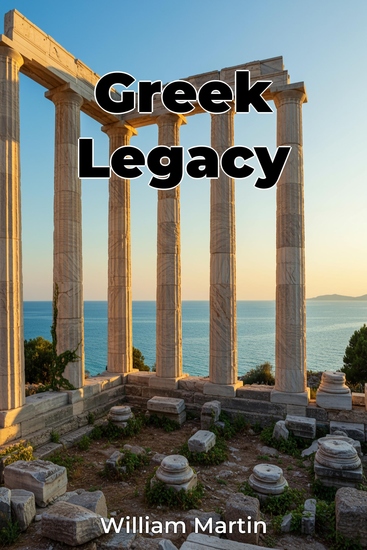
Greek Legacy - cover

Greek Legacy

William Martin

Translator A Ai

Publisher: Publifye

  • 0
  • 0
  • 0

Summary

Greek Legacy explores the enduring influence of ancient Greece on Western Civilization, focusing on philosophy, politics, and science. It argues that Greece provided both the initial spark and continuous inspiration for Western thought. The book examines how Greek innovations such as Athenian Democracy shaped modern governance and how figures like Euclid revolutionized mathematics.

 
The book progresses chronologically, beginning with the Bronze Age and continuing through the Roman period. It analyzes primary sources like Plato and Aristotle, along with archaeological findings, to understand Greek contributions. Intriguingly, Greek political systems evolved from monarchy to democracy, influencing modern governance, and their scientific advancements laid the groundwork for future discoveries.

 
Structured into three sections, the book covers the socio-political context, political innovations, and scientific achievements of ancient Greece. It reveals how key philosophical concepts emerged and how Greek advancements in astronomy and medicine continue to impact modern practices. This approach offers a holistic view of Greek influence, providing a deeper understanding of Western civilization's roots.
Available since: 03/20/2025.
Print length: 57 pages.

Other books that might interest you

  • The Cold Case Foundation - How a Team of Experts Solves Murders and Missing Persons Cases - cover

    The Cold Case Foundation - How a...

    Thomas McHoes, Gregory M. Cooper

    • 0
    • 0
    • 0
    When Gregory M. Cooper, former head of the FBI's Behavioral Sciences Unit, founded the Cold Case Foundation in 2013, he had high expectations, but couldn't anticipate the level of response. What started with just a half-dozen or so retired FBI agents and homicide detectives has ballooned to more than 150 women and men who volunteer their time to help families of deceased or missing loved ones bring closure to cases that have gone "cold." 


    The Cold Case Foundation shares riveting and rewarding cases the Foundation has helped solve, from high-profile missing persons cases to decades-old murders. The Cold Case Foundation has contributed to the solving of dozens of cases and is helping hundreds more homicide and missing persons investigations move forward. Police departments and victims' families from throughout the country have been supported by the Foundation's services, which are more than welcome for investigators that are increasingly finding themselves with fewer resources to dedicate to the most difficult cases. 


    The Cold Case Foundation covers not only the investigative approaches the Foundation's investigators employ and recommend, but also the principles and activities that help communities and law enforcement agencies come together to help solve cases that, for whatever reason, have gone unsolved—until now.
    Show book
  • Drained by the Pool Boy (Gay Alpha Male Erotica) - cover

    Drained by the Pool Boy (Gay...

    Archer Vale

    • 0
    • 0
    • 0
    “I'll help you sink deeper. I’ll help you understand what you need.” 
    His tight, powerful physique calls out to me. He says this is called “body worship”. 
    I hired him to be my pool boy, but he’s taking control of my life. I know this is a trap…he’s using me for my money. 
    But he makes me feel so weak… 
    He tells me I need to serve men. He makes me get on the ground and pretend to be a pony. He makes me wear his ex-girlfriend’s underwear. 
    It all feels so dirty…but I’m addicted now. 
    I need this. 
    --- 
    CONTAINS EXPLICIT GAY SEXUAL CONTENT. 
    For exclusive stories, visit www.ArcherVale.com.
    Show book
  • Discourse on Inequality - cover

    Discourse on Inequality

    Jean Jacques Rousseau

    • 0
    • 0
    • 0
    "Discourse on Inequality" by Jean-Jacques Rousseau explores the origins and effects of social inequality. Rousseau reflects on the evolution of human societies, arguing that inequality arises from the development of private property and the establishment of civil society. He critiques the impact of civilization on human virtue and freedom, advocating for a return to a more natural and egalitarian state. The discourse delves into philosophical reflections on the nature of humanity, societal structures, and the pursuit of a just and harmonious existence. Read in English, unabridged.
    Show book
  • What We Owe the Future: Book Summary & Analysis - cover

    What We Owe the Future: Book...

    Briefly Summaries

    • 0
    • 0
    • 0
    This is a concise summary and analysis of What We Owe the Future, by William MacAskill.
     
    It is not the original book and is not affiliated with or endorsed by William MacAskill.
     
    Ideal those seeking a quick and insightful overview.
     
    What We Owe the Future is a profound exploration of humanity's moral responsibility to future generations. This thought-provoking work delves into the long-term impact of our choices on the world, urging readers to consider the ethical implications of progress, technology, and the preservation of civilization. With a focus on the principles of longtermism, the book challenges us to act today to ensure a flourishing tomorrow, blending rigorous philosophy with compelling insights into practical action. It’s a call to reshape our priorities and redefine what it means to leave a meaningful legacy.
    Show book
  • NATO in Afghanistan - Fighting Together Fighting Alone - cover

    NATO in Afghanistan - Fighting...

    David P. Auerswald, Stephen M....

    • 0
    • 0
    • 0
    Modern warfare is almost always multilateral to one degree or another, requiring countries to cooperate as allies or coalition partners. Yet as the war in Afghanistan has made abundantly clear, multilateral cooperation is neither straightforward nor guaranteed. Countries differ significantly in what they are willing to do and how and where they are willing to do it. Some refuse to participate in dangerous or offensive missions. Others change tactical objectives with each new commander. Some countries defer to their commanders while others hold them to strict account.NATO in Afghanistan explores how government structures and party politics in NATO countries shape how battles are waged in the field. Drawing on more than 250 interviews with senior officials from around the world, David Auerswald and Stephen Saideman find that domestic constraints in presidential and single-party parliamentary systems--in countries such as the United States and Britain respectively--differ from those in countries with coalition governments, such as Germany and the Netherlands. As a result, different countries craft different guidelines for their forces overseas, most notably in the form of military caveats, the often-controversial limits placed on deployed troops. Providing critical insights into the realities of alliance and coalition warfare, NATO in Afghanistan also looks at non-NATO partners such as Australia, and assesses NATO's performance in the 2011 Libyan campaign to show how these domestic political dynamics are by no means unique to Afghanistan.
    Show book
  • Gladiators - History and Background of Roman Slave Fighters - cover

    Gladiators - History and...

    Kelly Mass

    • 0
    • 0
    • 0
    Gladiators were highly trained warriors who fought to the death for the entertainment of the Roman public. These brutal battles took place in large arenas throughout the Roman Republic and Empire, where gladiators would engage in combat with other fighters, wild animals, or even condemned criminals. The fights were often bloody and merciless, designed to showcase the might and martial prowess of the Roman world. While some gladiators volunteered, seeking fame and fortune in the arena, many were slaves or prisoners of war who were forced to fight. 
    The life of a gladiator was harsh and dangerous. Those who entered the arena did so at great personal risk, as their fights often meant risking their lives for the entertainment of the masses. Even voluntary gladiators, known as "auctorati," gambled with their personal safety and social standing. They had little to no rights and were subject to the whims of their owners or sponsors. Gladiators who survived and fought well could gain fame and admiration, but their lives were fraught with physical injury and emotional isolation. The training they underwent was grueling, often conducted in harsh conditions at special training schools known as "ludi," where they were forced to endure relentless drills and punishments. 
    Gladiators were not only fighters but also symbols of Roman martial virtues. Through their valor and resilience in the arena, they represented Rome's ideals of strength, honor, and discipline. Their performances were often immortalized in Roman art and artifacts, with their images appearing on coins, pottery, and sculptures. Despite the grim nature of their lives, gladiators could gain popular admiration for their ability to fight bravely or die with honor. Some even became beloved figures in Roman culture, celebrated in both elite and everyday art.
    Show book