Join us on a literary world trip!
Add this book to bookshelf
Grey
Write a new comment Default profile 50px
Grey
Subscribe to read the full book or read the first pages for free!
All characters reduced
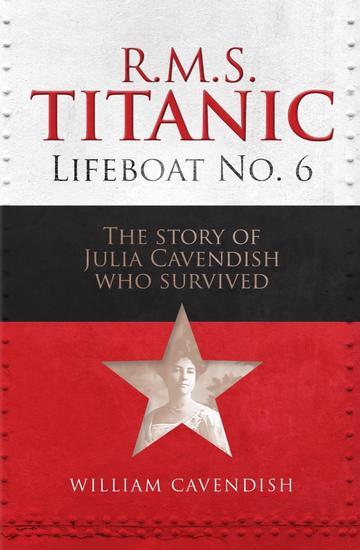
RMS Titanic Lifeboat No 6 - The Story of Julia Cavendish who Survived - cover

RMS Titanic Lifeboat No 6 - The Story of Julia Cavendish who Survived

William Cavendish

Publisher: Unicorn

  • 0
  • 0
  • 0

Summary

Tyrell and Julia booked to travel on the Titanic with their two sons to introduce them to their American grandfather, but the children were too ill to travel. Julia persisted in going without them. The fatal and tragic decision not only led to the unnecessary loss of her husband, it was to haunt her for the next fifty years. Why was she so determined to go? In a letter written to her sons, as her death approached, she claimed the purpose of the visit was 'to gain her wealthy father's support for his son-in-law's ambition to stand as a Member of Parliament.' Yet Tyrell had shown no enthusiasm for making the journey, as Julia had already made the trip alone, the previous year quite safely. From the Carpathia Julia cabled her father, Henry Siegel, to have clothes from his department stores ready for the Titanic's survivors. In 1992 and 2002 her son and grandson learnt from chance encounters with New Yorkers of Julia's father's shocking fall from grace, the grandfather who owned a famous department store with a 'soda fountain meeting place'. Now can be revealed the true reason for her mission.
Available since: 09/06/2024.
Print length: 112 pages.
Other books that might interest you

  • Feminism in the Wild - How Human Biases Shape Our Understanding of Animal Behavior - cover

    Feminism in the Wild - How Human...

    Melina Packer, Ambika Kamath

    • 0
    • 0
    • 0
    In Feminism in the Wild, Ambika Kamath and Melina Packer reveal how scientists studying animal behavior have long projected human norms and values onto animals while seeking to understand them. When scientific studies conclude that these norms and values are natural in animals, it makes it easier to think of them as natural in humans too. And because scientists, historically and to this day, largely belong to elite, powerful segments of society, the norms and values embedded into animal behavior science match those of the already powerful. How can animal behavior science escape this trap of naturalizing dominant culture? 


    Drawing from decades of feminist, antiracist, queer, disability justice, and Marxist contributions—including those of biologists—Kamath and Packer break down persistent assumptions in the status quo of animal behavior science and offer a multitude of alternative approaches. Core concepts in animal behavior science and evolutionary biology are carefully contextualized and critically reexamined. This unique collaboration between an animal behavior scientist and a feminist science studies scholar is an illuminating and hopeful book for anyone who is curious about how animals behave, and anyone who wants to break free from scientific approaches that perpetuate systems of oppression.
    Show book
  • The Dhammapada Vol 4 - The Way of the Buddha - cover

    The Dhammapada Vol 4 - The Way...

    Osho

    • 0
    • 0
    • 0
    The Dhammapada is a collection of sayings of the Gautama the Buddha in verse form and one of the most widely read and best known Buddhist scriptures. This is volume four of a 12-volume series of Osho Talks, where Osho brings Buddha's Dhammapada into the 21st century, opening them for a new understanding for contemporary mankind.
    In alternating chapters, Osho comments on specific sutras of Buddha and responds to questions from his audience, deepening the understanding of these timeless works. "My talking on Buddha is not just a commentary: It is creating a bridge. Buddha is one of the most important masters who has ever existed on the Earth - incomparable, unique."
    The setting of these talks is an open-air auditorium at the Osho International Meditation Resort in Pune, India. Osho and his audience sit surrounded by trees, and the elements of nature - the chirping of birds, wind, and the cracking bamboos as well as the distant sound of the local Pune-Mumbai morning train - are all parts of these recordings and give them a truly existential flavor.
    Osho employs his penetrating insight and wonderful humor to remove the dust of many misunderstandings gathered on Buddha's teachings and again emphasizes meditation over dogma, meditation being Buddha's greatest contribution to the development of human consciousness.
    "Buddha transformed the word meditation. Meditation had always been something of the mind, and Buddha brought a new quality, so totally new, diametrically opposite to the old meaning: He said meditation means a state of no mind. It is not concentration; it is not contemplation. It is not thinking; it is not thinking about God. It is not even prayer, because thinking is of the head, intellectual; prayer is emotional. That is another side of the head, not very far away from it - a different language used by another part of the head."
    Osho Talks are "meditating talks", allowing the listener an experience of meditation. "These words of Buddha come from eternal silence. They can reach you only if you receive them in silence."
    Chapters:
    
    - Better than a Hundred Years
    - The Highest Flower of Creativity
    - There Is No Hell
    - Truth Is Always Very Simple
    - Dust Thrown against the Wind
    - The Great Gift of Life
    - See Yourself in Others
    - The Ultimate Luxury
    - Awake to the Law
    - Aes Dhammo Sanantano
    © & ℗ 1979 OSHO International Foundation
    Show book
  • Aastha Khanna - cover

    Aastha Khanna

    Rekha Balakrishna

    • 0
    • 0
    • 0
    Sex on sets: India's first intimacy coordinator, Aastha Khanna, wants to create a safe space for performers
    Show book
  • The Constitution of the United States of America - cover

    The Constitution of the United...

    James Madison, Alexander...

    • 0
    • 0
    • 0
    Experience the foundation of American democracy in The Constitution of the United States, brought to life through the powerful narration of Gary Middleton. Written in 1787 by the James Madison, Alexander Hamilton, and John Jay, this defining document established the framework for the world’s first enduring republic — outlining the balance of powers, the rights of the people, and the principles of liberty that continue to guide the nation today. 
    More than a historical artifact, The Constitution is a living testament to the American experiment — a blueprint for self-governance, justice, and unity. This audiobook invites listeners to reflect on the words that have shaped over two centuries of freedom and debate. 
    Perfect for students, historians, educators, and anyone who wishes to better understand the foundation upon which the United States was built.
    Show book
  • Gender Swap 5 Book Bundle Volume 2 - cover

    Gender Swap 5 Book Bundle Volume 2

    Kinky Press

    • 0
    • 0
    • 0
    Five Gender Swapping Stories, One Hot Bundle! 
      
    Swapped and Toyed With: 
    Dear Husband has been a bad boy. 
    He’s been very demanding of his good little housewife and her body, and now Erica fed up with his calloused attentions. 
      
    Swapped and Tag Teamed: 
    The world is waking up to bits and pieces where they don’t belong. 
    Greg pulls down his boxers in the morning to use the bathroom he gets the surprise of a lifetime, he runs back into the bedroom where he sees the covers around his wife’s lower body raised in a way that he is very familiar with, just not around the body of his wife! 
      
    Swapped at College: 
    Alex is flunking science, and he’ll fail out of college if he doesn’t get his act together soon. His professor helps him create a ‘swap chemical’ that turns male mice into females. Then Alex accidentally drinks it … and turns into a beautiful young woman! 
      
    Swapped for the Beast: 
    Young Prince Thomas is a spoilt brat.  
    As punishment for his behavior he is sold to the cruel Earl to cook and clean and be his loyal servant. 
      
    Swapped for the Duke: 
    Does he have the assets to please the Duke? 
    Young Elliot doesn’t do much but cook and clean for his cruel, uncaring stepfather and oblivious, bimbo stepsisters. All he wants is to leave this place and start a new life somewhere—to be special to someone.
    Show book
  • The Science of Mummification - Techniques and Secrets Revealed - cover

    The Science of Mummification -...

    Omar Khalil

    • 0
    • 0
    • 0
    Mummification, the art and science of preserving bodies after death, has fascinated both historians and scientists for centuries. In ancient Egypt, mummification was not merely a process of preservation but also a vital part of the culture’s religious beliefs. The Egyptians believed in an afterlife, where the soul would continue to exist in a parallel realm. The preservation of the body was considered essential for the soul’s journey, as it would serve as a vessel for the soul's return. This chapter delves into the origins and purpose of mummification, shedding light on the techniques that evolved over millennia. 
    The practice of mummification is believed to have begun around 3500 BCE, initially as a natural process. Early Egyptians buried their dead in shallow graves in the hot, dry desert sands. The dry conditions naturally desiccated the bodies, preserving them for years or even centuries. However, as Egyptian society developed and religious beliefs became more complex, the need for a more deliberate and refined method of preservation emerged. Over time, the Egyptians developed techniques to prevent decomposition, ensuring that the deceased would be preserved for the afterlife. 
    Mummification’s primary purpose was to ensure the deceased’s body remained intact for the soul’s journey to the afterlife. Ancient Egyptians believed that the body was necessary for the soul to recognize and reunite with the deceased in the next world. The process, therefore, was not just about keeping the body intact; it was about ensuring the deceased's spiritual well-being. Alongside the physical mummification process, elaborate burial rituals were performed, including the offering of food, goods, and prayers to help guide the deceased through the afterlife.
    Show book