Join us on a literary world trip!
Add this book to bookshelf
Grey
Write a new comment Default profile 50px
Grey
Subscribe to read the full book or read the first pages for free!
All characters reduced
The Philosophy of Shelley's Poetry - cover

The Philosophy of Shelley's Poetry

William Butler Yeats

Publisher: Edizioni Aurora Boreale

  • 0
  • 0
  • 0

Summary

William Butler Yeats (1865-1939) was an Irish poet, dramatist, writer and initiate, and one of the foremost figures of 20th-century literature. He was a driving force behind the Irish Literary Revival, and along with Lady Gregory founded the Abbey Theatre, serving as its chief during its early years. He was awarded the 1923 Nobel Prize in Literature, and later served two terms as a Senator of the Irish Free State.
Considered one of the key English-language poets, Yates was a Symbolist, using allusive imagery and symbolic structures throughout his career. He chose words and assembled them so that, in addition to a particular meaning, they suggest abstract thoughts that may seem more significant and resonant. His use of symbols is usually something physical that is both itself and a suggestion of other, perhaps immaterial, timeless qualities.
The Yeats’ essay The Philosophy of Shelley's Poetry, written in 1900, was included in 1903 in the collection of Yeats’ non-fiction works and essays Ideas of Good and Evil, published in London by A.H. Bullen.
It is one of the great Irish author's masterpieces of literary criticism. In it Yeats does not limit himself to analyzing the magic, charm and philosophy of Percy Bysshe Shelley's poetry, but also manages to read these characteristics through his profound knowledge of symbols and archetypes, derived from his lifelong membership of The Hermetic Order of the Golden Dawn, a secret society dedicated to the study and practice of occult Hermeticism and metaphysics.
Available since: 05/27/2024.

Other books that might interest you

  • Chilling Secrets Behind Emperor's Downfall You Never Knew - "Dive into riveting audio insights about the Emperor's secrets for an engaging and transformative journey!" - cover

    Chilling Secrets Behind...

    Sullivan Hartwick

    • 0
    • 0
    • 0
    Chilling Secrets Behind Emperor's Downfall You Never Knew 
    ⭐⭐ A Simplified Guide & Explanations Included ⭐⭐ 
    Are you eager to enhance your understanding of historical events and uncover the hidden narratives that shaped emperors' downfalls? 
    Searching for a thorough guide that encompasses all essential elements to unravel these chilling secrets? 
    Look no further! 
    This guide is your ultimate companion for deepening your insights, applying critical thinking, and engaging in enlightening discussions. With this resource in hand, you're set for a successful exploration. 
    Updated for the latest historical analyses and interpretations. 
    Key features of this enriching guide: 
    - Profound insights into the hidden narratives surrounding emperors' downfalls 
    - Detailed explanations of significant historical events and figures 
    - Effective strategies for understanding and analyzing historical contexts 
    Our guide stands out through comprehensive coverage, which is crucial for your exploration of these historical secrets. We delve into concepts with accuracy and depth, ensuring that they are thoroughly understood. 
    Crafted with a clear structure and accessible language, our guide guarantees seamless transitions between topics. Bid farewell to convoluted terminology and embrace content that is clear, precise, and factually accurate. 
    So, why hesitate? Click the BUY NOW button, secure your guide, and embark on your journey to uncover the chilling secrets behind emperors' downfalls! 
    Start your enlightening journey today!
    Show book
  • Beyond The Brain - Re-Thinking Epilepsy Diagnosis And Treatment Through The Mind-Body Connection - cover

    Beyond The Brain - Re-Thinking...

    Brittany Forrester

    • 0
    • 0
    • 0
    This book takes a deep dive into the intricate world of epilepsy, encompassing its diagnoses, treatment, and scholarly exploration with a keen critical eye. Its primary mission is to present a compelling argument, challenging the prevailing biomedical approach's narrow focus on the brain as the sole locus of intervention for epilepsy. By doing so, it underscores that such an exclusive perspective falls short of addressing the multidimensional needs of individuals living with epilepsy and comprehending their profound lived experiences. 
    In response to this critical shortfall, it proposes a radical departure from the conventional reliance on pharmaceuticals and biological pathways. This innovative approach promises to unveil novel treatments and foster a holistic understanding of the human body's intricacies. By transcending the current biomedical boundaries, this approach has the power to alleviate the suffering of the estimated 70 million people worldwide who grapple with epilepsy.  
    This book represents a beacon of hope and a new era of enlightenment in epilepsy care, potentially significantly enhancing the quality of life for countless individuals affected by this condition.
    Show book
  • Kingdom of Israel The: The History of the United Jewish Kingdom and Its Demise - cover

    Kingdom of Israel The: The...

    Editors Charles River

    • 0
    • 0
    • 0
    Before any type of unified political entity named Israel existed, the Jewish groups whose descendants would later form Israel identified themselves by their particular tribe. If asked their nationality or country of origin, they would likely identify themselves as Danites (from the tribe of Dan; Ex. 31:6) or Ephraimites (from the tribe of Ephraim; Judg. 12:5), etc. The main way to differentiate these tribes from other tribes in Canaan was their common worship of the deity YHWH, but in terms of language or other cultural characteristics, it would have been difficult to tell a Canaanite from an Israelite. 
    Eventually, these separate tribes united together as a type of confederation, allies who made a treaty (covenant) to provide military aid for one another when threatened by an enemy state. But it was only under the charismatic leadership of David that the 12 tribes united into a single political entity. Scholars refer to the period encompassing the reign of David and his son Solomon as the United Monarchy. This period, spanning only two generations, was the only time when all of the tribes were politically united, and after a contentious schism that resulted because the northern tribes felt exploited by the Judean kings, the northern tribes seceded from the “United Kingdom” and reverted back to the ancient northern versus southern division of the tribes. The main difference this time was that the southern kingdom now incorporated the tribe of Benjamin, located at the border between these two new nations, within its political borders. The tribe of Simeon (south of Judah) had already ceased to maintain a separate existence (see below). The new northern kingdom adopted the name Israel, while the southern kingdom took their regional name of Judah.
    Show book
  • Polysecure Love: Secrets to Thriving Relationships and Healing - "Unlock thriving relationships! Discover transformative lessons to enhance your love life and foster healing" - cover

    Polysecure Love: Secrets to...

    Harrison Loxley

    • 0
    • 0
    • 0
    Polysecure Love: Secrets to Thriving Relationships and Healing 
    Are you eager to deepen your connections and foster healing in your relationships?  
    Searching for an in-depth guide that equips you with the knowledge needed to navigate love successfully? 
    Your journey begins here! 
    This audiobook serves as your ultimate companion for enhancing your understanding, applying your insights, and practicing transformative exercises for thriving relationships. With this, you are set for success. 
    Updated to reflect the latest insights in relationship dynamics and healing. 
    Key Features of This Enhanced Audiobook: 
    - Invaluable insights on cultivating secure and loving relationships 
    - Comprehensive explanations of polysecure love concepts 
    - Effective strategies for relationship preparation and resilience 
    Our guide stands out through its thorough coverage, essential for your relational growth. Concepts aren't just touched upon; they are explored with depth and clarity. 
    Please note that this audiobook is an independent resource and is not affiliated with any official relationship framework. 
    Crafted with a straightforward structure and accessible language, the *Polysecure Love* audiobook guarantees seamless transitions between topics. Say farewell to complicated jargon and embrace clear, concise, and insightful content. 
    So, why delay? Click the BUY NOW button, secure your audiobook, and embark on your journey to thriving relationships and healing! 
    Begin your path to understanding and healing today!
    Show book
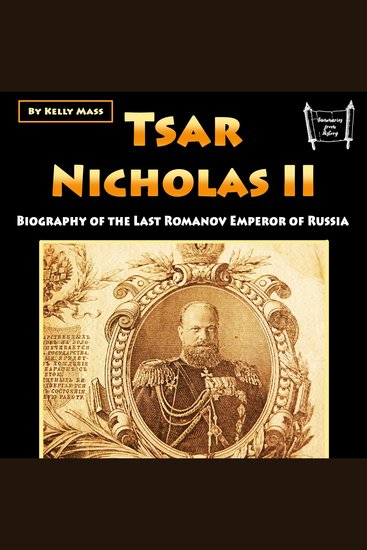
  • Tsar Nicholas II - Biography of the Last Romanov Emperor of Russia - cover

    Tsar Nicholas II - Biography of...

    Kelly Mass

    • 0
    • 0
    • 0
    Nicholas II, or Nikolai II Alexandrovich Romanov (18 May [O.S. 6 May] 1868 – 17 July 1918), was the last Emperor of Russia, reigning from 1 November 1894 to 15 March 1917. Revered as Saint Nicholas the Passion-Bearer in the Russian Orthodox Church, he also held the titles of King of Congress Poland and Grand Duke of Finland. His reign marked the end of the Romanov dynasty's 304-year rule over Russia. Though Nicholas supported economic and political reforms proposed by his prime ministers, Sergei Witte and Pyotr Stolypin, his adherence to authoritarianism and reluctance to empower the Duma stymied significant progress. His reign was further undermined by aristocratic resistance and military defeats during the Russo-Japanese War and World War I, which eroded public confidence in his leadership. 
    Internationally, Nicholas sought to bolster Russia's position through alliances and diplomatic agreements. He signed the Anglo-Russian Convention of 1907, aiming to counter German influence in the Middle East and end the longstanding Great Game rivalry with Britain. Earlier, he had initiated the Hague Convention of 1899, a pioneering but ultimately unsuccessful effort to promote disarmament and peaceful conflict resolution. These measures were part of his broader vision to solidify the Franco-Russian Alliance and strengthen Russia's global standing. 
    Domestically, however, Nicholas' reign was plagued by crises and controversies. He faced widespread criticism for his government's repressive policies, particularly during moments of significant unrest. The Khodynka Tragedy, a catastrophic stampede at his coronation celebrations, set a grim tone for his rule. His apparent complicity in anti-Jewish pogroms, the violent crackdown on Bloody Sunday in 1905, and the brutal suppression of the Russian Revolution that same year further tarnished his reputation.
    Show book
  • How Fascism Works: Book Summary & Analysis - cover

    How Fascism Works: Book Summary...

    Briefly Summaries

    • 0
    • 0
    • 0
    This is a concise summary and analysis of How Fascism Works, by Jason Stanley.
     
    It is not the original book and is not affiliated with or endorsed by Jason Stanley.
     
    Ideal those seeking a quick and insightful overview.
     
    How Fascism Works offers a penetrating examination of the mechanisms that fascist ideologies employ to seize and maintain power. With historical examples and contemporary insights, this book dissects the tactics of propaganda, division, and fear, revealing how these strategies exploit societal vulnerabilities to undermine democracy and promote authoritarianism. It is an essential guide for understanding the warning signs and combating the resurgence of fascist tendencies in the modern world.
    Show book