Rejoignez-nous pour un voyage dans le monde des livres!
Ajouter ce livre à l'électronique
Grey
Ecrivez un nouveau commentaire Default profile 50px
Grey
Abonnez-vous pour lire le livre complet ou lisez les premières pages gratuitement!
All characters reduced
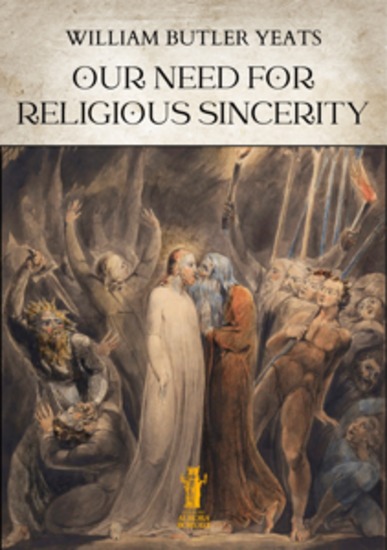
Our Need for Religious Sincerity - cover

Our Need for Religious Sincerity

William Butler Yeats

Maison d'édition: Edizioni Aurora Boreale

  • 0
  • 0
  • 0

Synopsis

William Butler Yeats (1865-1939) was an Irish poet, dramatist, writer and initiate, and one of the foremost figures of 20th-century literature. He was a driving force behind the Irish Literary Revival, and along with Lady Gregory founded the Abbey Theatre, serving as its chief during its early years. He was awarded the 1923 Nobel Prize in Literature, and later served two terms as a Senator of the Irish Free State.
Considered one of the key English-language poets, Yates was a Symbolist, using allusive imagery and symbolic structures throughout his career. He chose words and assembled them so that, in addition to a particular meaning, they suggest abstract thoughts that may seem more significant and resonant. His use of symbols is usually something physical that is both itself and a suggestion of other, perhaps immaterial, timeless qualities.
The Yeats’ short essay Our Need for Religious Sincerity, which today we propose to our readers, was published in 1926 in the magazine The Criterion. Of it Yeats wrote: «The Irish periodical, which has hitherto published my occasional comments on Irish events, explained that this essay would endanger its existence. I have therefore sought publication elsewhere». It is, in fact, a ruthless and biting criticism of the hypocrisy and false moralism of Irish society of that time and an exhortation to sincerity and religious freedom.
According to Yeats, «Christianity must meet to-day not the criticism as its ecclesiastics seem to imagine of the School of Voltaire, but of that out of which Christianity itself in part arose, the School of Plato, and there is less occasion for passion».
Disponible depuis: 18/01/2025.

D'autres livres qui pourraient vous intéresser

  • 7 Signs You Might Be Scared of Intimacy - Overcoming Emotional Barriers in Relationships - cover

    7 Signs You Might Be Scared of...

    John Harpoon

    • 0
    • 0
    • 0
    Intimacy is a fundamental part of human relationships, yet for many, it can feel overwhelming, even terrifying. While the desire for deep emotional connection exists, fear often creates barriers that prevent meaningful bonds from forming. This fear of intimacy can manifest in various ways—some obvious, others more subtle—causing individuals to push people away, sabotage relationships, or struggle with vulnerability. Understanding these signs is the first step toward breaking free from the patterns that keep love and closeness at a distance.  
      
    Many people who fear intimacy are unaware of their struggle, believing their actions stem from a need for independence or personal space. While autonomy is essential, there is a significant difference between healthy boundaries and emotional avoidance. For those who experience anxiety around deep emotional or physical closeness, relationships can become a source of stress rather than comfort. The walls built to protect against hurt and rejection can also prevent the fulfillment that comes with genuine connection.  
      
    Fear of intimacy is not an isolated issue—it is often rooted in past experiences. Childhood attachment patterns, past heartbreaks, or even societal influences can shape one’s ability to trust and connect with others. If a person grew up in an environment where emotional needs were ignored or dismissed, they may learn to suppress their own feelings to avoid pain. Likewise, repeated experiences of betrayal or disappointment in relationships can reinforce the belief that intimacy leads to hurt, causing a person to unconsciously avoid closeness. 
    Voir livre
  • What If No One Is Coming To Save You - And 67 Other Questions That Will Shatter Your Perceptions and Change The Way You Live Your Life - cover

    What If No One Is Coming To Save...

    Corey Gladwell

    • 0
    • 0
    • 0
    4X Best Selling Author Corey Gladwell take’s you on journey beyond what most would dare to venture in their minds. The possibilities he gives the reader of what could be are a true gift to the world. This is 68 questions that truly do shatter your perceptions and can ultimately take you into a life you only dreamed of inside and out. 
    In "What If No One Is Coming To Save You: And 67 Other Questions That Will Shatter Your Perceptions and Change The Way You" Corey Gladwell invites readers on a transformative journey of self-discovery and paradigm-shifting perspectives. This thought-provoking book delves into the power of 'what if' questions to challenge and expand our usual ways of thinking. Each chapter presents a series of insightful inquiries designed to provoke deep reflection and a reevaluation of one's beliefs and values. 
    Gladwell masterfully blends philosophy, psychology, and personal growth, encouraging readers to confront their limitations and unlock a more profound understanding of themselves and the world around them. Through a mix of personal anecdotes, scientific exploration, and practical exercises, this book offers a unique approach to personal development and consciousness expansion. 
    Whether you're seeking a new perspective on life's big questions or eager to break free from conventional thinking, "What If No One Is Coming To Save You: And 67 Other Questions That Will Shatter Your Perceptions and Change The Way You" is an essential guide for anyone looking to explore the depths of their mind and the possibilities of their existence. 
    Get Your Copy Now!
    Voir livre
  • Laurie and Werther Louisa May Alcott's Love For German Romanticism - cover

    Laurie and Werther Louisa May...

    Niina Niskanen

    • 0
    • 0
    • 0
    There are great deal of similarities between the arcs of Laurie in Little Women and Goethe's "sorrows of young werther." Both stories follow a young man's journey from innocence to experience and disillusionment, but the endings are vastly different. In this book we compare and contrast the two arcs to see which is more tragic. One of Louisa May Alcott´s favourite writers was the German poet Goethe and Laurie´s character arc in Little Women is surprisingly similar to Goethe´s young hero, Werther. Little Women Podcast is an ongoing series of video essays, articles and podcast episodes that examines the intersections in Louisa May Alcott´s Little Women. 
    Hosted by Alcott essayist Niina Niskanen. Regular visits from literal scholars and Little Women fans. You can listen to Little Women Podcast on YouTube, Spotify, I Heart Radio and all other major podcast platforms. 
    Goethe was one of the most praised German authors of his time. Louisa May Alcott was a big fan of Goethe. Louisa was a transcendentalist. The whole worldview of the transcendentalist could be described as a nature-centric form of Christianity. It was based on German philosophy and German romanticism. Goethe was one of the most important literal inspirations for the transcendentalist because he captured the essence of their belief into poetic form. 
    Louisa May Alcott according to her own words, grew up hearing stories of Goethe on her father's knee. Bronson Alcott's library included a contemporary translation of Goethe's biography, and we can assume that it was one of the first books that Louisa read. One of Lou's most famous literal characters, Laurie from Little Women is partially based on Goethe and Goethe's literal heroes.
    Voir livre
  • A Rare Recording of Joan Crawford - cover

    A Rare Recording of Joan Crawford

    Joan Crawford

    • 0
    • 0
    • 0
    Joan Crawford, born Lucille Fay LeSueur (March 23, 1904 - May 10, 1977) in San Antonio, TX, was an American dancer, businesswoman, and actress of 86 films. Crawford often played hardworking young women who find romance and financial success. Her films that were well received by Depression-era audiences and popular with women. By the 1930s, Crawford became one of Hollywood's most prominent movie stars—rivaling fellow actresses Norma Shearer and Greta Garbo. A three-time Academy Award Best Actress nominee, Crawford took home the Oscar for the 1945 film Mildred Pierce. In this 1971 recording, Crawford discusses filmmaking, her films, and her appearance at an upcoming AFI event in Washington, DC.
    Voir livre
  • Escaping Addiction - cover

    Escaping Addiction

    Patrick Bordeaux, George Koob

    • 0
    • 0
    • 0
    Addiction is a worldwide curse that seems to be growing in seriousness on a yearly basis. While to the general public addiction may seem almost inescapable, the truth is that there are solutions to overcoming the various addictions, though to date they seem more elusive than attainable. The goal of Escaping Addiction is to highlight the variety of causes of addiction alongside an array of useful tools anyone can use to break the cycle of addiction, whether it’s to alcohol, drugs, food, or video games. The seeds of addictive behavior are often planted in childhood then fed to grow over years of the input-and-reward cycle. Detaching the rewards from the addictive input is key to breaking the habits that keep us addicted. Presented here are a variety of treatments—from medications to therapeutic approaches—that can help. Offering a better understanding of the mechanisms of addiction, this book can help anyone struggling with addiction to unravel it in their own lives.
    Voir livre
  • Between King Cotton and Queen Victoria - How Pirates Smugglers and Scoundrels Almost Saved the Confederacy - cover

    Between King Cotton and Queen...

    Beau Cleland

    • 0
    • 0
    • 0
    Between King Cotton and Queen Victoria recenters our understanding of the Civil War by framing it as a hemispheric affair, deeply influenced by the actions of a network of private parties and minor officials in the Confederacy and British territory in and around North America. John Wilkes Booth likely would not have been in a position to assassinate Abraham Lincoln, for example, without the logistical support and assistance of the pro-Confederate network in Canada. That network, to which he was personally introduced in Montreal in the fall of 1864, was hosted and facilitated by willing colonials across the hemisphere. Many of its Confederate members arrived in British North America via a long-established transportation and communications network built around British colonies, especially Bermuda and the Bahamas, whose primary purpose was running the blockade. It is difficult to overstate how essential blockade running was for the rebellion's survival, and it would have been impossible without the aid of sympathetic colonials. The operations of this informal, semiprivate network were of enormous consequence for the course of the war and its aftermath, and our understanding of the Civil War is incomplete without a deeper reckoning with the power and potential for chaos of these private networks imbued with the power of a state.
    Voir livre