Rejoignez-nous pour un voyage dans le monde des livres!
Ajouter ce livre à l'électronique
Grey
Ecrivez un nouveau commentaire Default profile 50px
Grey
Abonnez-vous pour lire le livre complet ou lisez les premières pages gratuitement!
All characters reduced
Meditations - cover

Meditations

Marcus Aurelius

Maison d'édition: The Ebook Emporium

  • 0
  • 0
  • 0

Synopsis

"Written in the heat of battle and the halls of power—the ultimate guide to mastering your mind."

Meditations is a collection of twelve books containing the private thoughts of the most powerful man in the ancient world. Writing to himself as a form of spiritual exercise, Marcus Aurelius explores how to remain virtuous in a world of vice, how to find tranquility in the face of death, and how to perform one's duty without complaint. He argues that while we cannot control external events, we have absolute power over our own thoughts and reactions. This isn't just a book of philosophy; it is a practical blueprint for living a life of purpose, integrity, and calm.

The Core Principles of Stoicism: Through pithy aphorisms and deep introspection, Aurelius focuses on the concept of the Amor Fati (love of fate) and the Dichotomy of Control. He reminds himself—and the reader—that everything is change, and that the only thing that truly matters is the quality of one's character.

A Leader's Inner Battle: Unlike other philosophical texts, Meditations is deeply personal. It captures an emperor reminding himself to be patient with "tiresome people," to avoid the temptations of fame, and to stay grounded in the present moment. It remains a favorite of world leaders, athletes, and entrepreneurs for its brutal honesty and practical application.

Why It Matters Today: In an age of constant distraction and anxiety, Marcus Aurelius's words are more relevant than ever. He teaches us that "the happiness of your life depends upon the quality of your thoughts" and provides the tools to build an "inner citadel" that no external force can break.

Master your mind and conquer your world. Purchase "Meditations" today.
Disponible depuis: 15/01/2026.
Longueur d'impression: 154 pages.


D'autres livres qui pourraient vous intéresser

  • Steps to an Ecology of Mind - Collected Essays in Anthropology Psychiatry Evolution and Epistemology - cover

    Steps to an Ecology of Mind -...

    Gregory Bateson, Mary Catherine...

    • 0
    • 0
    • 0
    A landmark work that broke new ground in anthropology, psychology, cybernetics, and more—and remains relevant today. 
     
    Gregory Bateson was a philosopher, anthropologist, photographer, naturalist, and poet, as well as the husband and collaborator of Margaret Mead. In 1972, he published this career-spanning collection, and it has remained highly influential in multiple fields ever since. Ranging across anthropology, psychology and psychiatry, cybernetics, and much more, Bateson addresses culture, the self and the mind, addiction, the then-nascent field of computer science, and the very components of thought itself. This edition offers a new foreword by his daughter Mary Catherine Bateson reflecting on his career and thought, showing why this astonishing book continues to delight and inform readers, decades after its original publication. 
     
    This audiobook is expertly read and engineered by Mike Fraser. It was produced and published by Echo Point Books & Media, an independent bookseller in Brattleboro, Vermont. 
     
    PLEASE NOTE: The audiobook includes a supplemental PDF. It will be provided on purchase.
    Voir livre
  • Thus Spoke Zarathustra - cover

    Thus Spoke Zarathustra

    Friedrich Nietzche

    • 0
    • 0
    • 0
    Thus Spoke Zarathustra by Friedrich Nietzsche is one of the most influential and provocative works of modern philosophy. Written in a unique blend of poetry, storytelling, and philosophical reflection, this extraordinary book presents Nietzsche's bold ideas about human potential, morality, and the transformation of society.
    
    The work follows Zarathustra, a wandering sage who descends from years of solitude in the mountains to share his wisdom with the world. Having spent a decade in deep contemplation, Zarathustra returns to humanity with a message meant to challenge conventional beliefs and inspire a new vision of human existence.
    
    Through a series of speeches, parables, and encounters with various individuals, Zarathustra presents powerful ideas that question traditional moral values and established systems of thought. He calls for the creation of new values that arise from strength, creativity, and the courage to think independently.
    
    One of the central ideas explored in the book is the concept of the Übermensch, often translated as the "overman" or "higher individual." This figure represents humanity's potential to rise beyond limitations imposed by tradition, fear, and conformity. Nietzsche presents this ideal not as a literal being, but as a symbol of human growth, self-overcoming, and the continual pursuit of excellence.
    
    Throughout Zarathustra's journey, readers encounter vivid philosophical reflections on topics such as individual freedom, the search for meaning, personal transformation, the nature of truth, and the challenge of creating one's own values. The narrative unfolds through symbolic episodes that combine dramatic storytelling with profound intellectual insight.
    
    Nietzsche's writing style is both poetic and intense, filled with striking imagery, paradoxes, and memorable declarations. Rather than presenting a traditional philosophical argument, the book invites readers to reflect deeply and interpret its ideas through their own experiences and perspectives.
    
    More than a philosophical treatise, Thus Spoke Zarathustra is a work that challenges readers to reconsider the foundations of belief, morality, and human purpose. Its themes have influenced generations of thinkers, writers, artists, and philosophers, making it one of the most widely discussed works in intellectual history.
    
    Bold, visionary, and deeply philosophical, Thus Spoke Zarathustra remains a timeless exploration of human potential, self-transformation, and the courage to create new meaning in the world.
    Voir livre
  • Education: Does God Have An Opinion? - A Biblical Apologetic for Christian Education & Homeschooling - cover

    Education: Does God Have An...

    Israel Wayne

    • 0
    • 0
    • 0
    Education: Does God Have an Opinion? is a Scriptural guide designed to help you disciple and educate your children in agreement with God’s Word. Many Christians believe God doesn’t care about how children are schooled or the methods of education that are employed. This book uses the Bible to prove otherwise. 
     
    Author and speaker, Israel Wayne, faithfully applies the teaching of Scripture to the issue of education to see what God has to say about this vital topic. Within these pages, Christian parents will find a truly biblical philosophy of education and learn to strategically and systematically apply it to core subjects. 
     
    There is almost no topic that is as relevant to the future of Christianity or as controversial as the education of children. Students in school classrooms spend thousands of hours being instructed by people who are not their parents. Truths about God, the Gospel of Jesus Christ, and the inerrancy of the Bible are most often stripped from the curricula used to teach them. The anti-God misinformation campaign of public schools works directly against the faith you are responsible to build into your children’s lives through discipleship. There is almost no way to calculate the power and influence this has on your family and their eternity. 
     
    The future of your child’s education and, therefore, his or her life is ultimately in your hands as a parent. Education: Does God Have an Opinion? will give you discernment helping you understand how the One True God sees the issue of education.
    Voir livre
  • Humanitarianism - A Very Short Introduction - cover

    Humanitarianism - A Very Short...

    Julia F. Irwin

    • 0
    • 0
    • 0
    Humanitarian crises are a central problem of modern history and contemporary international relations. Since the 1990s, the aid sector has ballooned in size and is now a multi-billion-dollar industry. In this book, historian Julia F. Irwin traces the events and trends that defined modern humanitarianism, from the eighteenth century up to the present day. It describes the origins of international humanitarian action, the development of major humanitarian organizations and movements, the evolution of international humanitarian law, and the expansion of the international humanitarian sector. It examines organized efforts to save lives, alleviate suffering, and maintain human dignity amid major conflicts, disasters, refugee crises, and other humanitarian emergencies. At the same time, Irwin shows how beliefs about race, gender, religion, and nationality have historically influenced humanitarian sentiments and actions. Attuned to the distinctions between wartime, postwar, and non-conflict situations, Irwin assesses criticisms waged against humanitarian actions and debates over the legitimacy of humanitarian interventions. This Very Short Introduction also teases out the complex relationship between humanitarianism, human rights, and international development. Finally, this book surveys diverse and competing humanitarian traditions throughout the world.
    Voir livre
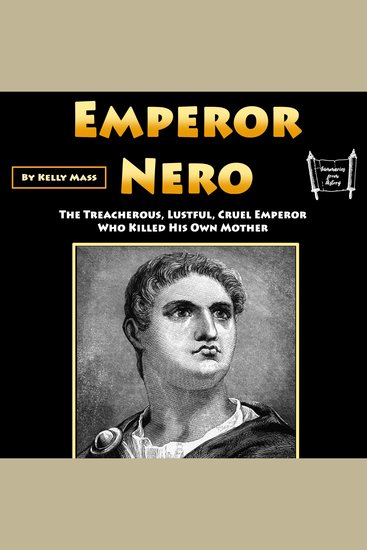
  • Emperor Nero - The Treacherous Lustful Cruel Emperor Who Killed His Own Mother - cover

    Emperor Nero - The Treacherous...

    Kelly Mass

    • 0
    • 0
    • 0
    Nero Claudius Caesar Augustus Germanicus, the fifth and final emperor of the Julio-Claudian dynasty, ruled the Roman Empire from AD 54 to 68. He was thrust into the highest seat of power at the age of sixteen after being adopted by Emperor Claudius, his stepfather. While Nero enjoyed popularity among the lower classes and the Praetorian Guard, who benefited from his patronage, the Roman aristocracy and Senate viewed him with contempt. Ancient historians portray him as a tyrannical and self-indulgent ruler, notorious for his extravagance, cruelty, and disregard for tradition. His reign ended in disgrace when the Senate declared him a public enemy, leading to his suicide at the age of thirty.  
    Born in AD 37 in the coastal town of Antium, Nero was the son of Gnaeus Domitius Ahenobarbus and Agrippina the Younger, a great-granddaughter of Emperor Augustus. His father died when he was only two years old, and his mother soon remarried, securing a position of influence at the imperial court. When Agrippina married Emperor Claudius, she maneuvered to have her son adopted as his heir, ultimately sidelining Claudius’ biological son, Britannicus. Following Claudius’ suspicious death in AD 54—widely believed to have been orchestrated by Agrippina—Nero ascended the throne with the backing of the Senate and the powerful Praetorian Guard.  
    In the early years of his reign, Nero was heavily influenced by a triad of advisers: his ambitious mother Agrippina, the philosopher and statesman Seneca the Younger, and the Praetorian prefect Sextus Afranius Burrus. Initially, the empire benefited from their guidance, as Nero enacted policies that were generally seen as moderate and pragmatic. However, as he grew older, he sought to rule independently, resenting the influence of his mother.
    Voir livre
  • Reading for the Love of God - How to Read as a Spiritual Practice - cover

    Reading for the Love of God -...

    Jessica Hooten Wilson

    • 0
    • 0
    • 0
    What if we viewed reading as not just a personal hobby or a pleasurable indulgence but a spiritual practice that deepens our faith? 


    In Reading for the Love of God, award-winning author Jessica Hooten Wilson does just that—and then shows listeners how to reap the spiritual benefits of reading. She argues that the simple act of reading can help us learn to pray well, love our neighbor, be contemplative, practice humility, and disentangle ourselves from contemporary idols. 


    Accessible and engaging, this guide outlines several ways Christian thinkers—including Augustine, Julian of Norwich, Frederick Douglass, and Dorothy L. Sayers—approached the act of reading. It also includes useful special features such as suggested reading lists, guided practices to approaching texts, and tips for meditating on specific texts or Bible passages. By learning to read for the love of God, listeners will discover not only a renewed love of reading but also a new, vital spiritual practice to deepen their walk with God.
    Voir livre