Join us on a literary world trip!
Add this book to bookshelf
Grey
Write a new comment Default profile 50px
Grey
Subscribe to read the full book or read the first pages for free!
All characters reduced
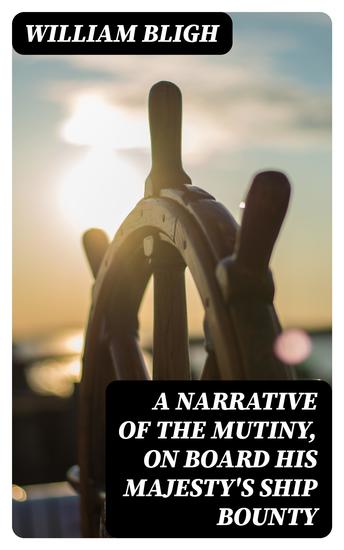
A Narrative Of The Mutiny On Board His Majesty's Ship Bounty - Enriched edition - cover

A Narrative Of The Mutiny On Board His Majesty's Ship Bounty - Enriched edition

William Bligh

Publisher: DigiCat

  • 0
  • 0
  • 0

Summary

In "A Narrative of the Mutiny, On Board His Majesty's Ship Bounty," Captain William Bligh provides a gripping first-hand account of the infamous mutiny that occurred in 1789, as well as the harrowing journey of survival that followed. Bligh's clarity of prose and meticulous attention to detail illuminate the tumultuous events aboard the HMS Bounty, embodying the themes of loyalty, authority, and the human spirit under duress. Written in a style that mirrors the voyage's perils, Bligh's narrative also serves as a cultural artifact, reflecting the maritime practices and colonial attitudes of his time, and providing a valuable perspective on the era's exploration and imperial aspirations. William Bligh, known for his notorious reputation as a strict yet able naval leader, was deeply influenced by his own experiences at sea, which shaped his authoritative yet sympathetic portrayal of the crew's insurrection. His unwavering commitment to documenting his experiences offers readers insight into the complicated nature of leadership and resistance. Having navigated treacherous waters both literally and metaphorically, Bligh's narrative stands as a testament to his resilience and character. This book is essential not only for those interested in naval history but also for readers intrigued by the complexities of human relationships in crisis. Bligh's account invites readers to engage with the events leading up to and following the mutiny, enabling them to grasp the lasting impact of this pivotal moment in maritime history. It is a compelling read for anyone seeking to understand the interplay between authority and rebellion.

In this enriched edition, we have carefully created added value for your reading experience:
- A succinct Introduction situates the work's timeless appeal and themes.
- The Synopsis outlines the central plot, highlighting key developments without spoiling critical twists.
- A detailed Historical Context immerses you in the era's events and influences that shaped the writing.
- An Author Biography reveals milestones in the author's life, illuminating the personal insights behind the text.
- A thorough Analysis dissects symbols, motifs, and character arcs to unearth underlying meanings.
- Reflection questions prompt you to engage personally with the work's messages, connecting them to modern life.
- Hand‐picked Memorable Quotes shine a spotlight on moments of literary brilliance.
- Interactive footnotes clarify unusual references, historical allusions, and archaic phrases for an effortless, more informed read.
Available since: 08/10/2022.
Print length: 68 pages.

Other books that might interest you

  • Cathars and Huguenots The: The History and Legacy of the Major French Christian Groups Who Were Persecuted by the Catholics - cover

    Cathars and Huguenots The: The...

    Editors Charles River

    • 0
    • 0
    • 0
    Carcassonne today is the capital of the Aude department in the Occitanie region of southwestern France, about 58 miles from Toulouse. This land is also home to several legends and local traditions. When the earth is drenched by heavy storms, the crumbling red soil drifts into the River Aude, staining the water with crimson. This beautiful, yet haunting phenomenon, which the locals call the “blood of the Cathars,” is a symbolic reminder of the blood shed by these “heretics” at the hands of the Catholic Church. Despite the controversial events, and their supposed heresy, it seemed that the fall of the Cathars brought an everlasting curse upon the region. 
    In the 16th century, corruption, debauchery, and the general perversion of ethics were running rampant within the Roman Catholic Church. The public began to grow leery of the crooked church, and soon, they could no longer bite their tongues. Among the church's most vocal opponents was Martin Luther, whose publication of the 95 Theses gave rise to the Protestant movement. This reformed brand of Christianity gradually spread throughout Europe, planting flags across the continent. France was among the first to latch onto the movement, and these new-wave Protestants became known as the “Huguenots.” The exact origins of the Huguenot name is still disputed to this day, but most historians have agreed it is a French and German translation of the Swiss-German term, “eidgenossen,” meaning “oath-fellowship.” The Huguenots mostly resided in the southern regions of France, along with the northern regions of Normandy and Picardy. They shared quite a few similarities with the Protestant Walloons, who lived in what is now Belgium, but the two groups were unique communities. Even so, both groups frequently convened to worship together as refugees.
    Show book
  • Todo sobre el tiempo All About Weather - cover

    Todo sobre el tiempo All About...

    Kim Mitzo Thompson, Karen Mitzo...

    • 0
    • 0
    • 0
    Kids will love this playful story in both Spanish and English. This dual language reader will encourage children to learn weather words and phrases. Simple sentence structures and repetitive words will have young readers learning a new language in no time. Kids will enjoy following along word-for-word with the recorded story that features sound effects and professional voices to teach correct pronunciation in both Spanish and English. This reader features adorable art showing diversity to help children form a sense of acceptance and understanding of different races and individual differences.
    Show book
  • The Greatest Civilizations of Ancient Mesopotamia - cover

    The Greatest Civilizations of...

    Editors Charles River

    • 0
    • 0
    • 0
    Long before Alexandria was a city and even before Memphis and Babylon had attained greatness, the ancient Mesopotamian city of Ur stood foremost among ancient Near Eastern cities. Today, the greatness and cultural influence of Ur has been largely forgotten by most people, partially because its monuments have not stood the test of time the way other ancient culture’s monuments have. For instance, the monuments of Egypt were made of stone while those of Ur and most other Mesopotamian cities were made of mud brick and as will be discussed in this report, mud-brick may be an easier material to work with than stone but it also decays much quicker. The same is true to a certain extent for the written documents that were produced at Ur. No site better represents the importance of the Sumerians than the city of Uruk. Between the fourth and the third millennium BCE, Uruk was one of several city-states in the land of Sumer. 
    As Hittite power grew during the Old Kingdom, the royal city of Hattusa became more important and even wealthier. From his citadel overlooking Hattusa, Hattusili I launched the first major Hittite attacks into the Near East, first conquering the cities between Hattusa and the Mediterranean.  
    Although the Biblical accounts of the Assyrians are among the most interesting and are often corroborated with other historical sources, the Assyrians were much more than just the enemies of the Israelites and brutal thugs. Among all the cities that thrived in the ancient Near East, few can match the opulence and ostentatiousness of Nineveh, the capital of the Assyrian Empire for much of the seventh century BCE. During that time it became known for its mighty citadels, grand palaces, beautiful gardens, and even its zoos. In fact, the beauty of Nineveh, especially its gardens, impressed later writers so much that they assigned its gardens as one of the original Seven Wonders of the World.
    Show book
  • Psychological Intimidation - Using Mental Tactics to Instill Fear or Compliance - cover

    Psychological Intimidation -...

    Cito Harder

    • 0
    • 0
    • 0
    Psychological intimidation refers to the use of mental tactics to instill fear, compliance, or submission in others. Unlike physical intimidation, which involves overt threats or aggressive behavior, psychological intimidation operates on a more subtle, covert level. It involves manipulating emotions, perceptions, and thought processes to control or influence an individual’s actions, often without them realizing they are being intimidated. This form of intimidation can be just as harmful as physical aggression, as it undermines the victim’s sense of security, autonomy, and well-being. 
    At its core, psychological intimidation is about the exertion of power. The intimidator uses fear or the threat of harm—whether real or perceived—to influence or dominate another person. It is often used in relationships, workplaces, and social dynamics where there is an imbalance of power. This type of intimidation can be subtle, often taking the form of guilt-tripping, manipulation, isolation, or the use of authority to control another’s behavior. It might include behaviors like silent treatment, constant criticism, gaslighting, or passive-aggressive actions, all designed to make the victim feel inadequate, fearful, or uncertain. 
    The effects of psychological intimidation are often long-lasting. Victims may experience anxiety, depression, and a diminished sense of self-worth. Over time, the individual may begin to question their own judgment, doubt their abilities, or feel that they are powerless to make decisions without the approval of the intimidator. This can create a cycle where the victim is more susceptible to future manipulation or control, reinforcing the power dynamic.
    Show book
  • How To Speak English Clearer in 30 Days - Transform Your English Speaking Skills with Our Interactive Audiobook! - cover

    How To Speak English Clearer in...

    Peter Baker

    • 0
    • 0
    • 0
    Are you tired of not being understood? If English isn't your first language, this interactive “repeat-after-me” audiobook is your ultimate guide to achieving clear, fluent, and confident English speech. 
    - Master English Sounds: Discover and practice the unique sounds in English that may not exist in your native language, enhancing your pronunciation and clarity. 
    - Memorable Phrases and Idioms: Learn and memorize essential phrases and idioms that will help you navigate conversations smoothly and make new friends effortlessly. 
    - American vs. British English: Explore the fascinating differences in words, pronunciations, and cultural nuances between American and British English. 
    - Tour Guide Tips: Special sections tailored for those working as tour guides, offering invaluable advice on how to engage and communicate effectively with native English-speaking tourists. 
    Your Expert Guides: Presented by professional voice trainers Peter Baker and Katy Brody, this audiobook is designed to transform your English speaking skills in just 30 days. Each day, you'll focus on a new chapter filled with practical exercises and tips to ensure steady progress. 
    Interactive and Engaging: With plenty of voice exercises throughout, this interactive audiobook will help you practice and perfect your English speaking abilities in an enjoyable and effective way.  
    Start your journey to better English today! Embrace this opportunity to speak clearly, confidently, and make meaningful connections wherever you go.
    Show book
  • Vietnam Combat - Firefights and Writing History - cover

    Vietnam Combat - Firefights and...

    Robin Bartlett

    • 0
    • 0
    • 0
    The year 1968 was arguably the most significant year of the war. It was the height of the American involvement, and because officer casualties had been so great after the Tet Offensive of January 1968, all prior officer assignments were canceled. 


    1st Lieutenant Robin Bartlett suddenly found himself at the "repo-depo" in Bien Hoa reassigned to the 1st Cavalry Division. The unit had more helicopter support than any other unit in Vietnam. Immediate support from artillery, helicopter gunships, and ARA was only minutes away to support a firefight. Wounded troops could be medevaced even in dense jungle using "jungle penetrators." It also meant that Bartlett's platoon could deploy through helicopter combat assaults into hot LZs (landing zones) at a moment's notice if an enemy force had been spotted. And they did. 


    It was with extreme anxiety that Bartlett made his way to join his battalion and company—it was the worst of times to be a platoon leader in Vietnam. Bartlett also had to cope with personal issues of commitment to a war that was rapidly losing support not only back home but among the soldiers he was leading. Fifty years later, Bartlett's vivid combat experiences are brought to light in a fast-moving, well-written, first-person narrative expressing the horror, fear, anguish, and sometimes illogical humor of that war.
    Show book