Join us on a literary world trip!
Add this book to bookshelf
Grey
Write a new comment Default profile 50px
Grey
Subscribe to read the full book or read the first pages for free!
All characters reduced
Poems of William Blake - cover

Poems of William Blake

William Blake

Publisher: DigiCat

  • 0
  • 0
  • 0

Summary

William Blake's "Poems of William Blake" presents a profound synthesis of visionary imagination and poetic craft, characterized by its richly symbolic language and innovative use of verse. The collection encompasses a diverse range of themes, from the innocence of childhood to the complexities of human experience, showcasing Blake's unique style that blends lyrical beauty with philosophical depth. His work reflects the tumultuous socio-political landscape of late 18th-century England, influenced by the Enlightenment, Romanticism, and the Industrial Revolution, as Blake engages with eternal questions of morality, spirituality, and the human condition. William Blake (1757-1827) was not only a poet but also a painter, engraver, and visionary thinker whose artistic endeavors were deeply intertwined with his beliefs. Growing up in the artistic milieu of London, Blake's radical views on religion and society informed his writings. A member of the pre-Romantic tradition, Blake's innovative approaches to form and content, along with his rejection of conventional artistic boundaries, led him to create a body of work that defies categorization and engages with both the personal and the universal. I highly recommend "Poems of William Blake" to readers seeking to explore the depths of human experience through the lens of imaginative poetry. This collection will resonate with those who appreciate rich symbolism and philosophical inquiry, inviting readers to reflect on the nature of existence and the power of the imagination.
Available since: 09/15/2022.
Print length: 115 pages.
Other books that might interest you

  • Bards Eternal - cover

    Bards Eternal

    Blue Jay walker

    • 0
    • 0
    • 0
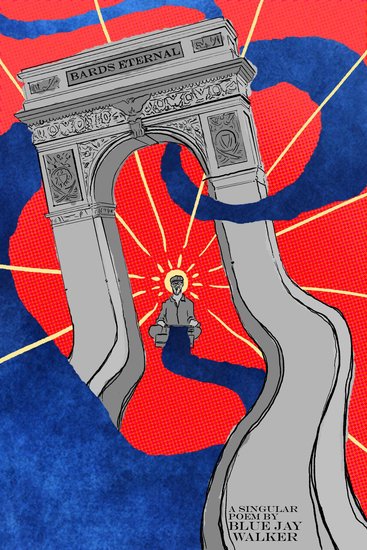
    In New York City's Washington Square Park,  
    An old familiar war is being waged between those in power,  
    and those who refuse to conform. 
      
    Blue Jay Walker has been a street busker all his life. Traveling across countries he earns his keep by writing poems for passers-by on his worn typewriter. 
      
    In the summer of 2023 when he arrived at one of his favourite haunts for hawking poems, he was dismayed to discover the authorities had banned all artists from making their living in the park. 
      
    However the artists were not giving up their home without a fight. Inspired by their tenacity, Walker joined the fray. Sticking a proverbial flag in the ground at the center of the park he began writing what would quickly become The Longest Physical Poem Of The 21st Century. 
      
    The 240 foot scroll is a distillation of all the wandering truth he has gained along his travels, twisted through the spiraling narrative of the Vagrants and Bards who have taught him not only how to make art, but how to see the world in a different light.
    Show book
  • I'm Sorry Here's a Plasma Rifle - A Collection of Short Stories Poems and Pastry Recipes - cover

    I'm Sorry Here's a Plasma Rifle...

    Aaron N. Hall

    • 0
    • 0
    • 0
    SENT BACK FROM THE YEAR 2124, I’m Sorry, Here’s a Plasma Rifle is the last known work of author Aaron N. Hall before his tragic jet ski accident with a shipping container of rubber ducks. 
    It contains seven short stories, eighteen poems, and four pastry recipes that highlight his affection for fantasy, science fiction, and the endearingly odd. 
    The current edition has been republished including the notes of Dr. Arthur B. Salazar, who sent the book from the future before being cryogenically frozen and launched into space prior to Earth’s decay. 
    Listen, enjoy, then say hello to the void.
    Show book
  • The Most Charming Creatures - Poems - cover

    The Most Charming Creatures - Poems

    Gary Barwin

    • 0
    • 0
    • 0
    With uncanny wit, inventive beauty, and numinous surprise, The Most Charming Creatures explores the contemporary and its language, considering our wonder, sorrow, bewilderment, anxiety, and tenderness. While these poems energize and connect and “turn the paren- / theses inside out so that / we mean everything,” they are also alive to the alluring complicity of language and its duplicity and deceptions. “This is the way the world ends / Not with a bang but / while we watch.”
    		 
    A follow-up to the award-winning author’s acclaimed selected poems, this new collection continues Barwin’s examination of the possibilities of the poem: a celebration, a story, an investigation, a riff, a word machine, a parable, a transformation. But what are the “most charming creatures” of the title? In 1862, scientific illustrator Ernst Haeckel termed radiolarians (ancient single-celled organisms with mineral skeletons) “the most charming creatures,” but here Barwin turns the microscope around to consider something just as strange and mysterious: language, our culture, and the self. From microorganisms, onion rings, grief, and Gerard Manley Hopkins to beetles, neoliberalism, sandwiches, Martin Luther, and stand-up comedy, he offers: “it’s a miracle that we’ve survived / it’s a miracle that we’ve survived at all.”
    Show book
  • Essay on Man An - Pope is one of our greatest poets here he once again demonstrates his brilliant talents - cover

    Essay on Man An - Pope is one of...

    Alexander Pope

    • 0
    • 0
    • 0
    Alexander Pope was born on May 21st, 1688 in London into a Catholic family.   
    His education was affected by the recent Test Acts, upholding the status of the Church of England and banning Catholics from teaching.  In effect this meant his formal education was over by the age of 12 and Pope was to now immerse himself in classical literature and languages and to, in effect, educate himself.    
    From this age too he also suffered from numerous health problems including a type of tuberculosis (Pott’s disease) which resulted in a stunted, deformed body.  Only to grow to a height of 4’ 6”, with a severe hunchback and complicated further by respiratory difficulties, high fevers, inflamed eyes and abdominal pain all of which served to further isolate him, initially, from society.  
    However his talent was evident to all. Best known for his satirical verse, his translations of Homer and the use of the heroic couplet, he is the second-most frequently quoted writer in The Oxford Dictionary of Quotations, after Shakespeare.  
    With the publication of Pastorals in 1709 followed by An Essay on Criticism (1711) and his most famous work The Rape of the Lock (1712; revised and enlarged in 1714) Pope became not only famous but wealthy.  
    His translations of the Iliad and the Odyssey further enhanced both reputation and purse.  His engagement to produce an opulent new edition of Shakespeare met with a mixed reception.  Pope attempted to "regularise" Shakespeare's metre and rewrote some of his verse and cut 1500 lines, that Pope considered to be beneath the Bard’s standard, to mere footnotes.  
    Alexander Pope died on May 30th, 1744 at his villa at Twickenham (where he created his famous grotto and gardens) and was buried in the nave of the nearby Church of England Church of St Mary the Virgin.   
    Over the years and centuries since his death Pope’s work has been in and out of favour but with this distance he is now truly recognised as one of England’s greatest poets.
    Show book
  • Live is Overrated - cover

    Live is Overrated

    Gorko

    • 0
    • 0
    • 0
    "Life is Overrated" is a thought-provoking collection that delves into various aspects of life, love, and social topics, among others. 
    Gorko has a unique way of expressing himself through a brutally honest yet eloquent approach. 
    Every poem is a captivating story that is worth reading for poetry lovers and those who are seeking a fresh new stream in their reading material.
    Show book
  • The Kingdom of Surfaces - Poems - cover

    The Kingdom of Surfaces - Poems

    Sally Wen Mao

    • 0
    • 0
    • 0
    In The Kingdom of Surfaces, award-winning poet Sally Wen Mao examines art and history—especially the provenance of objects such as porcelain, silk, and pearls—to frame an important conversation on beauty, empire, commodification, and violence. In lyric poems and wide-ranging sequences, Mao interrogates gendered expressions such as the contemporary “leftover women,” which denotes unmarried women, and the historical “castle-toppler,” a term used to describe a concubine whose beauty ruins an emperor and his empire. These poems also explore the permeability of object and subject through the history of Chinese women in America, labor practices around the silk loom, and the ongoing violence against Asian people during the COVID-19 pandemic. 
     
    At its heart, The Kingdom of Surfaces imagines the poet wandering into a Western fantasy, which covets, imitates, and appropriates Chinese aesthetics via Chinamania and the nineteenth-century Aesthetic Movement, while perpetuating state violence upon actual lives. The title poem is a speculative recasting of Through the Looking-Glass, set in a surreal topsy-turvy version of the eponymous China-themed 2015 Metropolitan Museum of Art Gala. The Kingdom of Surfaces is a brilliantly conceived call for those who recognize the horrors of American exceptionalism to topple the empire that values capital over lives and power over liberation.
    Show book