Join us on a literary world trip!
Add this book to bookshelf
Grey
Write a new comment Default profile 50px
Grey
Subscribe to read the full book or read the first pages for free!
All characters reduced
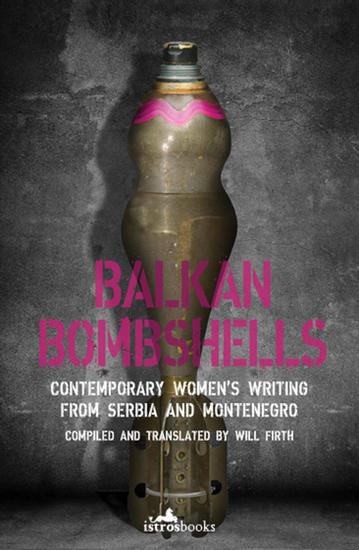
Balkan Bombshells - Contemporary Women's Writing from Serbia and Montenegro - cover

Balkan Bombshells - Contemporary Women's Writing from Serbia and Montenegro

Will Firth

Publisher: Istros Books

  • 0
  • 0
  • 0

Summary

A collection to whet the appetite of anyone wishing to learn more about a region rich in history, folklore and (her)stories. Telling it like a woman does not mean literature for women only: it provides an insight into half of humanity, a window onto the lives of citizens who work, love and develop their inner lives. This collection brings together the voices of a wide selection of prize-winning and established authors:
Balkan Bombshells brings together established Serbian and Montenegrin writers like Svetlana Slapšak, Jelena Lengold (winner of the EU Prize for Literature 2013), Dana Todorović and Olja Kneżević (author of Catherine the Great and the Small, Istros 2020), together with a select group of up-coming writers: Marijana Čanak (1982, Serbia): "Awakened" (Probuđena) follows the early years of a girl from a very simple background, who discovers she has extrasensory powers. A gruesome fascination with biology allows her to attend high school, where she ends up sewing a voodoo doll to take revenge on a molesting teacher. Marijana Dolić (1990, Bosnia-Herzegovina & Serbia): "Notes from the attic" (Zapisi iz potkrovlja), originally diary entries, are intense mediatations on faith, love and hope – poignant testimony to a struggle to cope in difficult times. Ana Miloš (1992, Serbia): "Peace" (Mir) portrays a woman struggling with disparate feelings after her only child dies. She has long since broken up with the child's father. She enjoys finally having time for herself, but she has to confront accusations of people around her that she is heartless. Once a mother, always a mother? Katarina Mitrović (1991, Serbia):"Small death" (Mala smrt). We are introduced to a fearful young woman who is far from happy with life, and we follow her on a summer holiday by the Adriatic, where a halfhearted romantic adventure takes a scary turn. Andrea Popov Miletić (1985, Serbia):|: excerpt from the novel Young pioneers, we are seaweed (Pioniri maleni, mi smo morska trava; 2019). This stand-alone excerpt is a poetic flashback to her childhood in the province of Vojvodina in the Yugoslav era, to holidays by the Mediterranean, and to feelings of belonging and home. Lena Ruth Stefanović (1970, Sebria/ Montenegro): "Zhenya" is a fragment from her 2016 novel Daughter of the Childless Man (Šćer onoga bez đece), is an entertaining meta-story about an ordinary woman in the late Soviet Union, whom the author decides to grant a new lease of life, so Zhenya studies languages, becomes a mondain writer and moves with her new husband to Montenegro, where the author loses track of her.
Available since: 02/20/2023.
Print length: 150 pages.

Other books that might interest you

  • The Adventures Of Sherlock Holmes - cover

    The Adventures Of Sherlock Holmes

    Arthur Conan Doyle

    • 0
    • 0
    • 0
    "The Adventures of Sherlock Holmes" is a collection of short stories featuring the iconic detective Sherlock Holmes and his friend Dr. John Watson. First published in 1892, the book includes some of Sherlock Holmes's most famous cases, such as "A Scandal in Bohemia," "The Adventure of the Blue Carbuncle," and "The Adventure of the Speckled Band." These stories showcase Holmes's unparalleled powers of observation and deduction as he solves various mysteries, from thefts and kidnappings to more complex and unusual crimes.
    Show book
  • The Challenge from Beyond - cover

    The Challenge from Beyond

    C. L. Moore, A. Merritt, H.P....

    • 0
    • 0
    • 0
    George Campbell retreats into the Canadian wilderness with nothing but a tent, hoping to escape the pressures of work. Deep in the forest, he stumbles upon a mysterious crystalline cube with strange, mesmerizing qualities — the longer he looks at it, the brighter it glows, gradually pulling him into a hypnotic trance. The object reminds him of the legendary Eltdown Shards, ancient texts said to describe similar cubes used by an otherworldly race to send their minds across the cosmos in search of knowledge. 
    The creator of the story was the young Julius Schwartz, publisher of the fanzine "Fantasy Magazine," who asked a group of well-known writers to create a multipart story based on the given title - each writer was to write one segment. One group of authors was to create a work in the spirit of science fiction, while the rest (including Lovecraft) - in the spirit of supernatural or fantasy tales. 
    C. L. Moore started the story. Then, Frank Belknap Long wrote his part. The next in line, the highest-paid writer among them all, A. Merritt, declared that Long had deviated too much from the title's essence in his development of the story. Merritt set a condition: either Long's portion would be rejected and replaced with his fragment, or he would withdraw from the project. Schwartz couldn't afford to lose such a prominent name, so he thanked Long. Of course, Merritt's contribution was minimal, and to advance the plot, Lovecraft had to intervene, creating the longest fragment of them all. The rest was completed by Robert E. Howard and – convinced by H.P. Lovecraft to return – Frank Belknap Long.
    Show book
  • The Immortality Complex - A Science Fiction Short Story - cover

    The Immortality Complex - A...

    Jeff Walker

    • 0
    • 0
    • 0
    A science fiction short story from Jeff Walker, author of such titles as: The Long Lost War, The Massive Planet: The Adventures Of Deep Contact, Your Service Is Required, The Jungle Planet and The Mysterious World of Professor Darkk and Miss Shadow. 
    Simon Janson died at the end of his life, only to be reborn into a new body and his mind uploaded to it. Now he must live in a world where death is no longer a factor in human beings anymore. Simon travels beyond Earth to find meaning in his life now, stumbling upon a new love and new challenges. But can he cope with living forever? Is better to die rather than live on and on with no end? As humanity continues to improve and stretch out into the cosmos, Simon feels the burden of being immortal.
    Show book
  • The Horse Dealer's Daughter - Poignant story exploring death and its effects by the author of Sons And Lovers - cover

    The Horse Dealer's Daughter -...

    D H Lawrence

    • 0
    • 0
    • 0
    David Herbert Lawrence was born on the 11th September 1885 in Eastwood, Nottinghamshire, a coal mining town where the reality of a harsh life was only useful as experiences for future literary works. 
     
    He was educated at Beauvale Board School and became the first local boy to receive a scholarship to attend Nottingham High School. After 3 years he became a junior clerk in Haywood’s surgical appliances factory. He was also attempting a literary career which, in the short term, led to a teacher training position in Eastwood and later a teaching qualification from University College, Nottingham.  
     
    Lawrence’s first efforts were poems, short stories and a draft of ‘The White Peacock’. Moving to London and a teaching position in Croydon his writing attracted the attention of Ford Madox Ford, editor of The English Review, and he commissioned him to write ‘Odour of Chrysanthemums’.  
     
    Wanting to write full-time he now began work on what would become ‘Sons and Lovers.   
     
    In 1912 he met the older and married mother-of-three Frieda Weekley. They eloped to Germany and here Lawrence could see for himself the growing tensions with France.  So keen was his interest that he was arrested and accused of being a British spy.  
     
    In early 1914 Frieda obtained her divorce and they returned to Britain to be married just days before the outbreak of war. Owing to her German parentage, and his own public dislike of militarism and violence, the couple were treated with contempt and suspicion throughout the war years.  
     
    Despite this he continued to write but his reputation in England was so tarnished and, mirrored by his own disdain for the country, he and Frieda left England in November 1919, first for Europe and then America via Ceylon and Australia. 
     
    They bought a ranch in Taos, New Mexico and visited Mexico several times. The third visit in March 1925 caused a near fatal attack of malaria. To convalesce they moved to Florence. Here he continued work on ‘Lady Chatterley’s Lover’ which for many years would cause controversy. A renewed interest in oil painting resulted in an exhibition in 1929 which was raided by the police and several works were confiscated.  
     
    D H Lawrence died of complications arising from a bout of tuberculosis on the 2nd of March 1930 in Vence, France.  He was 44. 
     
    In ‘The Horse Dealers daughter’ a young woman begins a relationship with a young doctor and a friend of her brothers.  What should be straight forward is intimately investigated by Lawrence’s foraging pen.
    Show book
  • Gold Rings - Seasonal Sparkles - cover

    Gold Rings - Seasonal Sparkles

    Mo Fanning

    • 0
    • 0
    • 0
    Welcome to 'Gold Rings,' a collection of four evocative short stories from Mo Fanning's acclaimed collection 'Five Gold Rings.' Each tale, narrated by a different voice, transports you through the seasons, unfolding a tapestry of human emotions and experiences. And if Christmas is just a little too jolly, let Mo change your mind.
    Show book
  • The Wisdom of Father Brown - cover

    The Wisdom of Father Brown

    G. K. Chesterton

    • 0
    • 0
    • 0
    "And the young woman of the house," asked Dr. Hood, with huge and silent amusement, "what does she want?" "Why, she wants to marry him," cried Father Brown, sitting up eagerly. "That is just the awful complication." "It is indeed a hideous enigma," said Dr. Hood. "This young James Todhunter," continued the cleric, "is a very decent man so far as I know; but then nobody knows very much. He is a bright, brownish little fellow, agile like a monkey, clean-shaven like an actor, and obliging like a born courtier. He seems to have quite a pocketful of money, but nobody knows what his trade is. Mrs. MacNab, therefore (being of a pessimistic turn), is quite sure it is something dreadful, and probably connected with dynamite.
    Show book