Join us on a literary world trip!
Add this book to bookshelf
Grey
Write a new comment Default profile 50px
Grey
Subscribe to read the full book or read the first pages for free!
All characters reduced
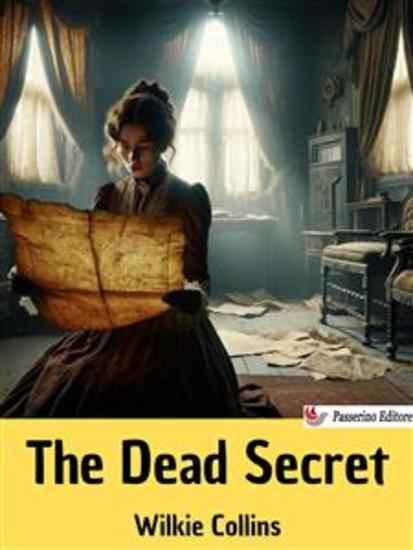
The Dead Secret - cover

The Dead Secret

Wilkie Collins

Publisher: Passerino

  • 0
  • 0
  • 0

Summary

The Dead Secret is a novel published by Wilkie Collins, first in 1857 as a series in Charles Dickens' Household Words weekly magazine and later the same year as a book.

William Wilkie Collins (8 January 1824 – 23 September 1889) was an English novelist and playwright known especially for The Woman in White (1859), a mystery novel and early sensation novel, and for The Moonstone (1868), which established many of the ground rules of the modern detective novel and is also perhaps the earliest clear example of the police procedural genre.
Available since: 04/23/2024.


Other books that might interest you

  • Black Prophet The: a Tale of Irish Famine - cover

    Black Prophet The: a Tale of...

    William Carlton

    • 0
    • 0
    • 0
    ""The Black Prophet: A Tale of Irish Famine" is a compelling work by William Carleton. This novel, set just before the onset of the Great Irish Famine in 1847, immerses readers in the vivid colors and authentic dialogue of the time. Carleton, who lived through these events, weaves a powerful narrative that captures the struggles, hopes, and tragedies of the Irish people during this tumultuous period.    Summary  Setting: The story unfolds in Ireland, a land marked by poverty, social upheaval, and impending disaster.  Themes: Carleton delves into themes of famine, social injustice, and the resilience of the human spirit.  Characters: The enigmatic figure of the Black Prophet looms large, foretelling doom and change. His presence adds an eerie dimension to the tale.  Atmosphere: The novel paints a vivid picture of the Irish countryside, its people, and their desperate fight for survival."
    Show book
  • Four Winds (Unabridged) - cover

    Four Winds (Unabridged)

    L. M. Montgomery

    • 0
    • 0
    • 0
    Lucy Maud Montgomery (November 30, 1874 - April 24, 1942), published as L. M. Montgomery, was a Canadian author best known for a series of novels beginning in 1908 with Anne of Green Gables. The book was an immediate success. The title character, orphan Anne Shirley, made Montgomery famous in her lifetime and gave her an international following.
    Four Winds: Alan Douglas threw down his pen with an impatient exclamation. It was high time his next Sunday's sermon was written, but he could not concentrate his thoughts on his chosen text. For one thing he did not like it and had selected it only because Elder Trewin, in his call of the evening before, had hinted that it was time for a good stiff doctrinal discourse, such as his predecessor in Rexton, the Rev. Jabez Strong, had delighted in.
    Show book
  • The Pearls of Parlay - cover

    The Pearls of Parlay

    Jack London

    • 0
    • 0
    • 0
    The Pearls of Parlay (1911) Parlay, who has become the ruler of the atoll of Hikihoho after marrying the queen there, summons the leading traders of the South Seas to his atoll for an auction of the whole of his fabulous collection of pearls. But that day is precisely at the peak of the hurricane season and when their ships have gathered in the atoll's lagoon the barometer starts going through the floor, as the mother of all hurricanes is on the verge of destroying not only all the ships but the island as well.
    Show book
  • Deal in Ostriches A (Unabridged) - cover

    Deal in Ostriches A (Unabridged)

    H. G. Wells

    • 0
    • 0
    • 0
    "A Deal in Ostriches" is a short story by the British writer H. G. Wells. It is a cautionary tale about simple human greed. The taxidermist of Wells' story "Triumphs of a Taxidermist" (1894) makes a return appearance as the narrator of the story.
    Show book
  • Blood - From their pens to your ears genius in every story - cover

    Blood - From their pens to your...

    Hanns Heinz Ewers

    • 0
    • 0
    • 0
    Hanns Heinz Ewers was born on 3rd November 1871 in Düsseldorf, Germany. 
    His first published poem was at 17 on the death, after a reign of only 99 days, of the German Emperor Frederick III. 
    A stint in the German military was cut short after only 44 days because of his myopia.  Writing was to be the way forward for him with a book of satiric verse published in 1901. At the same time he co-founded a literary vaudeville troupe that toured central and eastern Europe before censors and expenses forced its closure.  An inveterate traveller he was in South America when the Great War enveloped Europe and he relocated to New York. 
    From here his story darkens. Although by now a successful and admired author he was arrested in the U S in 1918 as a German Agent on the pretext of his travels and a falsified Swiss passport. Interned, he was released in 1921 and returned to Germany.  He claimed only to be raising money for the German Red Cross. 
    His literary fame is decidedly easier to clarify. His novels beginning with ‘The Sorcerer’s Apprentice’ in 1910 are dark, they bristle with evil intent and are littered with characters who have a dubious moral compass and yet, along with his short stories, are brazen, brilliant feats of literary narrative. 
    He also wrote and published plays, fairy tales, opera librettos, critical essays and lectured for many years on ‘The Religion of Satan’ and was one of the first to write scripts for the cinema, which he considered a legitimate art form. 
    As the Weimar republic began its chaotic death throes Ewers became attracted to the rising Nazi Party.  At first he was warmly received despite disagreeing with its anti-semitism (his most famed literary character had a Jewish mistress) and he was even commissioned by Hitler to write a biography of the Nazi martyr Horst Wessel.  This together with his own homosexuality culminated with his works being banned in 1934 and his assets and property seized.  It took him many years to have the ban lifted.  This association rightfully clouds his personal reputation but has meant his literary contributions are also overlooked and neglected. 
    Hanns Heinz Ewers died of tuberculosis on 12th June 1943 in his Berlin apartment.
    Show book
  • Eumenides - cover

    Eumenides

    Aeschylus

    • 0
    • 0
    • 0
    The final play of the Oresteia, called The Eumenides (Εὐμενίδες, Eumenídes), illustrates how the sequence of events in the trilogy ends up in the development of social order or a proper judicial system in Athenian society. 
    In this play, Orestes is hunted down and tormented by the Furies, a trio of goddesses known to be the instruments of justice, who are also referred to as the "Gracious Ones" (Eumenides). They relentlessly pursue Orestes for the killing of his mother. However, through the intervention of Apollo, Orestes is able to escape them for a brief moment while they are asleep and head to Athens under the protection of Hermes. Seeing the Furies asleep, Clytemnestra's ghost comes to wake them up to obtain justice on her son Orestes for killing her.
    Show book