Join us on a literary world trip!
Add this book to bookshelf
Grey
Write a new comment Default profile 50px
Grey
Subscribe to read the full book or read the first pages for free!
All characters reduced
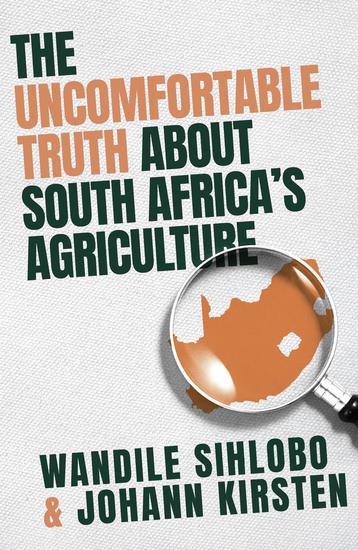
The Uncomfortable Truth about South Africa's Agriculture - cover

The Uncomfortable Truth about South Africa's Agriculture

Wandile Sihlobo, Johann Kirsten

Publisher: Tracey McDonald Publishers

  • 0
  • 0
  • 0

Summary

Wandile Sihlobo and Johann Kirsten chose to write The Uncomfortable Truth about South Africa's Agriculture in a candid, direct and unfiltered tone, not out of disregard, but with the hope of stirring South African agricultural stakeholders from inertia that may have taken hold over time.
One clear example of inertia is the endless policy discussions. When the government proposes policy positions – either good or bad – time is spent discussing these policies instead of anything substantive being done. The divisions amongst South African farmer organisations is the core issue behind the interminable conversations and this results in a 'performance of productivity' among participants in these meetings, creating an impression of progress simply because discussions are taking place.
While politicians and farmer representatives debate, farmers suffer, the unemployed languish, and small towns crumble. Poor roads and rising costs choke market access, while collapsing municipalities pile pressure on agribusinesses.
Things don't have to be this way, and the South African agricultural sector still has great potential to grow, increase employment, and revitalise the rural economy. This book will empower the reader with a clearer understanding of the agricultural constraints and how to overcome them and mobilise the much-needed sectorial focus to implementation.
While the contents may be uncomfortable for some, this book is intended to ignite an urgent call for decisive policy and programme implementation and to demand stronger collaboration among social partners.
Available since: 03/10/2025.
Print length: 176 pages.

Other books that might interest you

  • To Learn About Oneself One Has to Learn Anew Each Minute - Four Public Talks Bombay (Mumbai) India 1971 - cover

    To Learn About Oneself One Has...

    Jiddu Krishnamurti

    • 0
    • 0
    • 0
    "To perceive 'what is' is the basis of truth," 7 February 1971. Duration: 86 minutes.
    Where there is division, there must be conflict. A mind in conflict must inevitably be distorted, and therefore it cannot possibly see clearly what is truth.
    
    We need a total change, a deep revolution, psychological revolution, the inward revolution, without which you cannot possibly create a new society. Is it possible to observe, to perceive without the observer?
    
    How are images formed? Can the image building come to an end? Knowledge is absolutely necessary. Is it possible that knowledge, which the brain has accumulated through centuries, does not interfere with relationships?
    
    "Direct perception is freedom," 10 February 1971. Duration: 80 minutes.
    Can the mind living in this world ever be free, not only superficially but profoundly, at the very root of its existence? 'Freedom from' is an abstraction, but freedom in observing 'what is' and going beyond it is actual freedom.
    
    How do I observe greed? Do I observe it as an outsider looking in, or do I observe it without the observer? Without the mind being free, you cannot live in order. Three years have passed; I have no energy to be aware of my reactions. Can we seek God through observation?
    
    "Love is that quality of mind in which there is no division," 14 February 1971. Duration: 89 minutes.
    To live in this world with intelligence, in spite of all the complications. Is it possible to be free of fear, not only the superficial fear in relationship but the deep-rooted fear? Thought nourishes, sustains and gives continuity to fear and pleasure.
    
    When you are learning, your mind is awake. Truth isn't second-hand; you can't get it through a guru, a book; you have to learn about it. The beauty of learning is that you don't know what truth is.
    
    What is love? A man who has not love in his heart but the things made by thought will make a monstrous world, will construct a society that is totally immoral. To find out, you must undo everything that you have done.
    
    What does it mean to die?
    
    "A mind in meditation is concerned only with meditation, not with the meditator," 17 February 1971. Duration: 87 minutes.
    If you can put aside your favourite systems, if you can understand that concentration is merely a resistance and therefore constant conflict and wastage of energy, then we can find out for ourselves what is necessary for a mind that is in a state of meditation. To learn about oneself, a living thing, you have to watch, learn anew each minute.
    
    What is will? Consciousness is heritage, the result of time. Consciousness is the content of itself, which is time, sorrow, confusion, misery. Intelligence has no heritage.
    
    What is a mind that is completely silent? How does one cope with the extraordinary energy that human beings have?
    Show book
  • The African Wars - cover

    The African Wars

    Julius Caesar

    • 0
    • 0
    • 0
    Julius Caesar's African Wars were a series of military campaigns waged by the Roman general and statesman Julius Caesar between 58 and 50 BC in order to expand the Roman Republic's sphere of influence and gain control of the Mediterranean region. During this time, Caesar clashed with several prominent enemies such as King Juba I of Numidia, King Bocchus III of Mauretania, and the forces of Pharnaces II of Pontus. Read in English, unabridged.
    Show book
  • The Ming Dynasty - Maritime Exploration and the Forbidden City - cover

    The Ming Dynasty - Maritime...

    Jun Liu

    • 0
    • 0
    • 0
    The Ming Dynasty, one of China's most influential and enduring dynasties, emerged in the aftermath of the Mongol-led Yuan Dynasty’s decline. It was a period marked by great transformation, political consolidation, and cultural revival. The dynasty's establishment under Zhu Yuanzhang, later known as Emperor Hongwu, signified the restoration of Han Chinese rule and the reinforcement of Confucian governance. Through military conquest, administrative reforms, and strategic centralization of power, the Ming Dynasty laid the foundation for a strong and prosperous China. 
    The fall of the Yuan Dynasty was driven by internal corruption, economic mismanagement, and widespread discontent. Mongol rulers faced difficulties controlling the vast empire, and their reliance on foreign administrators alienated the native Chinese population. Heavy taxation and frequent natural disasters exacerbated social unrest, leading to a series of revolts across the country. Among these rebellions, the Red Turban Rebellion, a movement rooted in peasant uprisings and religious discontent, played a crucial role in undermining Yuan authority. It was within this turbulent period that Zhu Yuanzhang, a former Buddhist monk turned military leader, rose to prominence. His leadership and military strategies enabled him to unify rebel factions and ultimately overthrow the Mongols in 1368, marking the beginning of the Ming Dynasty. 
    Upon ascending the throne, Emperor Hongwu sought to consolidate power and rebuild a nation weakened by war and misrule. His first priority was to eliminate threats to his rule, which led to purges against those he suspected of disloyalty. To prevent a recurrence of Yuan-era administrative failures, he restructured the government, reducing the influence of court eunuchs and emphasizing Confucian ideals in governance. He also reinstated the civil service examination system, ensuring that officials were selected based on merit rather than birthright.
    Show book
  • Being seen & heard deep healing meditations coaching sessions & inner child healings - embrace the wounds hurts pains disappointments transform from within loving yourself deeply - cover

    Being seen & heard deep healing...

    LoveAndBloom

    • 0
    • 0
    • 0
    Every one of us deserves to be seen, heard, and protected. Especially during our childhood, the child wants to feel safely protected and supported. However, not every one of us has parental figures that provide all of that. Therefore, we resulted in wounds. 
    There is a deep need for us to be seen and heard. The wounds could be suppressed. It could manifest as anger, hurts, sadness, sensitivities, self-sabotages, feeling neglected in all kinds of relationships etc. 
    To heal, we need to completely accept ourselves as who we are. We re-parent our inner child so that it feels safe supported and protected. In this course, we will guide you in a step-by-step way through coaching sessions and meditation 
    In this course, we willTalk to our inner childHeal the deep woundsAllow yourself to be protectedListen and see your inner child as who he isReceive your own loveRe-parent yourselfLet go of what others thinkBe who you areAnd much more 
    You deserve love in all aspects of your life.
    Show book
  • The Last Best Hope - A History of American Realism - cover

    The Last Best Hope - A History...

    John Hulsman

    • 0
    • 0
    • 0
    In this brilliant exploration of American history and contemporary conservative politics, foreign policy expert John Hulsman draws on his years at the heart of Washington to present a compelling new vision of conservative realism. 
    In our current Age of Insecurity, Hulsman suggests, there has never been a bigger need for the re-ascendance of realist principles in conservative circles. By drawing on U.S. history to illustrate realist precepts at the heart of the American story, The Last Best Hope provides a practical, realist foreign policy for a new age of American politics. 
    There has never been a greater time to re-claim the primacy of conservative thought. By fusing the populist Jacksonian base of the GOP with the more libertarian Jeffersonian school of thought, this cogently argued manifesto hopes to grasp that opportunity, and to act as a clarion call for a new dominant realist foreign policy.
    Show book
  • Lost Cities of the Ancient World - cover

    Lost Cities of the Ancient World

    Philip Matyszak

    • 0
    • 0
    • 0
    The ruins of ancient Athens, Luxor, and Rome are familiar cornerstones of world history, visited by travelers from across the globe. But what about the cities that have dropped off the map? Where are they, and what can they tell us about our past? 


    In this compendium of forgotten cities, Philip Matyszak explores the trials, tribulations, and triumphs these cities faced. Lost Cities of the Ancient World brings to life the sites and settlements across Europe, the Middle East, and beyond that time forgot, from the sunken city of Pavlopetri in the Mediterranean to the deep cave dwellings of Derinkuyu in Turkey. Four thousand years of human history are covered in this volume, offering unique insights into forgotten cities and ways of life. 


    Matyszak reveals a dynamic network of peoples and cultures who fought and traded between themselves, exchanging inventions, ideas, and philosophies, with the result that people as far apart as Catalhöyükin Turkey and Skara Brae in Scotland's Orkney Islands shared a common heritage. By examining the motivations that first drew populations to gather and settle together, as well as the challenges that led to their cities' abandonment, this striking and often surprising book offers us a fresh perspective on our urban origins.
    Show book