Join us on a literary world trip!
Add this book to bookshelf
Grey
Write a new comment Default profile 50px
Grey
Subscribe to read the full book or read the first pages for free!
All characters reduced
The Pirate - cover

The Pirate

Walter Scott

Publisher: DigiCat

  • 0
  • 0
  • 0

Summary

In "The Pirate," Walter Scott crafts a captivating tale set against the rugged backdrop of the Scottish Isles, exploring themes of adventure, honor, and the tempestuous nature of loyalty. The narrative is woven with Scott's characteristic romanticism and poetic prose, presenting a blend of historical and fictional elements that reflect early 19th-century literary traditions. This novel encapsulates the turbulent lives of its characters, primarily focusing on the enigmatic figure of the pirate Captain Cleveland, whose moral complexity raises questions about heroism and villainy amidst societal turmoil. Walter Scott, a leading figure in the Scottish literary renaissance, drew on his own heritage and extensive knowledge of Scottish history to inform his writing. His immersion in the historical landscapes and cultural narratives of Scotland not only shaped his perspective but also the central conflicts in "The Pirate," where the clashing forces of loyalty and betrayal echo his belief in the power of history to inform contemporary morality. Readers who appreciate richly detailed settings and intricate character development will find "The Pirate" an enthralling exploration of the human spirit amidst chaos. Scott's deft storytelling invites readers into a world where the lines between lawfulness and outlawry blur, making this novel a compelling read for lovers of romantic literature and historical fiction.
Available since: 10/11/2022.
Print length: 346 pages.

Other books that might interest you

  • Classic Science Fiction Selected Short Stories - Of All Possible Worlds Accept No Substitutes Ask a Foolish Question Adjustment Team A Matter of Importance Time Enough at Last Nobody Saw the Ship Storm Cloud on Deka And the Gods Laughed and Bad Medicine - cover

    Classic Science Fiction Selected...

    Philip K. Dick, Murray Leinster,...

    • 0
    • 0
    • 0
    Step into the golden age of speculative imagination with Classic Science Fiction: Selected Short Stories, a masterfully curated collection from some of the most influential voices in science fiction history. This volume brings together visionary tales by Philip K. Dick, Murray Leinster, William Tenn, Robert Sheckley, Lynn Venable, E. E. Smith, and Fredric Brown—authors who shaped the genre with bold ideas, sharp wit, and unforgettable concepts. 
    From mind-bending explorations of reality and identity to satirical futures, cosmic adventures, and razor-sharp thought experiments, these classic short stories capture the essence of early science fiction at its most creative and daring. Each story reflects an era when imagination was limitless and big ideas mattered more than special effects. 
    Perfect for fans of classic sci-fi, golden-age short stories, and intellectually stimulating speculative fiction, this collection is an essential addition to any science fiction library. Whether you’re revisiting legendary authors or discovering them for the first time, these stories remain as provocative and entertaining today as when they were first published.
    Show book
  • Christmas at Red Butte - From their pens to your ears genius in every story - cover

    Christmas at Red Butte - From...

    Lucy Ward Montgomery

    • 0
    • 0
    • 0
    The bookshelves of American literature are incredible collections that have gathered together centuries of very talented authors.  From this continent their fame spread and whilst among their number many are now forgotten or neglected their talents endure.  Among them is Lucy Ward Montgomery.
    Show book
  • Witchcraft - From their pens to your ears genius in every story - cover

    Witchcraft - From their pens to...

    Arthur Machen

    • 0
    • 0
    • 0
    Arthur Llewelyn Jones was born in Caerleon, Monmouthshire on the 3rd March 1863. 
    Machen came from a long line of clergymen, and when he was two, his father became vicar of a small parish about five miles north of Caerleon, and Machen was brought up at the rectory there. 
    In his early years he received an excellent classical education, but family poverty ruled out university, and he was sent to London to sit exams to attend medical school but failed the exams.  He did show literary promise with the publication of the poem ‘Eleusinia’ in 1821.  But life in London was difficult and it was only in 1884 that he published again and was taken on to translate several French works which thereafter became the standard editions for many years. 
    In 1887, his father died.  That same year he married Amelia Hogg, a maverick music teacher with a passion for the theatre.  He also began to receive legacies from Scottish relatives which allowed him to devote more time to writing. 
    After publishing in literary magazines in 1894 he published his first book ‘The Great God Pan’.  Its sexual and horrific content very much helped sales. 
    Over the next decade or so he wrote some of his best work but was unable to find a publisher mainly due to the collapse of the decadent market over Oscar Wilde’s scandalous trial. 
    In 1899, his wife died and during his long recovery he took up acting and travelled around the country as part of a travelling company.  Three years later he was publishing again and had remarried. 
    Re-publishing of earlier works helped anchor both his reputation and his income.  By the time the Great War opened Europe’s wounds he returned to the public eye with ‘The Bowmen’ helped by the publicity around the ‘Angel of Mons’ episode. 
    However, by the late 20’s new works had dried up and his back catalogue was no longer a source of regular income. 
    In 1932 he received a Civil List pension of ₤100 per annum but other work was not forthcoming.  His finances finally stabilised with a literary appeal in 1943 for his eightieth birthday and allowed him to live his remaining years in relative comfort. 
    Arthur Machen died on 15th December 1947 in Beaconsfield. He was 84.
    Show book
  • Children's Nighmares and Fantasies - Juvenile works of HP Lovecraft - cover

    Children's Nighmares and...

    H.P. Lovecraft

    • 0
    • 0
    • 0
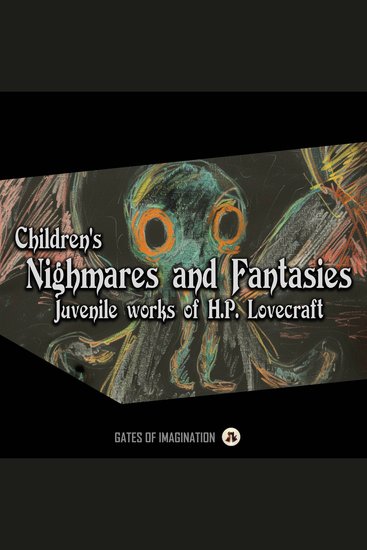
    This audiobook is narrated by an AI Voice. Collection of surviving tales from Lovecraft's childhood. Young Lovecraft wrote extensively, but being dissatisfied with his early work, he destroyed most of his youthful creations. Only 4 works survived, saved by the writer's mother: 
     
    - The Little Glass Bottle - The earliest existing fictional prose work by Lovecraft. A humorous tale about the naivety of a certain ship captain who was fooled by a message in a bottle speaking of a hidden treasure. Lovecraft drew a very simple map of the Indian Ocean for the text, marking the location where the treasure was hidden. The short story was saved from destruction by Lovecraft's mother. 
     
    -The Secret Cave, or John Lees adventure - The titular John Lee, in his parents' absence, sets off with his little sister to explore a cave discovered in the basement. 
     
    -  The Mystery of the Grave-Yard, or “A Dead Man’s Revenge” - Here's the translation into English: 
    The longest of Lovecraft's youthful tales. From the author's later annotation on the manuscript, we learn that he wrote it at the end of 1898 or the beginning of 1899. It is a plot-twisting, somewhat tersely described (12 chapters of about 50 words each) typical detective story, modeled after the dime novels that Lovecraft was avidly reading at the time. The name of the story's main character, detective King John, might have been a combination of the names of two dime novel heroes: Old King Brady (from Francis Worcester Doughty's prose) and Prince John (from Joseph Badger Jr.'s prose). 
     
    - The Mysterious Ship - The latest of Lovecraft's youthful stories. It consists of ten short chapters about a ship whose appearance in any port heralded the disappearance of people. Although it is decidedly one of Lovecraft's weaker stories from his youth, the author went to extraordinary lengths to "publish" it: he typed it, bound it in small covers, wrapped it in fabric, and finally sketched a ship on both sides. Moreover, he highly valued the story – he "demanded" 25 cents for it.
    Show book
  • No Living Voice - From their pens to your ears genius in every story - cover

    No Living Voice - From their...

    Thomas Street Millington

    • 0
    • 0
    • 0
    The bookshelves of British literature are incredible collections that have gathered together centuries of very talented authors.  From these Isles their fame spread and whilst among their number many are now forgotten or neglected their talents endure.  Among them is Thomas Street Millington.
    Show book
  • The Phantom Hearse - cover

    The Phantom Hearse

    Mary Fortune

    • 0
    • 0
    • 0
    The Phantom Hearse means death. Death always comes to the house where it’s sighted on moonlit evenings. But why does wicked old Jones love to talk about it so much? ¶ Mary Helena Fortune was a pioneer in detective fiction, albeit largely a unknown one. She travelled from Canada to Australia in 1855, where for the next fifty years, she contributed to magazines and newspapers under the pseudonyms “Waif Wanderer”, “W.W.”and her own initials “M.H.F.”. She wrote in a variety of genres: poetry, serialized novels, memoirs, and even gothic romance. But most significantly, she wrote over 500 detective stories. Her collection of stories, The Detective’s Album, by W.W. was published in 1871, and was described as, “The first book of detective stories to appear in Australia”. Only one copy is known to remain in existence. ¶ Mary Fortune helped delineate a few of the techniques significant in detective fiction. For example, the forensic manner in which the crime is treated, and delivering the story from the point of view of the detective. The Phantom Hearse also includes a supernatural element, which is also innovative, and synchronous with some Russian crime fiction.
    Show book