Join us on a literary world trip!
Add this book to bookshelf
Grey
Write a new comment Default profile 50px
Grey
Subscribe to read the full book or read the first pages for free!
All characters reduced
Marius the Epicurean (Vol 1&2) - Philosophical Novel - cover

Marius the Epicurean (Vol 1&2) - Philosophical Novel

Walter Pater

Publisher: Good Press

  • 0
  • 0
  • 0

Summary

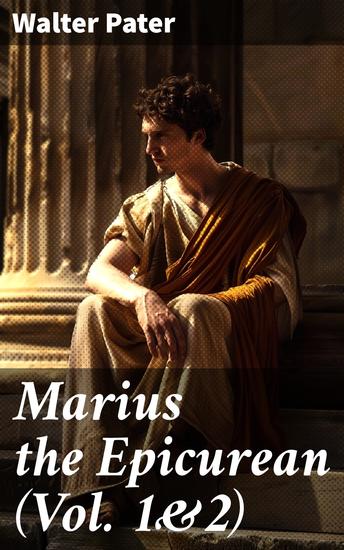
Walter Pater's "Marius the Epicurean" is a profound exploration of the philosophical and aesthetic dilemmas faced by its titular character in the tempestuous milieu of ancient Rome. Written in a richly descriptive and impressionistic style, the novel engages deeply with themes of hedonism, beauty, and the search for meaning amidst moral ambiguity. Pater immerses readers in a lush landscape of sensory experiences and intellectual reflections, capturing the essence of Epicurean thought while also critiquing its limitations against the backdrop of a decaying empire. The narrative delicately balances lush prose with thoughtful insights, marking it as a significant contribution to late 19th-century literature that anticipates modern existential concerns. Walter Pater (1839-1894) was an influential English essayist and critic, notably linked with the Aesthetic Movement and the pre-Raphaelite circle. His philosophical approach, particularly his emphasis on 'art for art's sake,' reflects his own engagement with the tensions between beauty and morality. Pater's scholarly background in Renaissance studies played a crucial role in shaping Marius's character as he navigates the ethical considerations of pleasure and intellect amidst the cultural decline of Rome. Readers seeking a nuanced and evocative exploration of philosophical inquiry embedded within a narrative rich with historical context will find "Marius the Epicurean" a compelling read. Pater's distinctive prose and profound ideas invite deep reflection, making this work not only a significant literary achievement but also a thought-provoking journey into the interplay of art, philosophy, and life itself.
Available since: 12/27/2023.
Print length: 292 pages.
Other books that might interest you

  • Unraveling Habits - An Alternative Approach to The Power of Habit - cover

    Unraveling Habits - An...

    MAX EDITORIAL

    • 0
    • 0
    • 0
    Presentation of the objectives of the book and the proposal to offer an alternative perspective to "The Power of Habit."Welcome to the book "Unveiling Habits: An Alternative Approach to The Power of Habit Book." In this work, we embark on a journey of exploring and questioning traditional theories about habits, presenting an alternative perspective to that proposed by the author Charles Duhigg in his acclaimed book.Since the publication of "The Power of Habit," many readers have been inspired by Duhigg's ideas about how habits shape our lives and how we can transform them to achieve success and happiness. However, while we recognize the merit of your contributions, we also believe that it is essential to question and deepen the understanding of the complex mechanisms that govern our automatic behaviors.Our approach is not simply to challenge Duhigg's work for contesting. On the contrary, we seek to expand knowledge on the subject of habits and to provide readers with a more complete and refined view of how they are formed, how they are maintained and how they can be modified.Our goal is to go beyond the simplistic idea that all habits follow a pattern of trigger-routine-reward, highlighting that habits are much more complex than this formula. We will investigate the influence of the social and cultural context on the formation of habits, as well as the importance of self-awareness for the change of entrenched behaviours.As we dive into this journey, we will seek support in recent research on neuroscience, behavioral psychology and other relevant disciplines. We will be looking for a deeper understanding of the brain connections that support habits, as well as identifying effective strategies for the adoption and maintenance of positive habits.Throughout the next chapters, we invite you to reflect with us and question the established premises without fear of exploring new horizons. Our intention is to offer a complementary rather than competitive approach to Duhigg's work, providing readers with a comprehensive and grounded view of the habits that govern our lives.We hope that, at the end of this journey, you will feel empowered to understand better the mechanics of habits and to make conscious choices that lead you to a healthier, more productive and satisfying life. Accompany us in discovering the nuances and secrets behind habits, and together we will unravel the power that they really exercise in our lives.
    Show book
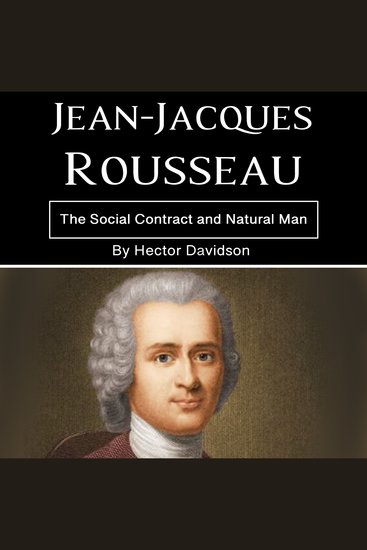
  • Jean-Jacques Rousseau - The Social Contract and Natural Man - cover

    Jean-Jacques Rousseau - The...

    Hector Davidson

    • 0
    • 0
    • 0
    Jean-Jacques Rousseau, one of the most influential philosophers of the 18th century, reshaped the landscape of political and social theory. His ideas, particularly those outlined in The Social Contract and Discourse on the Origin and Basis of Inequality Among Men, have had a profound impact on modern thought, influencing the French Revolution, the development of democratic ideals, and the evolution of social theory. Rousseau's philosophy is a reflection of his deep concern with the relationship between individuals and society, the nature of human freedom, and the consequences of civilization. 
    At the heart of Rousseau’s thought is his concept of the "state of nature," a condition in which humans existed before the corrupting influence of society. In this natural state, Rousseau argued, humans were free, equal, and solitary. Their basic needs were limited, and they acted primarily on instinct, guided by compassion and self-preservation. However, with the rise of private property, inequality began to emerge, leading to the social contract—a mechanism through which individuals could unite to form a collective body politic, agreeing to follow the “general will” for the common good. This social contract was Rousseau's answer to the problem of how to create a just society that respects both individual liberty and collective harmony. 
    Rousseau rejected the view that human beings are inherently selfish, as suggested by other philosophers like Hobbes. Instead, he believed that while civilization introduced inequality and competition, it also created the potential for true human freedom, which could only be realized in a political community that was based on the collective will of its people. Rousseau’s idea of the general will is central to his political theory. The general will is not simply the sum of individual desires but represents the collective interests that transcend personal ambitions, aiming for the common good.
    Show book
  • Surviving Master Joshua: The BDSM Memoir Of An Unfaithful Wife - cover

    Surviving Master Joshua: The...

    Karma Said

    • 0
    • 0
    • 0
    This is a true story. Master Joshua is a pansexual, polyamorous pro-Dom (a male Dominatrix). He leads a leather tribe and, when we met, was battling accusations of rape and abuse. Master Joshua was the intended subject of my story… until I became it. My own name doesn't matter. I can't use it here. Suffice it to say that I was a reporter and a comfortably married mother of two. But, following Joshua deeper and deeper into New York's sexual underground, I crossed the line between observer and participant. Our experiences changed me: I lied and cheated to facilitate them, though a lying cheater was not who I wanted to become. I wanted to remain a good wife and mother, and a decent person. So did Joshua. But we couldn't have our cake and eat it too… or could we? This is a true story, about one of the least understood and most sensationalized factions of LGBTQA+. But more so, it’s about my own family’s capacity to survive.  
     
    Show book
  • Günter Grass: A short biography - 5 Minutes: Short on time – long on info! - cover

    Günter Grass: A short biography...

    5 Minutes, 5 Minute Biographies,...

    • 0
    • 0
    • 0
    Günter Grass, literary world star and Nobel Prize laureate: Life and work in a short biography! Everything you need to know, brief and concise. Infotainment, education and entertainment at its best!
    Show book
  • No Time To Get Angry For Anyone I Have My Best Life To Live… - Simple And Effective Anger Management Methods For Women To Stay Calm Positive And Focused On The Goal Ahead - cover

    No Time To Get Angry For Anyone...

    The Winning Woman

    • 0
    • 0
    • 0
    At times, it can feel almost impossible not to become angry. 
    Whether it’s with a person, an event, or unforeseen circumstances, we all find ourselves starting to get very angry from time to time! 
    But some people are much better at handling these feelings of anger than others. 
    Perhaps you struggle to prevent your anger from taking control of you, and you want to become someone who can handle these issues and remain calm in the face of anger-inducing situations. 
    Introducing No Time To Get Angry For Anyone. I Have My Best Life To Live… This book will show you simple and effective anger management methods for women to stay calm, positive, and focused on the goal ahead. 
    Rather than allowing yourself to feel overcome with anger and frustration, this book will show you how to channel those emotions and instead think clearly, and positively and act accordingly. 
    Say goodbye to fits of rage and anger, and replace those feelings with happiness, relaxation, and productivity. 
    Inside No Time To Get Angry For Anyone. I Have My Best Life To Live..., discover: 
    ●     How to understand your anger and the anger of other women. 
    ●     The impact of anger issues on your life. 
    ●     The importance of anger management and the benefits from it. 
    ●     Steps to take control of your temper. 
    ●     How to deal with frustration effectively. 
    Isn’t it time you regained control of your life and let go of anger? 
    Grab a copy of No Time To Get Angry For Anyone. I Have My Best Life To Live… today!
    Show book
  • A Rare Recording of John Wanamaker Telling a Leo Tolstoy Anecdote - cover

    A Rare Recording of John...

    John Wanamaker

    • 0
    • 0
    • 0
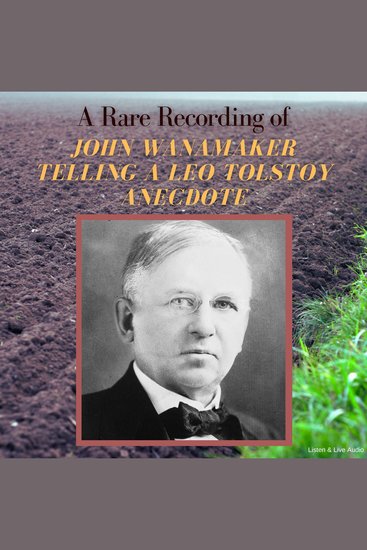
    Unable to make the 1908 Pennsylvania German Society's annual gathering due to illness, their president-- businessman, religious leader, and politician, John Wanamaker--sent in a message he recorded "through this wonderful invention of Mr. Edison on the Edison phonograph." This recording recalls an anecdote of Leo Tolstoy's, in which the Russian writer stopped at the roadside and asked a farmer who was ploughing, "Friend, what would you do today if you knew positively you would die tomorrow?" 
     
    John Wanamaker (July 11, 1838 - December 12, 1922), born in Philadelphia, was a religious, civic, and political figure, as well as, founder of one of the first American department stores. He was considered a proponent of advertising and a "pioneer in marketing." In addition, Wanamaker served as U.S. Postmaster General from 1889 to 1893 during the term of U.S. President Benjamin Harrison.
    Show book