Join us on a literary world trip!
Add this book to bookshelf
Grey
Write a new comment Default profile 50px
Grey
Subscribe to read the full book or read the first pages for free!
All characters reduced
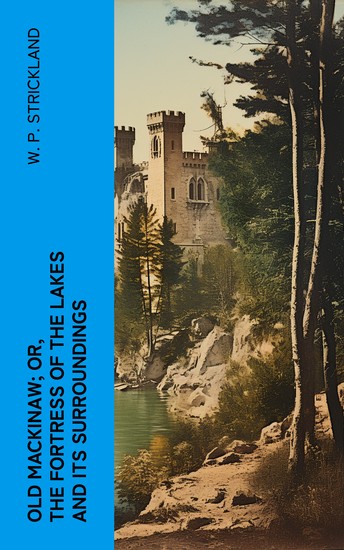
Old Mackinaw; Or The Fortress of the Lakes and its Surroundings - cover

Old Mackinaw; Or The Fortress of the Lakes and its Surroundings

W. P. Strickland

Publisher: e-artnow

  • 0
  • 0
  • 0

Summary

"Old Mackinaw; Or, The Fortress of the Lakes and its Surroundings" by W. P. Strickland. Published by e-artnow. e-artnow publishes a wide range of titles that encompasses every genre. From well-known classics & literary fiction and non-fiction to forgotten−or yet undiscovered gems−of world literature, we issue the books that need to be read. Each e-artnow edition has been meticulously edited and formatted to boost readability for all e-readers and devices. Our goal is to produce eBooks that are user-friendly and accessible to everyone in a high-quality digital format.
Available since: 11/23/2023.
Print length: 566 pages.

Other books that might interest you

  • Phocion - Good Citizen in a Divided Democracy - cover

    Phocion - Good Citizen in a...

    Thomas R. Martin

    • 0
    • 0
    • 0
    "Elegant and enlightening." —Dominic Green, Wall Street Journal 


    Phocion (402–318 BCE) won Athens's highest public office by direct democratic election an unmatched forty-five times and was officially honored as a "Useful Citizen." A student at Plato's Academy, Phocion gained influence and power during a time when Athens faced multiple crises stemming from Macedonia's emergence as an international power under Philip II and his son Alexander the Great. Following Athens's defeat by Macedonia, Phocion unsuccessfully sought mild terms of surrender. Oligarchy was imposed on democratic Athens, and more than twelve thousand "undesirable" Athenians were exiled. When the oligarchic regime was overthrown and the exiles returned, dispossessed Athenians took out their volcanic anger on Phocion, who throughout his career had often been a harsh critic of the citizens' political decisions. His inflammatory rhetoric contributed to the popular conclusion that he lacked a genuine sense of belonging to the community he wished so desperately to preserve. When he was eighty-four, the Athenians convicted him of treason and condemned him to die by hemlock. In this fresh biography, Thomas R. Martin explores how and why Phocion ultimately failed as a citizen and as a leader. His story offers unsettling lessons for citizens in democracies today.
    Show book
  • FUCK YOUR NEGATIVE THOUGHTS - Overcoming Self-Sabotage and Cultivating a Positive Mindset (2023 Beginner Guide) - cover

    FUCK YOUR NEGATIVE THOUGHTS -...

    Kyla Pearson

    • 0
    • 0
    • 0
    "Fuck Your Negative Thoughts: Overcoming Self-Sabotage and Cultivating a Positive Mindset" is your no-nonsense guide to breaking free from the cycle of self-doubt and negativity, empowering you to reclaim control over your thoughts and emotions. This book provides practical tools and strategies to help you overcome the grip of negative thinking and foster a resilient and optimistic mindset. 
    Inside this empowering guide, you'll discover:Understanding Negative Thought Patterns: An insightful exploration of the origins and impacts of negative thought patterns and their influence on your emotional well-being.Reframing Techniques: Practical tools for reframing negative thoughts into positive affirmations and constructive self-talk.Cognitive Restructuring Strategies: Techniques for challenging and restructuring negative cognitive distortions to foster a more balanced and realistic perspective.Building Resilience and Self-Compassion: Strategies for building emotional resilience and fostering self-compassion to navigate setbacks and challenges with grace and determination.Gratitude and Positivity Cultivation: Insights into the transformative power of gratitude practices and positive thinking to rewire your brain for optimism and abundance.Behavioral Change Techniques: Practical exercises and behavior modification strategies to align your actions with your positive mindset and foster lasting change. 
    This guide equips you with the tools and insights to break free from the grip of negative thinking and embrace a life filled with self-confidence and optimism. Rediscover the power of your thoughts and rewrite your narrative to one of empowerment and possibility.
    Show book
  • Ancient Empires - The Rise and Fall of the Akkadian Byzantine Mongolian and Ottoman Empire - cover

    Ancient Empires - The Rise and...

    Kelly Mass

    • 0
    • 0
    • 0
    You are in luck, because you are getting extra material out of this combo. The following topics are going to be addressed: 
    Part 1: The Akkadian Empire is one of the oldest civilizations we know of. Dating back to a few thousand years B.C., it presents itself with some archaeological finds, as well as long-forgotten mysteries and unanswered questions that will probably remain that way. 
    However, despite of the many secrets this advanced, vast empire holds, it could definitely be worth our time to explore some of the things we do know. 
    Part 2: The Byzantine Empire has often been overlooked. Yet, this vast empire last for hundreds of years and has had a major impact on the world religions and politics even into the past century. 
    The Byzantine Empire was heavily influenced by the Romans and the Christian culture. Several centuries A.D. It was marked by conquests, emperors, rules, orthodoxy, and the giant capital of Constantinople (which is now Istanbul). 
    Part 3: The Mongolian Empire was not to be trifled with! Genghis Khan and his followers conquered a vast part of Asia, Europe, and beyond. There aren’t many people who haven’t heard of these conquerors and their achievement. Honor them or despise them, but at least acknowledge their existence. 
    How did the Mongol Empire grow so big? 
    What was it like before the expansion? 
    And how come Mongolia is an area with such a small population now? 
    These questions and many others will be answered in this historical guide. 
    Part 4: The Ottoman Empire was so big and lasted for so long, yet it is one of those empires that many common people have forgotten about. The people who lived in what is now Turkey, and in surrounding areas, were mostly devout Muslims who were defending their beliefs and trying to expand the realm to conquer more territory. Shockingly, the empire was slowly falling apart by the time the 20th century came around the corner.
    Show book
  • Class War - A Literary History - cover

    Class War - A Literary History

    Mark Steven

    • 0
    • 0
    • 0
    A bold new history of the global class war 


    A thrilling and vivid work of history, Class War weaves together literature and politics to chart the making and unmaking of social class through revolutionary combat. In a narrative that spans the globe and more than two centuries of history, Mark Steven traces the history of class war from the Haitian Revolution to Black Lives Matter. 


    Surveying the literature of revolution, from the poetry of Shelley and Byron to the novels of Émile Zola and Jack London, exploring the writings of Frantz Fanon, Che Guevara, and Assata Shakur, Class War reveals the interplay between military action and the politics of class, showing how solidarity flourishes in times of conflict. Written with verve and ranging across diverse historical settings, Class War traverses industrial battles, guerrilla insurgencies, and anticolonial resistance, as well as large-scale combat operations waged against capitalism's regimes and its interstate system. 


    In our age of economic crisis, ecological catastrophe, and planetary unrest, Steven tells the stories of those whose actions will help guide future militants toward a revolutionary horizon.
    Show book
  • Spain’s Explorers in the Age of Discovery - cover

    Spain’s Explorers in the Age of...

    Editors Charles River

    • 0
    • 0
    • 0
    The most seminal event of the last millennium might also be its most controversial. As schoolchildren have been taught for over 500 years, “In 1492 Columbus sailed the ocean blue.” In October of that year, the Italian Christopher Columbus immortalized himself by landing in the New World and beginning the process of European settlement in the Americas for Spain, bringing the Age of Exploration to a new hemisphere with him. Ironically, the Italian had led a Spanish expedition, in part because the Portugese rejected his offers in the belief that sailing west to Asia would take too long. 
    If Columbus and Cortés were the pioneers of Spain’s new global empire, Pizarro consolidated its immense power and riches, and his successes inspired a further generation to expand Spain’s dominions to unheard of dimensions. Furthermore, he participated in the forging of a new culture: like Cortés, he took an indigenous mistress with whom he had two mixed-race children, and yet the woman has none of the lasting fame of Cortés’s Doña Marina. With all of this in mind, it is again remarkable that Pizarro remains one of the less well-known and less written about of the explorers of his age. 
    Today Ferdinand Magellan is remembered as the first man to circumnavigate the globe, an ironic legacy given that he died half a world away from completing that journey. But though it ended catastrophically for Magellan and most of his crew, his expedition accomplished its objective, and in economic terms, the opening up of new trade routes with Asia was a more significant development than the conquest of the Americas for the Europeans of the early 16th century.
    Show book
  • Consciousness - Where Did It Come From and Where Is It Going? - cover

    Consciousness - Where Did It...

    Ylia Callan

    • 0
    • 0
    • 0
    This audiobook is narrated by an AI Voice.   
    What is consciousness, and why does it matter? Is it a byproduct of the brain, a reflection of the cosmos, or the very fabric of reality itself? Consciousness – Where Did It Come From and Where Is It Going? takes listeners on a profound journey through the mysteries of awareness, exploring both the science and the spirit of mind. 
    From leading theories such as Integrated Information Theory and Global Workspace Theory, to deeper explorations of memory, dreams, the self, and even the quantum question, this audiobook illuminates the many faces of consciousness. It traces the evolution of awareness - from the earliest stirrings of life’s inner eye, to the possibility of a universal consciousness shaping the cosmos. 
    With clarity and depth, the chapters reveal consciousness as both a scientific puzzle and a timeless mystery. Is the self an illusion? Can dreams open gateways to hidden dimensions of mind? What role does the body play in shaping awareness? And most importantly, what might the future of consciousness hold for humanity and beyond? 
    Whether you are fascinated by neuroscience, intrigued by philosophy, or drawn to the spiritual dimensions of mind, this audiobook offers a sweeping exploration of one of the greatest questions of existence: Where did consciousness come from - and where is it going?
    Show book