Join us on a literary world trip!
Add this book to bookshelf
Grey
Write a new comment Default profile 50px
Grey
Subscribe to read the full book or read the first pages for free!
All characters reduced
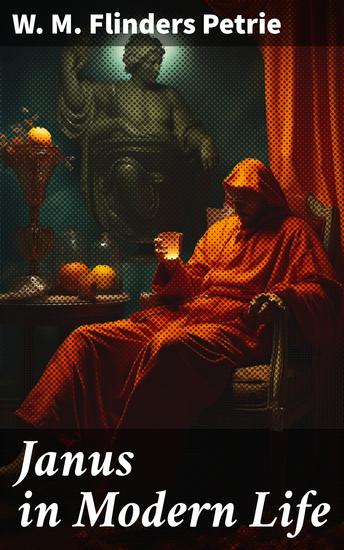
Janus in Modern Life - Exploring Duality in Modern Society - cover

Janus in Modern Life - Exploring Duality in Modern Society

W. M. Flinders Petrie

Publisher: Good Press

  • 0
  • 0
  • 0

Summary

In "Janus in Modern Life," W. M. Flinders Petrie explores the duality of human experience through a lens that fuses classical scholarship with contemporary observations. The title references the Roman deity Janus, symbolizing beginnings, transitions, and duality, which serves as a metaphor throughout the text for the complexities of modern existence. Petrie's narrative eruditely oscillates between detailed archaeological insights and philosophical reflections, calling upon historical contexts to frame contemporary dilemmas in an increasingly fragmented society. The book challenges readers to introspectively engage with the nuanced perspectives of past and present, urging an understanding of life'Äôs transitions. W. M. Flinders Petrie, renowned as the father of modern archaeology, was not only instrumental in revolutionizing the field but was also a keen observer of cultural shifts. His background in both science and the humanities imbued his writing with a unique authority; Petrie understood how history echoes in the human condition. His extensive fieldwork and academic pursuits shaped his worldview, prompting a desire to elucidate the lessons history offers regarding modern life'Äôs challenges. Readers seeking a thought-provoking examination of identity, time, and societal change will find "Janus in Modern Life" indispensable. Petrie'Äôs ability to intertwine scholarly rigor with accessible prose invites both academic and casual readers alike to reflect on their positions within a continuum of human experience, making this work a timeless addition to the study of social dynamics.
Available since: 11/03/2023.
Print length: 78 pages.

Other books that might interest you

  • Mr Prohartchin - Poverty Pride and the Tragic Irony of a Miser’s Life - cover

    Mr Prohartchin - Poverty Pride...

    Fyodor Dostoevsky, Tim Zengerink

    • 0
    • 0
    • 0
    He lived simply. He died quietly. Then the truth came out. 
    In Mr. Prohartchin, Fyodor Dostoevsky reveals the inner life of a lonely, tight-fisted man scorned by his neighbors. Through subtle storytelling and emotional detail, the story explores how poverty, shame, and pride shape the way we live—and how we’re remembered after we’re gone. 
    This modern audiobook adaptation brings fresh clarity and rhythm to Dostoevsky’s understated tale, preserving its quiet intensity while making it accessible for today’s listeners. 
    What You’ll Hear in This Modern Translation: 
    •	A revealing story about a reclusive man’s misunderstood life 
    •	Rich insights into human judgment, insecurity, and secret generosity 
    •	A quiet tragedy wrapped in subtle irony and deep empathy 
    Included in This Edition: 
    Updated for clarity and modern sensibilities, this audiobook presents Dostoevsky’s tale with emotional nuance and accessibility—perfect for fans of psychological fiction and hidden gems from classic literature. 
    Listen today—and uncover the truth behind a life no one bothered to understand.
    Show book
  • Resilient Grieving Second Edition - How to Find Your Way Through a Devastating Loss - cover

    Resilient Grieving Second...

    PhD Lucy Hone, PhD Karen Reivich

    • 0
    • 0
    • 0
    The death of someone we hold dear may be inevitable; being paralyzed by our grief is not. Recent research has revealed our capacity for resilient grieving, our innate ability to respond to traumatic loss by finding ways to grow—by becoming more engaged with our lives, and discovering new, profound meaning. 


    In this completely updated and expanded second edition, author and resilience/well-being expert Lucy Hone, a pioneer in positive psychology and bereavement research, continues to push her field forward. In 2014, Lucy was faced with her own inescapable sorrow after her twelve-year-old daughter was killed in a car accident. By following the strategies of resilient grieving, she found a proactive way to move through her grief, and, over time, embrace life again. Since then, Lucy has become a leading voice in resilience and bereavement science, overturning widely held myths and misconceptions, making plain the harms of rigid models such as Kübler-Ross's five stages, and advocating for a more adaptive grieving process that emphasizes emotions, relationships, attention, forgiveness, and self-compassion. 


    As heard on NPR's Hidden Brain and CBS News 


    2017 Foreword INDIES Bronze Winner
    Show book
  • Asian Deities and Demons - Myths and Legends from the East - cover

    Asian Deities and Demons - Myths...

    Odessa Nightshade

    • 0
    • 0
    • 0
    Mythology has always been a reflection of human culture, shaping beliefs, traditions, and the way people understand the world. Across Asia, an incredibly diverse range of myths and legends has developed over thousands of years, creating a rich spiritual tapestry that continues to influence daily life. These myths tell stories of powerful deities who govern the heavens, fearsome demons that bring destruction, and legendary heroes whose deeds inspire generations. Whether found in Hindu, Buddhist, Shinto, or Taoist traditions, these stories reveal deep cultural values and offer insights into the forces that ancient civilizations believed controlled their destinies.  
      
    Deities and demons in Asian mythology are not merely figures of worship or fear; they serve as representations of human emotions, natural phenomena, and moral lessons. Many gods and spirits embody forces of nature—thunder, wind, fire, and water—while others symbolize virtues such as wisdom, courage, and compassion. Some deities are benevolent protectors, while others test humanity through trials and temptations. Meanwhile, demons and malevolent spirits serve as cautionary figures, reminding people of the consequences of greed, arrogance, or disobedience to the divine order. These myths have been passed down through oral tradition, sacred texts, and artistic expressions, evolving over time yet retaining their core significance. 
    Show book
  • Thinking about Thinking - cover

    Thinking about Thinking

    Darin Jewell

    • 0
    • 0
    • 0
    "Thinking About Thinking" is a based on a series of lectures delivered at Harvard University in 1996 by Professors Alan Dershowitz (lawyer), Robert Nozick (philosopher) and Stephen Jay Gould (paleontologist) about perennial issues such as truth, free will, race, gender and religion.
    Show book
  • Serenity in the Storm - Living Through Chaos by Leaning on Christ - cover

    Serenity in the Storm - Living...

    Kayleigh McEnany

    • 0
    • 0
    • 0
    Kayleigh McEnany brings to life the key cultural and political issues of our time,  analyzing world events through the lens of faith and providing listeners with Serenity in the Storm. 


    Our world, without question, is experiencing aberrational times. The life-altering realities of COVID-19 that I worked through as White House press secretary were just the start of it. What followed was a series of history-defining events. From the fall of Afghanistan to the nationwide crime wave, we've all endured painful images of death, destruction, and chaos. Meanwhile, radical teachings on gender and race have infiltrated our nation's schools, poisoning the minds of our children—all at a time when our country feels more divided than ever before. Along with these twenty-first century realities can come a feeling of despair and discouragement. Indeed, I hear it all the time as I crisscross the country: Americans feel disheartened and seek hope. 


    Taking a similar format to my New York Times bestselling book, For Such a Time as This, I analyze our domestic and international challenges through the lens of faith. Though we have lived through dark times, the storms we face have prompted many great leaders to rise to the moment and have left a yearning in the human heart for a Savior, Jesus Christ, who is walking alongside us every step of the way.
    Show book
  • The Winter's Tale - cover

    The Winter's Tale

    William Shakespeare

    • 0
    • 0
    • 0
    The Winter's Tale is a play by William Shakespeare, originally published in the First Folio of 1623. Although it was grouped among the comedies, some modern editors have relabelled the play as one of Shakespeare's late romances. Some critics consider it to be one of Shakespeare's "problem plays", because the first three acts are filled with intense psychological drama, while the last two acts are comedic and supply a happy ending. The play has been intermittently popular, revived in productions in various forms and adaptations by some of the leading theatre practitioners in Shakespearean performance history, beginning after a long interval with David Garrick in his adaptation called Florizel and Perdita (first performed in 1754 and published in 1756).    The Winter's Tale was revived again in the 19th century, when the third "pastoral" act was widely popular. In the second half of the 20th century The Winter's Tale in its entirety, and drawn largely from the First Folio text, was often performed, with varying degrees of success. Short Summary of the Tale: John Fawcett as Autolycus in "The Winter's Tale" (1828) by Thomas Charles Wageman. Following a brief setup scene the play begins with the appearance of two childhood friends: Leontes, King of Sicilia, and Polixenes, the King of Bohemia. Polixenes is visiting the kingdom of Sicilia, and is enjoying catching up with his old friend. However, after nine months, Polixenes yearns to return to his own kingdom to tend to affairs and see his son. Leontes desperately attempts to get Polixenes to stay longer, but is unsuccessful. Leontes then decides to send his wife, Queen Hermione, to try to convince Polixenes. Hermione agrees and with three short speeches is successful. Leontes is puzzled as to how Hermione convinced Polixenes so easily, and Leontes suddenly goes insane and suspects that his pregnant wife has been having an affair with Polixenes and that the child is a bastard. Leontes orders Camillo, a Sicilian Lord, to poison Polixenes. Camillo instead warns Polixenes and they both flee to Bohemia.    Furious at their escape, Leontes now publicly accuses his wife of infidelity, and declares that the child she is bearing must be illegitimate. He throws her in prison, over the protests of his nobles, and sends two of his lords, Cleomenes and Dion, to the Oracle at Delphi for what he is sure will be confirmation of his suspicions. Meanwhile, the queen gives birth to a girl, and her loyal friend Paulina takes the baby to the king, in the hopes that the sight of the child will soften his heart. He grows angrier, however, and orders Paulina's husband, Lord Antigonus, to take the child and abandon it in a desolate place. Cleomenes and Dion return from Delphi with word from the Oracle and find Hermione publicly and humiliatingly put on trial before the king. She asserts her innocence, and asks for the word of the Oracle to be read before the court. The Oracle states categorically that Hermione and Polixenes are innocent, Camillo an honest man, and that Leontes will have no heir until his lost daughter is found. Leontes shuns the news, refusing to believe it as the truth. As this news is revealed, word comes that Leontes' son, Mamillius, has died of a wasting sickness brought on by the accusations against his mother. Hermione, meanwhile, falls in a swoon, and is carried away by Paulina, who subsequently reports the queen's death to her heartbroken and repentant husband. Leontes vows to spend the rest of his days atoning for the loss of his son and his queen.
    Show book