Join us on a literary world trip!
Add this book to bookshelf
Grey
Write a new comment Default profile 50px
Grey
Subscribe to read the full book or read the first pages for free!
All characters reduced
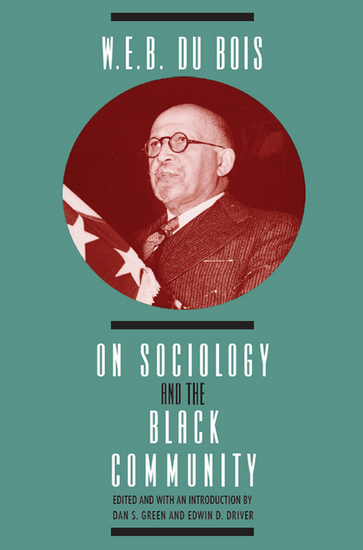
W E B DuBois on Sociology and the Black Community - cover

W E B DuBois on Sociology and the Black Community

W. E. B. Du Bois

Publisher: The University of Chicago Press

  • 0
  • 0
  • 0

Summary

Historian, journalist, educator, and civil rights advocate W. E. B. Du Bois was perhaps most accomplished as a sociologist of race relations and of the black community in the United States. This volume collects his most important sociological writings from 1898 to 1910. The eighteen selections include five on Du Bois's conception of sociology and sociological research, especially as a tool in the struggle for racial justice; excerpts from studies of black communities in the South and the North, including The Philadelphia Negro; writings on black culture and social life, with a selection from The Negro American Family; and later works on race relations in the United States and elsewhere after World War II. This section includes a powerful fiftieth-anniversary reassessment of his classic 1901 article in the Atlantic in which he predicted that "the problem of the twentieth century is the problem of the color line." The editors provide an annotated bibliography, a lengthy overview of Du Bois's life and work, and detailed introductions to the selections. "The most significant contribution of this book is its inclusive look at Du Bois as both academic and activist. . . . Individuals interested in the study of social issues and political sociology would benefit from reading and discussing this book."—Paul Kriese, Sociology: Reviews of New Books "Green and Driver, informing this volume with a 48-page essay that summarizes Du Bois' career and places him in the context of the profession, have intelligently organized his writings. . . . A welcome contribution that should have wide use."—Elliott Rudwick, Contemporary Sociology
Available since: 11/15/2013.
Print length: 330 pages.
Other books that might interest you

  • The History and Legacy of Asia Minor’s Most Important Ancient Civilizations - cover

    The History and Legacy of Asia...

    Editors Charles River

    • 0
    • 0
    • 0
    The pages of world history textbooks contain a litany of “lost” empires and civilizations, but usually, upon further review, it is revealed that these so called lost empires are often just lesser known cultures that had a less apparent impact on history than other more well-known civilizations. When one scours the pages of history for a civilization that was inexplicably lost, but had a great impact during its time, very few candidates can be found, but the Hittites are a notable example. In fact, the Hittites are an ancient people who remain somewhat enigmatic, and perhaps little known to most people, but their influence on the ancient Near East is undeniable. From high on their capital of Hattusa in central Anatolia, the Hittites were able to conquer and control a kingdom that roughly comprised the area of the modern nation-states of Turkey, Syria, and parts of Iraq and Lebanon. 
    Among the peoples of the ancient Near East, few are more misunderstood than the Scythians. The Scythians swept into Anatolia in the early first millennium BCE and left a large swath of destruction in their wake. They challenged old, strong, and venerable kingdoms such as the Assyrians, Egyptians, and Medes, until they were defeated by the Medes and then gradually disappeared into historical obscurity once more. According to the ancient Greek historian Herodotus, the Scythians ruled a large part of the Near East for nearly 30 years, but before they disappeared from the historical record, the Scythians greatly impacted the history of the Near East. 
    Of all the empires and kingdoms in the ancient world, few could compare with the Lydians in terms of wealth and opulence. From the early 7th century BCE until the middle of the 6th century BCE, the Lydians played an important role in the history of the eastern Mediterranean region as they took on the role of middleman between the empires of the Near East and the emerging Hellenic civilization in Greece.
    Show book
  • Ultimate Guide to Extraordinary Greatness in Life - cover

    Ultimate Guide to Extraordinary...

    Sachin Naha

    • 0
    • 0
    • 0
    Unlock Your Exceptional Potential with "Ultimate Guide to Extraordinary Greatness in Life"! This inspiring book is your roadmap to personal and professional success. Each chapter is packed with practical strategies that help you discover your true self, cultivate a positive mindset, and set clear, achievable goals. Learn how to develop empowering habits, face your fears, and foster strong relationships while maintaining a balanced life. With insights on resilience, innovation, and effective leadership, this guide will not only inspire you to strive for greatness but also equip you with the tools to enjoy the journey. Dive in and start transforming your life today! 
    Show book
  • God and Race: Audio Bible Studies - A Guide for Moving Beyond Black Fists and White Knuckles - cover

    God and Race: Audio Bible...

    John Siebeling, Wayne Francis

    • 0
    • 0
    • 0
    How you—and your church community—can play a part in ending racism.  
    Pastors John Siebeling and Wayne Francis—whose thriving congregations are the embodiment of diversity—have pooled their insights and experiences to help others have conversations about racism. Many churches and leaders have sought their counsel, hoping to emulate their success, and yours can too. 
    God and Race provides a non-threatening means for pastors, church leaders, and churchgoers to speak to each other about this difficult and pervasive problem. In this audio study, Wayne and John show how neither black fists nor white knuckles are the answer to the problem, but that what is needed are open hands, open hearts, and open minds. Together, they:Examine the White-Black tension from both perspectives.Answer all the uncomfortable questions we're afraid to ask—regarding ourselves, our families, our work and relationships, and the church.Discuss seven key statements that they believe the church needs to acknowledge today—including that racism is a real problem, that it's more than just a spiritual issue, and that the Gospel is the solution.Provide practical steps anyone can take to become part of the solution. 
    In the Gospels, we see how the crowds came to Jesus because he talked about real issues and was not afraid to engage in the important issues of his day. In the church of today, we need to be doing the same: only by recognizing, addressing, and openly dialoguing about the racial tension in America can we begin to work toward real solutions together. 
    _______________________ 
    Coordinating study guide available separately.  
    The Audio Bible Studies series provides a unique audio learning experience. Unlike a traditional audiobook's direct narration of a book's text, this audio Bible study includes high-quality, live audio sessions from the author that cover important Bible-based topics. These sessions will reflect the ambiance of the unique recording locations, immersing the listener into the teaching. While not required for the audio experience, these studies are designed to partner with the coordinating study guide, sold separately.
    Show book
  • Rain of Ruin - Tokyo Hiroshima and the Surrender of Japan - cover

    Rain of Ruin - Tokyo Hiroshima...

    Richard Overy

    • 0
    • 0
    • 0
    A leading historian of World War II sheds new light on the purposes and impact of the U.S. incendiary and atomic bombing of Japan’s cities in 1945. 
      
    With the development of the B-29 “Superfortress” in summer 1944, strategic bombing, a central component of the Allied war effort against Germany, arrived in the Pacific theater. In 1945 Japan experienced the three most deadly bombing attacks of the war. The firebombing of Tokyo in March burned the city’s most densely populated sector, killed some 85,000 residents, and left more than one million homeless. The attack was part of a months-long campaign of incendiary bombing that destroyed almost two-thirds of Japan’s cities. The two atomic blasts in August killed hundreds of thousands in Hiroshima and Nagasaki, most of them civilians. The bombing brought a destabilizing devastation that, combined with a declaration of war by the Soviet Union, induced Japan, as they put it, to terminate the war. 
      
    Many at the time and since have credited American air power, and especially the two atomic bombs, with Japan’s surrender. But Richard Overy tells a different, more dimensional story. Drawing on his expertise on the war and its bombing campaigns, he delivers a precise recounting of these aerial attacks, and a balanced, informed assessment of how and why they occurred. Overy is astute on the Allied decision-making, and, notably, integrates the Japanese leadership as well. He ably navigates the dramatic endgame of the war, which featured factional infighting within the Japanese cabinet, a scramble by American officials to formulate an acceptable version of “unconditional surrender,” and the crucial role played by the emperor, Hirohito. The atomic bombing emerges as impactful but not decisive in this rich, multilayered history.
    Show book
  • Writers - Genius Writers from the 20th Century and Before - cover

    Writers - Genius Writers from...

    Kelly Mass

    • 0
    • 0
    • 0
    This is a compilation of 6 different titles, which are about the following topics: 
    1: Charles Dickens is often remembered because of his Christmas Carol. And even though that is a very interesting novel, it wasn’t even his favorite. Some artists and authors claim that a work of art or a novel should be completely separated from the creator. 
    2: Perhaps you have heard of Edgar Allan Poe. Perhaps not. Either way, this 19th-century author has received quite some fame for his works and his unique style. His mystery and gruesome horror stories, comedy, and other genres have reached far into the depths of American literature. 
    3: Jane Austen is well-known for some famous books, among which the popular “Pride and Prejudice.” As an author in the early 1800s, many people may envision pretty dresses and fancy demeanor, but the reality of her life included some hardships as well that may not be so obvious by reading her novels. 
    4: Mark Twain is arguably one of the most famous authors in the United States, with his books Tom Sawyer and Huckleberry Finn. His characters were a typical and yet deviant episode of the time period in which he lived, depicting the circumstances under which many people lived. 
    5: Oscar Wilde was a wild one. His statements were bold, his career was successful, and his tongue was sharp. Not only did he disturb the common narrative of the nuclear family, the Catholic church, and the idea of patriotism, but he also blew many people away with his defense of his principles, his criticism on the state, philosophies on life itself, etc. 
    6: William Shakespeare is the celebrated script writer of the most popular plays in the English language. By writing both tragedies, romances, and comedies in the 16th century, he made a name for himself and became successful in the art of drama.
    Show book
  • Light in Bandaged Places - Healing in the Wake of Young Betrayal - cover

    Light in Bandaged Places -...

    Liz Kinchen

    • 0
    • 0
    • 0
    Light in Bandaged Places shows us the harm done when an older man in a position of power convinces a child that sex with him is alright because he loves her. This poignant story takes us through the long-term wounding of such abuse, and the multifaceted path of healing. 
    As a lonely girl coming of age in the 1970s, Liz has every reason to believe her 8th-grade teacher is in love with her. Because the sex isn’t physically violent and is wrapped in a message of love, she learns to exchange sex for attention. But years later, as an adult, emotional closeness eludes Liz. Even after marrying a sensitive, caring man, she is walled off. Struggling through confusing years, she believes something is deeply wrong with her. 
    Healing begins when an unexpected event takes Liz back to those formative years, and she sees for the first time that what happened to her was not love but abuse. As she begins to understand how her relationship with her former teacher destroyed her innocence and self-worth, she begins a spiritual and psychological journey that sets her free. 
    Now a meditation teacher and Buddhist practitioner, Liz offers her story in hope of helping others along their own paths of discovery and healing.
    Show book