Join us on a literary world trip!
Add this book to bookshelf
Grey
Write a new comment Default profile 50px
Grey
Subscribe to read the full book or read the first pages for free!
All characters reduced
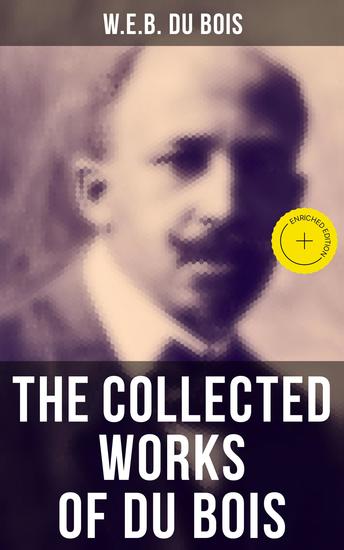
The Collected Works of Du Bois - Enriched edition The Souls of Black Folk The Suppression of the African Slave Trade Darkwater The Black North… - cover

The Collected Works of Du Bois - Enriched edition The Souls of Black Folk The Suppression of the African Slave Trade Darkwater The Black North…

W. E. B. Du Bois

Publisher: Musaicum Books

  • 0
  • 0
  • 0

Summary

W.E.B. Du Bois' 'The Collected Works of Du Bois' is a groundbreaking collection of essays, poems, and speeches that delve deep into the prevailing issues of race, class, and equality in America. Du Bois' unparalleled ability to blend academic rigor with emotional depth makes this book a masterpiece of civil rights literature. His use of vivid imagery and poignant language showcases his passion for social justice and his firm belief in the power of education. With essays such as 'The Souls of Black Folk' and 'The Talented Tenth,' Du Bois challenges the status quo and advocates for meaningful change in society. Born in 1868, W.E.B. Du Bois was a prominent Civil Rights activist, sociologist, and historian. As a co-founder of the NAACP, he dedicated his life to advocating for racial equality and social justice. His experiences as an African American living in a racially divided society inspired him to write 'The Collected Works of Du Bois,' a testament to his unwavering commitment to fighting injustice. I highly recommend 'The Collected Works of Du Bois' to readers interested in delving into the complexities of race relations, social inequality, and the history of civil rights in America. Du Bois' timeless writings continue to resonate today, serving as a powerful reminder of the importance of fighting for equality and justice for all.

In this enriched edition, we have carefully created added value for your reading experience:
- A comprehensive Introduction outlines these selected works' unifying features, themes, or stylistic evolutions.
- The Author Biography highlights personal milestones and literary influences that shape the entire body of writing.
- A Historical Context section situates the works in their broader era—social currents, cultural trends, and key events that underpin their creation.
- A concise Synopsis (Selection) offers an accessible overview of the included texts, helping readers navigate plotlines and main ideas without revealing critical twists.
- A unified Analysis examines recurring motifs and stylistic hallmarks across the collection, tying the stories together while spotlighting the different work's strengths.
- Reflection questions inspire deeper contemplation of the author's overarching message, inviting readers to draw connections among different texts and relate them to modern contexts.
- Lastly, our hand‐picked Memorable Quotes distill pivotal lines and turning points, serving as touchstones for the collection's central themes.
Available since: 03/21/2018.
Print length: 750 pages.

Other books that might interest you

  • Bricks that Build Us Book 2 - Family and a successful childhood concerning constructive beliefs and influences Christian virtues philosophy's rolecommunity with fallible education and law - cover

    Bricks that Build Us Book 2 -...

    Rob Howat

    • 0
    • 0
    • 0
    Since you recognize that things are going dangerously wrong both worldwide and on our streets, this is a series of four short books for you. They develop the calling for immediate action with many of the avoidable causes identified, listed and remedies stated clearly all in 'crystal clear' language. Now is the time to push back and protect our loved ones, our young, those who are vulnerable and all our futures. Later may well be too late. For many thinking people there is a well-founded and growing disquiet about where our world is going. Undeniably we observe that wasteful preoccupation with owning things which has replaced family values, sound reason, decency and necessary self-discipline for far too many. The me-first society focuses upon personal gratification while rejecting the more central need to think and work together to maintain our community and social family. Discarded is the we-first, polite and supportive normality of quieter times, led now by the shallow, self-interested more grotesque ideas, ideals and human actors. Through this storm of mediocracy and shallow existence can be heard the tramping of media moguls, the infected internet and dead actors of artificial "intelligence", cold scam 'phone callers that daily threaten our loved ones and us. We must most urgently identify our enemies with their manipulative control methods and develop effective counterarguments with successful countermeasures. Unified, self-disciplined, clarified actions, focused on restoring our interdependent caring communities, can and will successfully rebuild common sense and social sanity one brick at a time.
    Show book
  • The Death of Stalin - cover

    The Death of Stalin

    Sheila Fitzpatrick

    • 0
    • 0
    • 0
    The personal and the political collide in this masterful account of the death of a dictatorWhen Joseph Stalin died in 1953, he had been the unchallenged leader of the Soviet Union for over twenty years, having presided over the ruthless modernisation of the early 1930s, the Great Purges later in the decade, the near-catastrophe and ultimate victory of World War II, and the country's postwar emergence as a superpower. He was surrounded by a cult that made him seem godlike; no successors were in sight. His death was bound to be a deeply unsettling event, both in the Soviet Union and elsewhere.Sheila Fitzpatrick draws on her unparalleled knowledge of Stalin's circle and Soviet society to tell a tale that blends black comedy with forensic analysis, exploring the problems and opportunities -- often missed -- created by the death of the dictator. The final chapter deals with Stalin's eventful afterlife, including his recent resurrection in Putin's Russia. This is both a riveting read and a salutary one.
    Show book
  • Myths of Pre-Columbian America - cover

    Myths of Pre-Columbian America

    Donald MacKenzie

    • 0
    • 0
    • 0
    Expert discussions of such myths and mythological figures as the milk goddess and her pot symbol, the jewel-water and mugwort goddess, goddesses of love and food, Tlaloc and the dragon, love and mother deities, Quetzalcoatl, many more. Also, symbolism, burial customs, other topics. Over 70 illustrations. Map. This description may be from another edition of this product.
    Show book
  • Language and Writing in Ancient Mesopotamia: The History and Legacy of the Languages and Scripts Used across the Region in Antiquity - cover

    Language and Writing in Ancient...

    Editors Charles River

    • 0
    • 0
    • 0
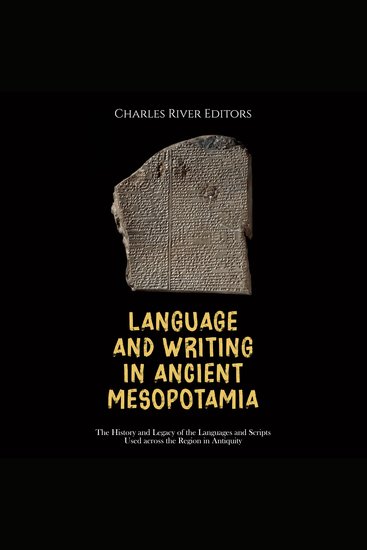
    Along with Egypt, the cultural and geographic region known as Mesopotamia was home to some of the world’s earliest civilizations and also the first known form of writing, cuneiform. Many different ethnic groups vied for power in ancient Mesopotamia over the course of antiquity, spanning about 3,000 years, and many of them spoke different languages. Despite these differences, the people in Mesopotamia shared many cultural attributes, including similar religious practices, a common art and architecture style, and a shared use of the cuneiform script.  
    	As this suggests, language and writing were different but also interconnected. The languages spoken by the peoples of Mesopotamia were as diverse as the many ethnic groups, but as those groups asserted their military, economic, and cultural power over the other groups, two languages became dominant in the region: Sumerian and Akkadian. These were the two languages that were primarily used by the people of Mesopotamia to record their myths, religious rituals, government records, and historiographical accounts.  
    	Indeed, the languages and written scripts of Mesopotamia were not just enduring over time in the region, but they also had wide geographic influence, much more than any language groups or scripts at the time. The Sumerian language continued to be learned by scribes throughout Mesopotamia centuries after it had become a “dead language,” and the Akkadian language eventually became the lingua franca of the Near East by the Late Bronze Age. Akkadian became the language of diplomacy and trade, while cuneiform was used to record agreements in Akkadian between the "Great Powers” of the era. Cuneiform was also adopted by people outside of Mesopotamia, such as the Hittites and Elamites, who modified the script to fit the lexicons and rules of grammar for their own languages.
    Show book
  • How to Talk to Anyone with Ease - 9 Crucial Skills to Connect with People Master Small Talk and Have Better Conversations Anytime - cover

    How to Talk to Anyone with Ease...

    Chase Hill

    • 0
    • 0
    • 0
    Talking to others doesn’t have to be so stressful. With these 9 skills by your side, you can make conversations a breeze. 
    Just saying ‘hi’ is never enough, and keeping others interested in you while trying to keep the conversation afloat can easily become nightmarish. 
    Sometimes, you end up ruining a conversation by overthinking a simple reply. 
    You probably also hate making small talk, only to be completely ignored (besides, how many times can you actually ask about the weather?) 
    Thankfully, you don’t have to search far and wide – the answer to your problems is here. 
    In this guide, focused on helping you become confident in talking to anyone, you’ll discover:9 crucial conversational and social skills to swear by – make conversations a breeze (without feeling stupid)How to melt the awkwardness, no matter whom you’re talking to, by projecting real confidenceA comprehensive guide to the science of body language – observe subtle non-verbal cues and find out what others are really trying to say!The conversation masterclass – take your verbal skills to the next level and learn how to kick off conversations and continue them without failingEverything you ever wanted to know on how to make small talk more engaging (without faking it)How to be charming in conversations so that others find you interestingHow to make meaningful and fulfilling conversations as well as connections with people around you 
    Communicating with others shouldn’t be a hassle for anyone to begin with. 
    With this book, you’ll get smart tips and tricks to overcome your shyness and tackle social situations with ease. 
    Step into the limelight and make interesting conversations, no matter who you’re talking to.
    Show book
  • The War of 1812 - cover

    The War of 1812

    Harry L. Coles

    • 0
    • 0
    • 0
    This compact history of the War of 1812 attempts to separate myth from reality. Harry Coles narrates the main operations on both land and sea of the three-year struggle. He examines the conflict from the British (and Canadian) as well as the American point of view, relating events in America to the larger war going on in Europe.
     
    “A balanced analysis of tactics and strategy, this book also summarizes succinctly and clearly recent scholarship on causes and describes briefly the war’s military, economic, and political consequences. Coles has surveyed thoroughly the existing literature but arrives at a number of independent judgments. It is the best single-volume account of the war in all its aspects. In recounting sea battles, Coles puts aside the patriotic blinders that have for so long prevented a sensible understanding of American capabilities and strategic necessities; thus American naval victories are put in a proper perspective. And in dealing with land engagements, he has shunned the mocking and amused attitude which has so often passed for historical judgment. Undergraduates will be stimulated by the hints of modern parallels and will find useful the excellent annotated bibliography and simple maps.”—Choice
    Show book