Unisciti a noi in un viaggio nel mondo dei libri!
Aggiungi questo libro allo scaffale
Grey
Scrivi un nuovo commento Default profile 50px
Grey
Iscriviti per leggere l'intero libro o leggi le prime pagine gratuitamente!
All characters reduced
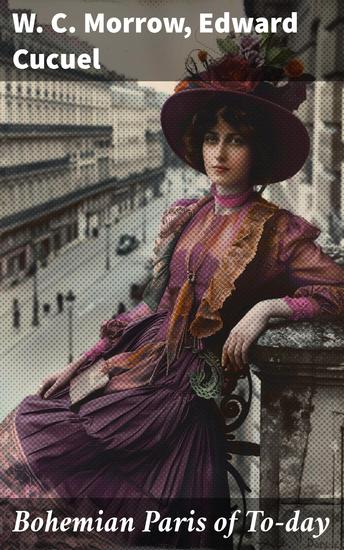
Bohemian Paris of To-day - Exploring Bohemian Paris: Art Life and Rebellion in the Late 19th Century - cover

Bohemian Paris of To-day - Exploring Bohemian Paris: Art Life and Rebellion in the Late 19th Century

W. C. Morrow, Edward Cucuel

Casa editrice: Good Press

  • 0
  • 0
  • 0

Sinossi

In 'Bohemian Paris of To-day,' readers are invited to embark on a vivid exploration of the Parisian artistic and literary landscape at the dawn of the twentieth century. This anthology captures the eclectic spirit of the bohemian lifestyle through a rich tapestry of narrative styles, from evocative prose to enchanting sketches. The collection encapsulates the essence of an era steeped in innovation and radical thought, offering a fascinating glimpse into the worlds of artists, writers, and dreamers who shaped the dynamic tapestry of Paris'Äôs cultural milieu. Notable pieces bring to life the vibrancy and eccentricity of bohemian communities, wrapped in a magical aura reminiscent of the city's unique allure. Curated by W. C. Morrow and brought to life with Edward Cucuel's illustrations, the anthology brings together a variety of writerly voices who collectively narrate the bohemian experience. Each contributor is seeped in the narrative traditions of European modernism and participates in a broader dialogue with cultural and artistic revolutions of the time. These authors contribute diverse insights into the transforming world around them, capturing the zeitgeist of La Belle √âpoque. The interplay of their unique experiences and approaches presents an enlightening commentary on this cultural crossroads. 'Bohemian Paris of To-day' is an indispensable resource for those seeking to immerse themselves in the romance and radicalism of Paris during a pivotal historical moment. The anthology offers readers the chance to understand the complex dynamics of a thriving cultural hub through an array of perspectives and artistic expressions. This collection serves as a scholarly and entertaining journey through the intellectual corridors of bohemian Paris, encouraging readers to savor the myriad stories and contexts it unpeels. Perfect for enthusiasts of art, literature, and history, this book provides both an educational journey and a celebration of the daring spirits who defied convention to shape an era.
Disponibile da: 26/10/2023.
Lunghezza di stampa: 189 pagine.

Altri libri che potrebbero interessarti

  • Canon Alberic's Scrap Book - From their pens to your ears genius in every story - cover

    Canon Alberic's Scrap Book -...

    M R James

    • 0
    • 0
    • 0
    Montague Rhodes James is cited as perhaps the greatest English writer of ghost stories, an opinion few would disagree with. 
    James was born on 1st August 1862 at Goodnestone Parsonage in Kent, where his father was Curate but at age 3 the family went to live at Livermere, near Bury St Edmunds in East Anglia.  
    From early childhood he had a passion for mediaeval books and antiques. He was educated initially as a boarder at Temple Grove School in East Sheen, west London, before gaining a scholarship to Eton and thence Cambridge where he gained a double first, becoming a distinguished linguist and mediaevalist.  
    Before the Great War vacations were usually spent touring Europe absorbing cultures and references for his later writing. 
    A man of enormous knowledge it was said he timed his breakfast egg whilst he completed the Times crossword.  
    Many of his elegant yet terrifying tales were created by discarding the prevailing gothic cliches and placing his characters and narrative in a realistic setting.  Thereby the stories gained atmosphere and menace on a grand scale and he was famed as the originator of the antiquarian ghost story. 
    Although story-telling and writing these 30 or so tales was a hobby, when published their effect transformed the genre and still chill the bones in our more modern times. 
    James was also a medievalist scholar and translator whose work remains highly respected. He was also Provost of Eton College between 1918 and 1936. 
    M R James died on 12th June 1936 at Eton in Buckinghamshire.  He was 73.
    Mostra libro
  • Louisa May Alcott's Love For Germany (Little Women Podcast) - cover

    Louisa May Alcott's Love For...

    Niina Niskanen

    • 0
    • 0
    • 0
    Louisa May Alcott´s Little Women is the author´s love song for German culture and literature. In the novel, there are many moments when the characters make references to German literature, and Jo's love interest professor Bhaer is also based on Alcott's favourite writer, the German poet Goethe. When Friedrich helps Jo when she struggles writing to Weekly Volcano, we can see her influences from Goethe, Friedrich recommends Jo read Shakespeare and study characters like Goethe would have done. It is also remarkable that Alcott gives Jo a German love interest because German immigrants were widely discriminated in 19th century America, but in Concord where Alcott's resided there was a full-blown German epidemic with people rushing to buy German books and anything that came from Germany. 
    In the very first chapter of Little Women Jo wishes for a copy of Undine and Sintram as a Christmas present. Undine and Sintram is a collection of Scandinavian and Germanic fables written by French-German author Friedrich de la Motte Fouqué. This book appears again in the last Little Women book, Jo´s boys. Marches help the poor Hummel family who has immigrated from Germany. Beth and Marmee are especially close to them. Beth catches terrible scarlet fever, but the Marches never blame the Hummels. Epidemic diseases were rather common back then and Louisa always writes about the Hummels with great sympathy. In the chapter "Camp Lawrence" John Brooke translates a German song for Meg and reads her parts from "Mary Stuart", a play that was written by German poet and philosopher Friedrich Schiller. At Meg´s and John´s wedding, Laurie suggests that they dance as the Germans do.
    Mostra libro
  • Social Experiments in the 20th Century: The History of the World’s Most Famous and Infamous Psychological Experiments - cover

    Social Experiments in the 20th...

    Editors Charles River

    • 0
    • 0
    • 0
    The human psyche is one of the most complex, unpredictable, enigmatic, and therefore riveting phenomena in existence, one that psychologists have been working on deciphering since the dawn of modern science. To better understand the multifaceted intricacies of human behavior, and to unlock the secrets of the conscious mind and the subconscious, ambitious professionals in the field have conducted numerous groundbreaking – and at times, problematic – psychological experiments. The practice originated with German philosopher Wilhelm Wundt, one of the fathers of modern psychology and the creator of the world's first experimental psychology laboratory at the University of Leipzig. He sought to measure the average speed of thought processes by assigning a range of reaction time tasks to his subjects.  
    	As the nascent, yet fast-developing scientific discipline took hold around the globe, psychological experiments simultaneously diversified. As revolutionary and eye-opening as many of these experiments were, they often danced on the fine line between ethical and unethical. There was, for instance, the now-infamous Little Albert Experiment, conducted at Johns Hopkins University in 1920, in which a nine-month-old infant was deliberately manipulated into developing an irrational fear for the purpose of studying classical conditioning, and the correlation between adult fears and childhood traumas. The Monster Study, carried out at the University of Iowa in 1939, attempted to convert orphans into stutterers, half of whom were subjected to positive reinforcements and the others to negative ones. Then, there was arguably the most notorious psychological experiment in history: the 1971 Stanford Prison Experiment, in which participants were randomly assigned the character of either prisoner or prison guard. That role-playing study quickly spiraled out of control.
    Mostra libro
  • Cicero - A Very Short Introduction (Very Short Introductions) - cover

    Cicero - A Very Short...

    Yelena Baraz

    • 0
    • 0
    • 0
    Marcus Tullius Cicero (106-43 BCE) was one of the most influential figures in late republican Rome, a moment of great social, political, and cultural unrest that would lead to the transition from republic to empire. Cicero was a statesman who held the highest political office, the consulship, and then suffered politically motivated exile. His career was grounded in his continued success as an orator: his speeches were famous during his lifetime and, together with his rhetorical treatises, shaped the practice and theory of public speaking for centuries to come. His ideas influenced early church fathers, Renaissance humanists, and Enlightenment thinkers and his dramatic death captured imagination of his contemporaries, who saw it as standing for the death of the republic and eloquence.In this Very Short Introduction, Yelena Baraz presents a concise and integrated account of Cicero's life and accomplishments, locating him within the political and intellectual contexts of his time. It shows that in all his pursuits Cicero saw himself as a mediating figure: between theory and practice, philosophy and politics, Greek and Roman, and among political interest groups. Baraz tackles each area of Cicero's activity on its own terms while showing how overarching ideas and priorities permeate the apparently separate endeavors.
    Mostra libro
  • The Raven - cover

    The Raven

    Edgar Allan Poe

    • 0
    • 0
    • 0
    "The Raven" is a narrative poem by American writer Edgar Allan Poe. First published in January 1845, the poem is often noted for its musicality, stylized language, and supernatural atmosphere. It tells of a distraught lover who is paid a mysterious visit by a talking raven. The lover, often identified as a student is lamenting the loss of his love, Lenore. Sitting on a bust of Pallas, the raven seems to further antagonize the protagonist with its constant repetition of the word "Nevermore". The poem makes use of folk, mythological, religious, and classical references.
    Mostra libro
  • Aloysha the Pot - From their pens to your ears genius in every story - cover

    Aloysha the Pot - From their...

    Leo Tolstoy

    • 0
    • 0
    • 0
    Leo Tolstoy was born in 1828 in the Russian province of Tula to a wealthy noble family. As a child, he had private tutors but he showed little interest in any formal education. When he went to the University of Kazan in 1843 to study oriental languages and law, he left without completing his courses.  Life now was relaxed and idle but with some writing also taking place.  Gambling debts forced an abrupt change of path and he joined the army to fight in the Crimean War.  He was commended for his bravery and promoted but was appalled at the brutality and loss of life.  He recorded these and other earlier experiences in his diaries which formed the basis of several of his works. 
    In 1852 ‘Childhood’ was published to immediate success and was followed by ‘Boyhood’ and ‘Youth’. 
    His experience in the army and the horrors he witnessed resulted in ‘The Cossacks’ in 1862 and the trilogy ‘Sevastopol Tales’. After the war he travelled around Europe, visiting London and Paris and meeting such luminaries as Victor Hugo and Charles Darwin.  
    It was now that Tolstoy began his masterpiece, ‘War and Peace’. Published in 1869 it was an epic work that changed literature. He quickly followed this with ‘Anna Karenina’.  
    These successes made Tolstoy rich and helped him accomplish many of his dreams but also brought problems as he grappled with his faith and the lot of the oppressed poor. These revolutionary views became so popular that the authorities now kept him under surveillance.  
    He led a life of asceticism and vegetarianism and put his socialist ideals into practice by establishing numerous schools for the poor and food programmes. He also believed in giving away his wealth, which caused much discord with his wife.  
    His writing continued to bring forth classics such as ‘The Death of Ivan Ilyich’ and many brilliant and incisive short stories such as ‘How Much Land Does A Man Need’.  
    In 1901 Tolstoy was excommunicated from the Church and controversially deselected for the Nobel Prize for Literature. 
    Whilst undertaking a pilgrimage by train in October 1910 with his daughter Aleksandra he caught pneumonia in the nearby town of Astapovo.  Leo Tolstoy died on November 9th, 1910, he was 82.
    Mostra libro