Join us on a literary world trip!
Add this book to bookshelf
Grey
Write a new comment Default profile 50px
Grey
Subscribe to read the full book or read the first pages for free!
All characters reduced
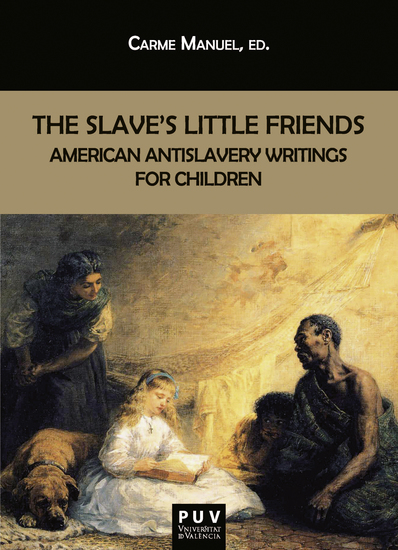
The Slave's Little Friends - American Antislavery Writings for Children - cover

The Slave's Little Friends - American Antislavery Writings for Children

VV VVAA

Publisher: Publicacions de la Universitat de València

  • 0
  • 1
  • 0

Summary

The texts included in this anthology illustrate the wide range of possibilities that abolitionist writings offered to American children during the first half of the nineteenth century. Composing their works under the wings of the antislavery movement, authors responded to the unequal and controversial development of abolitionist politics during the decades that led up to the outbreak of the Civil War. These writers struggled to teach children "to feel right," and attempted to instruct them to actively respond to the injustice of the slavery system as rendered visible by a harrowing visual archive of suffering bodies compiled by both English and American antislavery promoters.
Reading was equated with knowledge and knowledge was equated with moral responsibility, and therefore reading about "the abominations of slavery" became an act of emotional personal transformation. Children were thus turned into powerful agents of political change and potential activists to spread the abolitionist message. Invited to comply with a higher law that entailed the breaking of their nation's edicts, they were morally rewarded by the Christian God and approvingly applauded by their elders for their violation of these same American regulations. These texts enclosed immeasurable value for young nineteenth-century Americans to fulfill a more democratic and egalitarian role in their future. Undoubtedly, abolitionist writings for children took away American children's innocence and transformed them into juvenile abolitionists and empowered compassionate citizens.
Available since: 04/13/2022.
Print length: 446 pages.


Other books that might interest you

  • Suddenly Silent and Still - Finding joy and meaning through illness - cover

    Suddenly Silent and Still -...

    Nin Mok

    • 0
    • 0
    • 0
    This audiobook is narrated by an AI Voice.   
    In a life-changing instant, Nin is thrown into chaos by the onset of sudden hearing loss and violent vertigo. As a project management executive specialising in planning and control, she grapples with the randomness of her condition and the uncertainty of recovery. 
    Fuelled by love for her children, she fights to reclaim her life in a silent and still world, navigating grief, loss and medical trauma. Nin's abrupt transition from an ambitious career woman to a stay-at-home parent sparks profound introspection. 
    Is security merely an illusion? What determines a person's worth? How can you accept a worse reality? Through her journey, she discovers new perspectives and an infallible purpose in a less-abled body. 
    With honesty and humour, she offers hope to those facing loss, chronic illness and disability. Grounded yet uplifting, this inspiring true story shows how the resilience of the human spirit can prevail in the face of suffering.
    Show book
  • Abducted: A Boy's Story of Survival and Courage - cover

    Abducted: A Boy's Story of...

    Azhar ul Haque Sario

    • 0
    • 0
    • 0
    The purpose of "Abducted: A Boy's Story of Survival and Courage" is to bring attention to the issue of child abduction, inspire and uplift readers, and empower survivors of trauma while also serving as a cautionary tale to raise awareness and prevent future abductions.
    Show book
  • My Saviour - cover

    My Saviour

    Rita Giddings

    • 0
    • 0
    • 0
    This is a true story of Rita Giddings experience of how she and her family were ensnared by witchcraft that was practised on them, until the solution to the difficulties was found and successfully used. The family battled with their youngest daughter's food allergies, struggled with health problems that hospitalised their two young daughters, close relatives became mysteriously ill and died, they had to move from their dream house because they and their neighbours were being poisoned by farm pesticides and Rita's husband sadly became an alcoholic which created many problems for her and the family. The support group that she found to help her over this hurdle is available to everyone. She even had to cope with her husband's dementia as his health failed. It is a story about her refusal to give in to her difficulties and how she handed all her problems over in prayer. As a result of this God's amazing healing took place in her and members of her family's lives to eliminate health problems they were suffering from on several occasions.
    Show book
  • Rock and Roll Children - An 80's Hair Metal Garage Band Story - cover

    Rock and Roll Children - An 80's...

    Sean Frazier

    • 0
    • 0
    • 0
    It was the best of times, it was the worst of times... it was the 80's! 
    A fictionalized retelling of somewhat real events about a boy and his band. We didn't have any money, we didn't think we had a future, all we had was the music. A coming of age tale in the era of spandex, big hair and Reganomics.
    Show book
  • Reading the Bible with Ten Church Fathers - How to Interpret Teach and Preach Like the Early Christians - cover

    Reading the Bible with Ten...

    Gerald Bray

    • 0
    • 0
    • 0
    By AD 100, all the original disciples had died and a new generation of preachers, teachers, and scholars had taken on the responsibility to preach, teach, and interpret the Scriptures. These men have become known as the church fathers. But who were they? When and where did they live? And, most importantly, what did they teach about how to read and understand the Bible?Join professor and author Gerald Bray as he uncovers the fascinating history of the men who shaped the faith for the first few centuries after the apostles, including Justin Martyr, Origen, Gregory of Nyssa, Ambrosiaster, John Chrysostom, Theodore of Mopsuestia, Jerome, Augustine of Hippo, Cyril of Alexandria, and Theodoret of Cyrrhus.This compelling introduction reveals how early Christians read, preached, and understood the Bible, offering a unique look at their shared vision to spread the gospel with clarity amid remarkable diversity of perspective. Pastors, teachers, and thoughtful laypeople alike will find this book both educational and inspiring.
    Show book
  • Demir-Kaya - From their pens to your ears genius in every story - cover

    Demir-Kaya - From their pens to...

    Alexander Kuprin

    • 0
    • 0
    • 0
    Alexander Kuprin was born in Narovchat, Penza in Russia on 7th September 1870. 
    At 3 his Father died and he and mother moved to Moscow. By 10 he was enrolled at the Second Moscow Military High School and there his interest in literature began. The Alexander Military Academy followed and two years later he was a sub-lieutenant and posted to an Infantry Regiment for a further four years. 
    Despite his duties he was a now a keen writer and published his first short story at this time. His military duties also garnered him experiences for his breakthrough work ‘The Duel’.  Leaving the military he left for Kiev to work for local newspapers.  He continued to publish both stories and novels and by 1901 he was in St Petersburg becoming part of a group that included Chekhov, Ivan Bunin, Maxim Gorky and Leonid Andreyev.  
    In the years that followed further controversial works and acclaim followed.  His comments on the regime meant he was also put under secret police surveillance.   
    As World War I erupted, Kuprin opened a military hospital but was then given command of an infantry company in Finland. He was soon discharged on grounds of ill health.  
    The October Revolution saw him praise Lenin, but he warned that the Bolsheviks threatened Russian culture and might cause further widespread suffering to the peasants.  As Civil War raged he took his family to Helsinki and then on to Paris. 
    Exile saw his talents decline further and his succumbing to alcoholism. He became lonely and withdrawn. The family's poverty increased his malaise.   
    In May 1937, the Kuprin’s returned to Moscow.  He now saw his work published but wrote almost nothing new.  In 1938 his health rapidly deteriorated.  Already suffering from a kidney problems and sclerosis, he had now developed cancer of the oesophagus.  
    Alexander Kuprin died on 25th August 1938.
    Show book