Join us on a literary world trip!
Add this book to bookshelf
Grey
Write a new comment Default profile 50px
Grey
Subscribe to read the full book or read the first pages for free!
All characters reduced
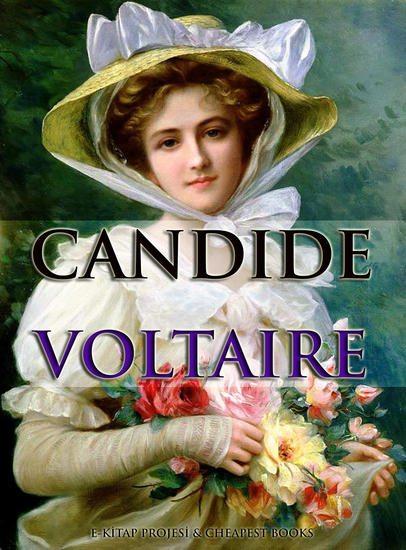
Candide - cover

Candide

Voltaire

Publisher: E-Kitap Projesi & Cheapest Books

  • 0
  • 0
  • 0

Summary

Candide is characterised by its sarcastic tone, as well as by its erratic, fantastical and fast-moving plot. A picaresque novel with a story similar to that of a more serious bildungsroman, it parodies many adventure and romance clichés, the struggles of which are caricatured in a tone that is mordantly matter-of-fact. Still, the events discussed are often based on historical happenings, such as the Seven Years' War and the 1755 Lisbon earthquake.

As philosophers of Voltaire's day contended with the problem of evil, so too does Candide in this short novel, albeit more directly and humorously. Voltaire ridicules religion, theologians, governments, armies, philosophies, and philosophers through allegory; most conspicuously, he assaults Leibniz and his optimism.

Voltaire's men and women point his case against optimism by starting high and falling low. A modern could not go about it after this fashion. He would not plunge his people into an unfamiliar misery. He would just keep them in the misery they were born to.

But such an account of Voltaire's procedure is as misleading as the plaster cast of a dance. Look at his procedure again. Mademoiselle Cunégonde, the illustrious Westphalian, sprung from a family that could prove seventy-one quarterings, descends and descends until we find her earning her keep by washing dishes in the Propontis. The aged faithful attendant, victim of a hundred acts of rape by negro pirates, remembers that she is the daughter of a pope, and that in honor of her approaching marriage with a Prince of Massa-Carrara all Italy wrote sonnets of which not one was passable. We do not need to know French literature before Voltaire in order to feel, although the lurking parody may escape us, that he is poking fun at us and at himself. His laughter at his own methods grows more unmistakable at the last, when he caricatures them by casually assembling six fallen monarchs in an inn at Venice.

A modern assailant of optimism would arm himself with social pity. There is no social pity in "Candide." Voltaire, whose light touch on familiar institutions opens them and reveals their absurdity, likes to remind us that the slaughter and pillage and murder which Candide witnessed among the Bulgarians was perfectly regular, having been conducted according to the laws and usages of war.

Had Voltaire lived today he would have done to poverty what he did to war. Pitying the poor, he would have shown us poverty as a ridiculous anachronism, and both the ridicule and the pity would have expressed his indignation.
Available since: 01/02/2024.
Print length: 250 pages.
Other books that might interest you

  • The Crown Derby Plate - cover

    The Crown Derby Plate

    Marjorie Bowen

    • 0
    • 0
    • 0
    Written in 1933, this classic ghost story features Bowen's typically superb descriptions of desolation and decay.
    Show book
  • Top 10 Short Stories The - The 1890's - The top ten short stories written in the 1890's - cover

    Top 10 Short Stories The - The...

    Arthur Conan Doyle, Charlotte...

    • 0
    • 0
    • 0
    As the Century draws to a close it shows no sign of its literary talents diminishing.  Authors stride into stories with a confidence and knowledge that now speak of a gilded age.  We are challenged on many levels but always, always the story delivers a literary triumph. 
     
    1 - The Top Ten - The 1890's 
     
    2 - B24 by Arthur Conan Doyle 
     
    3 - An Occurrence At Owl Creek Bridge by Ambrose Bierce 
     
    4 - The Yellow Wallpaper by Charlotte Perkins Gilman 
     
    5 - The Open Boat by Stephen Crane 
     
    6 - Désirée's Baby by Kate Chopin 
     
    7 - A New England Nun by Mary E Wilkins Freeman 
     
    8 - The Burial of the Rats by Bram Stoker 
     
    9 - The Inconsiderate Waiter by J M Barrie 
     
    10 - Gooseberries by Anton Chekhov 
     
    11 - The Repairer of Reputations by Robert W Chambers
    Show book
  • The Adventure of the Copper Beeches - cover

    The Adventure of the Copper Beeches

    Arthur Conan Doyle

    • 0
    • 0
    • 0
    The Adventure of the Copper Beeches, one of the 56 short Sherlock Holmes stories written by Sir Arthur Conan Doyle, is the last of the twelve collected in The Adventures of Sherlock Holmes. It was first published in Strand Magazine in June 1892.Violet Hunter visits Holmes, asking whether she should accept a job as governess; a job with very strange conditions. She is enticed by the phenomenal salary which, as originally offered, is £100 a year, later increased to £120 when Miss Hunter baulks at having to cut her long hair short (her previous position paid £48 a year). This is only one of many peculiar provisos to which she must agree. The employer, Jephro Rucastle, seems pleasant enough, yet Miss Hunter obviously has her suspicions.She announces to Holmes, after the raised salary offer, that she will take the job, and Holmes suggests that if he is needed, a telegram will bring him to Hampshire, where Mr Rucastle's country estate, the Copper Beeches, is situated.After a fortnight, Holmes receives such a message, beseeching him to come and see her in Winchester. Miss Hunter tells them one of the most singular stories that they have ever heard. Mr. Rucastle would sometimes have Miss Hunter wear a particular electric blue dress and sit in the front room reading, with her back to the front window. She began to suspect that she was not supposed to see something outside the window, and a small mirror shard hidden in her handkerchief showed her that she was right: there was a man standing there on the road looking towards the house.Famous works of the author Arthur Conan Doyle's: "A Study in Scarlet", "Silver Blaze", "The Hound of the Baskervilles", "The Yellow Face", "A Scandal in Bohemia", "The Red-Headed League", A Case of Identity", "The Boscombe Valley Mystery", "The Five Orange Pips", "The Man with the Twisted Lip", "The Blue Carbuncle", "The Speckled Band", "The Engineer's Thumb", "The Noble Bachelor", "The Beryl Coronet", "The Copper Beeches" and many more.
    Show book
  • Virginibus Puerisque I (Unabridged) - cover

    Virginibus Puerisque I (Unabridged)

    Robert Louis Stevenson

    • 0
    • 0
    • 0
    Robert Louis Balfour Stevenson was a Scottish novelist, poet, and travel writer, and a leading representative of English literature. He was greatly admired by many authors, including Jorge Luis Borges, Ernest Hemingway, Rudyard Kipling and Vladimir Nabokov.
    VIRGINIBUS PUERISQUE I: With the single exception of Falstaff, all Shakespeare's characters are what we call marrying men. Mercutio, as he was own cousin to Benedick and Biron, would have come to the same end in the long run.
    Show book
  • Count Magnus - From their pens to your ears genius in every story - cover

    Count Magnus - From their pens...

    M R James

    • 0
    • 0
    • 0
    Montague Rhodes James is cited as perhaps the greatest English writer of ghost stories, an opinion few would disagree with. 
    James was born on 1st August 1862 at Goodnestone Parsonage in Kent, where his father was Curate but at age 3 the family went to live at Livermere, near Bury St Edmunds in East Anglia.  
    From early childhood he had a passion for mediaeval books and antiques. He was educated initially as a boarder at Temple Grove School in East Sheen, west London, before gaining a scholarship to Eton and thence Cambridge where he gained a double first, becoming a distinguished linguist and mediaevalist.  
    Before the Great War vacations were usually spent touring Europe absorbing cultures and references for his later writing. 
    A man of enormous knowledge it was said he timed his breakfast egg whilst he completed the Times crossword.  
    Many of his elegant yet terrifying tales were created by discarding the prevailing gothic cliches and placing his characters and narrative in a realistic setting.  Thereby the stories gained atmosphere and menace on a grand scale and he was famed as the originator of the antiquarian ghost story. 
    Although story-telling and writing these 30 or so tales was a hobby, when published their effect transformed the genre and still chill the bones in our more modern times. 
    James was also a medievalist scholar and translator whose work remains highly respected. He was also Provost of Eton College between 1918 and 1936. 
    M R James died on 12th June 1936 at Eton in Buckinghamshire.  He was 73.
    Show book
  • Beowulf - An Anglo-Saxon Epic Poem (Unabridged) - cover

    Beowulf - An Anglo-Saxon Epic...

    J. Lesslie Hall

    • 0
    • 0
    • 0
    The protagonist Beowulf, a hero of the Geats, comes to the aid of Hrothgar, king of the Danes, whose great hall, Heorot, is plagued by the monster Grendel. Beowulf kills Grendel with his bare hands, then kills Grendel's mother with a giant's sword that he found in her lair. Later in his life, Beowulf becomes king of the Geats, and finds his realm terrorized by a dragon, some of whose treasure had been stolen from his hoard in a burial mound.
    Show book