Join us on a literary world trip!
Add this book to bookshelf
Grey
Write a new comment Default profile 50px
Grey
Subscribe to read the full book or read the first pages for free!
All characters reduced
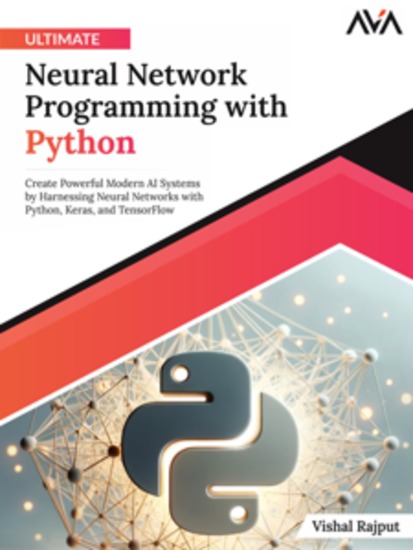
Ultimate Neural Network Programming with Python: Create Powerful Modern AI Systems by Harnessing Neural Networks with Python Keras and TensorFlow - cover

Ultimate Neural Network Programming with Python: Create Powerful Modern AI Systems by Harnessing Neural Networks with Python Keras and TensorFlow

Vishal Rajput

Publisher: Orange Education Pvt Ltd

  • 0
  • 0
  • 0

Summary

Master Neural Networks for Building Modern AI Systems. 
 Key Features ● Comprehensive Coverage of Foundational AI Concepts and Theories.● In-Depth Exploration of Maths Behind Neural Network Mathematics.● Effective Strategies for Structuring Deep Learning Code.● Real-world applications of AI Principles and Techniques.Book DescriptionThis book is a practical guide to the world of Artificial Intelligence (AI), unraveling the math and principles behind applications like Google Maps and Amazon. The book starts with an introduction to Python and AI, demystifies complex AI math, teaches you to implement AI concepts, and explores high-level AI libraries.Throughout the chapters, readers are engaged with the book through practice exercises and supplementary learning. The book then gradually moves to Neural Networks with Python before diving into constructing ANN models and real-world AI applications. It accommodates various learning styles, letting readers focus on hands-on implementation or mathematical understanding.This book isn't just about using AI tools; it's a compass in the world of AI resources, empowering readers to modify and create tools for complex AI systems. It ensures a journey of exploration, experimentation, and proficiency in AI, equipping readers with the skills needed to excel in the AI industry.What you will learn● Leverage TensorFlow and Keras while building the foundation for creating AI pipelines.● Explore advanced AI concepts, including dimensionality reduction, unsupervised learning, and optimization techniques.● Master the intricacies of neural network construction from the ground up.● Dive deeper into neural network development, covering derivatives, backpropagation, and optimization strategies.● Harness the power of high-level AI libraries to develop production-ready code, allowing you to accelerate the development of AI applications.● Stay up-to-date with the latest breakthroughs and advancements in the dynamic field of artificial intelligence.Who is this book for?This book serves as an ideal guide for software engineers eager to explore AI, offering a detailed exploration and practical application of AI concepts using Python. AI researchers will find this book enlightening, providing clear insights into the mathematical concepts underlying AI algorithms and aiding in writing production-level code. This book is designed to enhance your skills and knowledge to create sophisticated, AI-powered solutions and advance in the multifaceted field of AI.Table of Contents1. Understanding AI History2. Setting up Python Workflow for AI Development3. Python Libraries for Data Scientists4. Foundational Concepts for Effective Neural Network Training5. Dimensionality Reduction, Unsupervised Learning and Optimizations6. Building Deep Neural Networks from Scratch7. Derivatives, Backpropagation, and Optimizers8. Understanding Convolution and CNN Architectures9. Understanding Basics of TensorFlow and Keras10. Building End-to-end Image Segmentation Pipeline11. Latest Advancements in AI       Index
Available since: 02/11/2025.
Print length: 402 pages.
Other books that might interest you

  • Literary Theory for Robots - How Computers Learned to Write - cover

    Literary Theory for Robots - How...

    Dennis Yi Tenen

    • 0
    • 0
    • 0
    Literary Theory for Robots reveals the hidden history of modern machine intelligence, taking listeners on a spellbinding journey from medieval Arabic philosophy to visions of a universal language, past Hollywood fiction factories, and missile defense systems trained on Russian folktales. In this provocative reflection on the shared pasts of literature and computer science, former Microsoft engineer and professor of comparative literature Dennis Yi Tenen provides crucial context for recent developments in AI, which holds important lessons for the future of humans living with smart technology. 


    Intelligence expressed through technology should not be mistaken for a magical genie, capable of self-directed thought or action. Rather, in highly original and effervescent prose with a generous dose of wit, Yi Tenen asks us to read past the artifice—to better perceive the mechanics of collaborative work. Something as simple as a spell-checker or a grammar-correction tool, embedded in every word-processor, represents the culmination of a shared human effort, spanning centuries. 


    With its masterful blend of history, technology, and philosophy, Yi Tenen's work ultimately urges us to view AI as a matter of labor history, celebrating the long-standing cooperation between authors and engineers.
    Show book
  • The World As We Knew It - Dispatches From a Changing Climate - cover

    The World As We Knew It -...

    Tajja Isen, Amy Brady

    • 0
    • 0
    • 0
    Nineteen leading literary writers from around the globe offer timely, haunting first-person reflections on how climate change has altered their lives 


    In this riveting anthology, leading literary writers reflect on how climate change has altered their lives, revealing the personal and haunting consequences of this global threat. 


    In the opening essay, National Book Award finalist Lydia Millet mourns the end of the Saguaro cacti in her Arizona backyard due to drought. Later, Omar El Akkad contemplates how the rise of temperatures in the Middle East is destroying his home and the wellspring of his art. Gabrielle Bellot reflects on how a bizarre lionfish invasion devastated the coral reef near her home in the Caribbean—a precursor to even stranger events to come. Traveling through Nebraska, Terese Svoboda witnesses cougars running across highways and showing up in kindergartens. 


    As the stories unfold—from Antarctica to Australia, New Hampshire to New York—an intimate portrait of a climate-changed world emerges, captured by writers whose lives jostle against incongruous memories of familiar places that have been transformed in startling ways.
    Show book
  • Lean Software Development - Lean Software Development - cover

    Lean Software Development - Lean...

    Daniel Greene

    • 0
    • 0
    • 0
    In today's competitive and fast-paced software industry, efficiency and agility are more than just advantages—they are necessities. "Lean Software Development: Simplifying Processes, Enhancing Efficiency" is a transformative guide that introduces software professionals to the principles of Lean thinking adapted specifically for the software development sector. This book takes you on a journey to explore how the Lean methodology, originally crafted for manufacturing, can be ingeniously applied to software development to improve quality, reduce waste, and increase productivity. 
    At the heart of Lean Software Development are seven fundamental principles: Eliminate Waste, Amplify Learning, Decide as Late as Possible, Deliver as Fast as Possible, Empower the Team, Build Integrity In, and Optimize the Whole. This book breaks down each principle in detail, illustrating how they can be applied to real-world software development projects to achieve efficient and effective results. 
    The book begins with a comprehensive introduction to the origins of Lean thinking and its evolution into a versatile framework that can dramatically improve the software development process. It offers a deep dive into the mindset and cultural shifts required to implement Lean practices effectively, emphasizing the importance of continuous improvement and respect for people. 
    "Lean Software Development: Simplifying Processes, Enhancing Efficiency" is an essential resource for software developers, project managers, and IT leaders seeking to harness the power of Lean. By applying the insights and strategies presented in this book, readers will be equipped to streamline their processes, boost efficiency, and achieve software development excellence in the Lean way. 
      
     
    Show book
  • Leaders Make the Future Third Edition - Ten New Skills to Humanize Leadership with Generative AI - cover

    Leaders Make the Future Third...

    Bob Johansen, Jeremy Kirshbaum,...

    • 0
    • 0
    • 0
    Over the next decade, all leaders will be augmented with some form of generative artificial intelligence, or GenAI. For the best leaders, this will mean dramatic improvement. For mediocre leaders, this will mean persistent confusion, distraction, and pretense. With futureback thinking—looking ten years ahead, then planning backward from future to next to now—this third edition of Leaders Make the Future shows how people can improve their leadership skills while expanding their human perspective. 


    Now 75 percent revised and expanded with resources from the Institute for the Future, this new edition is organized around ten future leadership skills: augmented futureback curiosity, augmented clarity, augmented dilemma flipping, augmented bio-engaging, augmented immersive learning, augmented depolarizing, augmented commons creating, augmented smart mob swarming, augmented strength with humility, and human calming. 


    AI-augmented leadership will be key for any organization to tackle the uncertainty of the future. And by incorporating practical methodologies, ethical guidelines, and innovative leadership practices, this book will help leaders develop their clarity and moderate their certainty.
    Show book
  • NASA Programs in the 1970s: The History and Legacy of the Space Agency’s Missions to Mars and Beyond - cover

    NASA Programs in the 1970s: The...

    Editors Charles River

    • 0
    • 0
    • 0
    Space exploration was always an expensive business, and throughout NASA’s history, the agency has had to justify to Congress its need for every dollar it intended to spend. This problem has helped NASA to be more careful and more creative with the money they did receive, and scientists had to justify the equipment they wanted to include on each space probe. They had to justify the size and the power demand, too. If they wanted too much, the entire mission might be scrubbed, and all their work would have been for naught. This made planning and designs leaner and more efficient, as scientists and engineers were more careful with their recommendations. 
    In fact, the Pioneer program was the most diversified sequence of any of NASA’s programs, and though they’re now remembered for being among the first probes in history to reach the Outer Solar System, the elaborate planning changed goals several times over several years before resulting in historic successes. NASA had wanted to do a Grand Tour of the Solar System toward the end of the 1970s to take advantage of the scheduled alignment of planets, which meant the Pioneer missions were meant to be test runs prior to the main events (Voyager 1 and Voyager 2), and a great many things discovered by Pioneer 10 and Pioneer 11 were essential to the successful planning of the Voyager probes. 
    Voyager 1 and 2 have done far more than accomplish their original missions. In fact, they are now exploring interstellar space, far beyond the outer planets in the cold wasteland between the stars. Each spacecraft carries a copy of a golden record which contains an introduction to Earth, should some alien civilization happen to encounter either Voyager 1 or Voyager 2. In the first Star Trek movie, writers imagined just that, creating a story of a Voyager spacecraft being captured and adapted for its own uses.
    Show book
  • Life Lessons from a Parasite - What Tapeworms Flukes Lice and Roundworms Can Teach Us About Humanity's Most Difficult Problems - cover

    Life Lessons from a Parasite -...

    John Janovy Jr.

    • 0
    • 0
    • 0
    The answers to life's biggest questions can be found by looking at the little things . . . 


    Though you may not be able to see them with the naked eye, parasites—miniscule life forms that live inside other organisms—inhabit our everyday lives. From headlice to bird droppings, litterboxes to unfiltered water, you have brushed up against the most common way of life on our planet. 


    In this unique book, John Janovy Jr., one of the world's preeminent experts on parasites, reveals what can humans learn from the most reviled yet misunderstood animals on Earth: lice, tapeworms, flukes, and maggots that can eat a lizard from the inside, and how these lessons help us negotiate our own complicated world. Whether we're learning to adapt to adverse conditions, accept our own limitations, or process new information in an ever-changing landscape—we can be sure a parasite did it first. 


    At once peculiar and profound, Life Lessons from a Parasite makes a case for using knowledge of the natural world, with all its wonderful mysteries and quirks, to tackle our worst problems.
    Show book