Join us on a literary world trip!
Add this book to bookshelf
Grey
Write a new comment Default profile 50px
Grey
Subscribe to read the full book or read the first pages for free!
All characters reduced
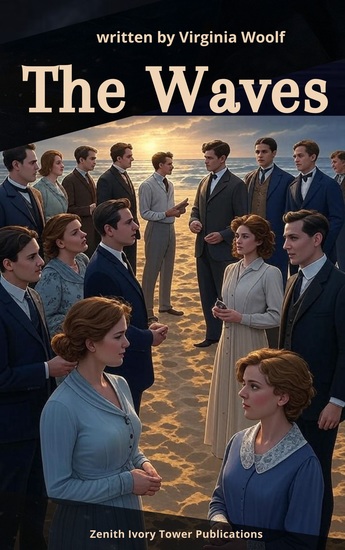
The Waves - A Lyrical Masterpiece of Identity Consciousness and the Rhythms of Life - cover

The Waves - A Lyrical Masterpiece of Identity Consciousness and the Rhythms of Life

Virginia Woolf, Zenith Ivory Tower Publications

Publisher: Zenith Ivory Tower Publications

  • 0
  • 0
  • 0

Summary

Six voices. One life. A novel like no other.
The Waves is Virginia Woolf's most experimental and poetic novel—a bold meditation on time, identity, and the fluidity of human experience.

Told through the inner monologues of six characters—Bernard, Susan, Rhoda, Neville, Jinny, and Louis—The Waves flows like a symphony, weaving together their individual perspectives from childhood through adulthood. As they struggle with love, isolation, art, and mortality, Woolf dissolves the boundaries between self and other, character and narrator, prose and poetry.

More than a story, The Waves is an experience. A novel where sunlight, sea, and silence speak as loudly as the human voice—where time ebbs and flows like the ocean itself.

"A work of genius... Woolf's most daring and profound book." — The New York Times
"A hypnotic novel of voices and visions." — The Guardian
"Reading The Waves is like listening to an orchestra of thought." — Goodreads Reviewer

Ideal for readers of modernist literature, poetic fiction, and philosophical introspection, The Waves is a landmark of experimental writing and one of the most ambitious novels of the 20th century.

Click 'Buy Now' and immerse yourself in a literary tide of beauty, depth, and transformation.
Available since: 07/24/2025.
Print length: 193 pages.
Other books that might interest you

  • Rainbow The: D H Lawrence - cover

    Rainbow The: D H Lawrence

    D. H. Lawrence

    • 0
    • 0
    • 0
    David Herbert Lawrence was born on September 11, 1885. He was an English writer and poet. His collected works represent, among other things, an extended reflection upon the dehumanizing effects of modernity and industrialization. Lawrence's writing explores issues such as sexuality, emotional health, vitality, spontaneity, and instinct. His novels include Sons and Lovers, The Rainbow, Women in Love, and Lady Chatterley's Lover. 
      
    Lawrence's opinions earned him many enemies, and he endured official persecution, censorship, and misrepresentation of his creative work throughout the second half of his life, much of which he spent in a voluntary exile he called his "savage pilgrimage".At the time of his death, his public reputation was that of a pornographer who had wasted his considerable talents. E. M. Forster, in an obituary notice, challenged this widely held view, describing him as "the greatest imaginative novelist of our generation." Later, the literary critic F. R. Leavis championed both his artistic integrity and his moral seriousness. 
      
    The Rainbow tells the story of three generations of the Brangwen family, a dynasty of farmers and craftsmen who live in the East Midlands of England, on the borders of Nottinghamshire and Derbyshire. The book spans a period of roughly 65 years from the 1840s to 1905 and shows how the love relationships of the Brangwens change against the backdrop of the increasing industrialization of Britain. The first central character, Tom Brangwen, is a farmer whose experience of the world does not stretch beyond these two counties; while the last, Ursula, his granddaughter, studies at university and becomes a teacher in the progressively urbanized, capitalist, and industrial world. 
     
    Show book
  • The Keepers of Memory - A Tale of the Norman Conquest - cover

    The Keepers of Memory - A Tale...

    Christopher Allen

    • 0
    • 0
    • 0
    "The Keepers of Memory" tells the remarkable story of Lady Aelfwyn, an Anglo-Saxon widow whose world is shattered by the Norman Conquest of 1066. When her husband Thegn Aelred dies at the Battle of Hastings, Aelfwyn faces an impossible choice: flee into exile with her three children or submit to Norman rule and marry the foreign knight who has claimed her lands. 
    Choosing survival over pride, Aelfwyn marries Sir Raoul de Montfort, a Norman lord who needs legitimacy through union with Anglo-Saxon nobility. But this marriage of necessity becomes the foundation for something far more significant—a quiet revolution of cultural preservation. While publicly embracing her role as a Norman lady, Aelfwyn secretly begins teaching her children the Anglo-Saxon heritage that the conquest threatens to erase. 
    In hidden evening lessons, she passes down the ancient stories, songs, and customs of her people. Her eldest son Godwin struggles with his dual identity, torn between resentment and pragmatism. Her daughter Eadgyth becomes a natural bridge between cultures, while young Wulfric grows up truly bilingual and bicultural. Through patient persistence, Aelfwyn demonstrates that Anglo-Saxon traditions can coexist with Norman rule, gradually winning over even her initially skeptical husband. 
    The family's greatest test comes when Archbishop Lanfranc arrives to investigate reports of their cultural preservation activities. Rather than deny her actions, Aelfwyn boldly argues that understanding Anglo-Saxon customs makes Norman lords more effective rulers. Her courage and wisdom not only save her family but help convince the Church hierarchy that transformation, rather than destruction, is the wisest approach to conquered peoples. 
    The story culminates thirty-three years later, when Aelfwyn's youngest son Wulfric is commissioned by King Henry I to establish a school teaching both Norman and English customs to royal administrators.
    Show book
  • Murder at the Masked Ball - A 1920s Historical Cozy Mystery - cover

    Murder at the Masked Ball - A...

    Magda Alexander

    • 0
    • 0
    • 0
    Amateur sleuth Kitty Worthington once more investigates when a noble lord plummets to his death, and a dear friend is suspected of murder. 


    London. 1923. When an invitation arrives to the Duchess of Brightwell's Midsummer Masked Ball, Kitty Worthington does not even think of declining. Not with a mother on the hunt for a noble husband for her. But no sooner does she curtsy to her hostess at the ball than tragedy strikes. A very dead earl is found at the bottom of a staircase, and it's clearly the work of foul play. 


    Having proven himself a dab hand at dealing with the nobility, Scotland Yard Detective Inspector Robert Crawford is soon asked to investigate. In no time at all he hones in on Lord Newcastle, a friend of Kitty who'd earlier pummeled the earl for sorely abusing his wife. 


    Afraid her friend may wrongfully pay with his life, Kitty once more organizes her ace team, including her maid, two noble lords, a beloved sister, a lady, and Sir Winston, her still flatulent Basset Hound. From the seediest parts of London, to the fancy mansions of Mayfair, they fearlessly pursue the truth. For if they fail to find the killer, their dear friend may dance one last jig at the end of a rope.
    Show book
  • The Warwolf - A Peasant Chronicle of the Thirty Years War - cover

    The Warwolf - A Peasant...

    Hermann Löns

    • 0
    • 0
    • 0
    The Thirty Years War, fought between 1618 and 1648, was a ruthless struggle for political and religious control of central Europe. Engulfing most of present-day Germany, the war claimed at least ten million lives. The lengthy conflict was particularly hard on the general population, as thousands of undisciplined mercenaries serving Sweden, Spain, France, the Netherlands, and various German principalities, robbed, murdered, and pillaged communities; disease spread out of control and starvation became commonplace. In The Warwolf, Hermann Löns's acclaimed historical novel, the tragedy and horrors of war in general, and these times in particular are revealed. The Warwolf, based on the author's careful research, traces the life of Harm Wulf, a land-owning peasant farmer of the northern German heath who realizes after witnessing the murder of neighbors and family at the hands of marauding troops that he has a choice between compromising his morals or succumbing to inevitable torture and death. Despite his desire for peace, Wulf decides to band with his fellow farmers and live like "wolves," fiercely protecting their isolated communities from all intruders. Löns's brilliant portrayal of the two sides faced by any person in a moral crisis—in Harm Wulf's case, whether to kill or be killed—continues to resonate.
    Show book
  • Hard Winter - cover

    Hard Winter

    William W. Johnstone, J. A....

    • 0
    • 0
    • 0
    Two Families. Two Dynasties. Two Centuries. 


    A Saga of Montana. 


    NOW 


    As winter descends upon Cutthroat County, rancher Ashton Maddox has to rely on a skeleton crew to keep his cattle from succumbing to the dangers of the cold winter months. County Sheriff John T. Drew has his hands full this time of year heading up search and rescue missions for adventurous snowboarders and skiers tempting fate on nearby Always Winter mountain range. When an unexpected blizzard covers the region, Drew finds himself babysitting a vicious gang of prisoners stranded in town. And as the storm triggers avalanches, Drew and Maddox learn their son and daughter are trapped on the mountain—and that the gang's leader has escaped from custody . . .  


    THEN 


    This isn't the first Montana blizzard that the Drew and Maddox families have faced. Back in 1894, Murdo Maddox lost his livestock—and nearly his entire cowboy crew—braving a treacherous storm that ravaged the countryside. Sheriff Napoleon Drew pursued a mad dog killer across the unforgiving snow and ice. Both men risked their lives to save others, fighting the most devastating weather conjured by nature—and the worst in human nature . . .
    Show book
  • Waiting for Wovoka - Envoys of Good Cheer and Liberty - cover

    Waiting for Wovoka - Envoys of...

    Gerald Vizenor

    • 0
    • 0
    • 0
    In the summer of 1962, a group of young Native American puppeteers travel in a converted school bus from the White Earth Reservation to the Century 21 Exposition, World's Fair in Seattle, Washington. The five Natives, three young men and two young women, have endured abandonment, abuse, poverty, and find solace, humor, and courage with a mute puppeteer—a Native woman in her seventies who writes original dream songs, and creates hand puppets and ironic parleys that mock the ghosts of authority. Dummy Trout, the mute puppeteer, also figured in Native Tributes and Satie on the Seine. The troupe attends a performance of Waiting for Godot by Samuel Beckett and they create a puppet parley for Wovoka, the inspiration of the Native American Ghost Dance Religion.
    Show book