Join us on a literary world trip!
Add this book to bookshelf
Grey
Write a new comment Default profile 50px
Grey
Subscribe to read the full book or read the first pages for free!
All characters reduced
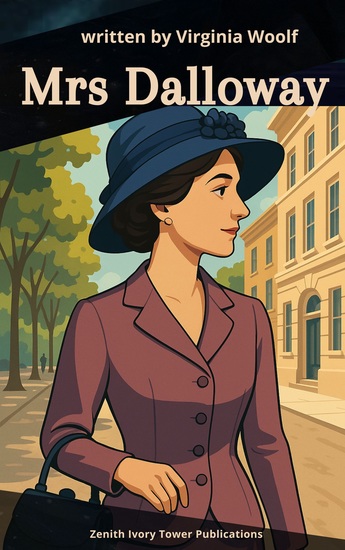
Mrs Dalloway - Virginia Woolf's Modernist Masterpiece of Time Memory and the Inner Life - cover

Mrs Dalloway - Virginia Woolf's Modernist Masterpiece of Time Memory and the Inner Life

Virginia Woolf, Zenith Ivory Tower Publications

Publisher: Zenith Ivory Tower Publications

  • 0
  • 0
  • 0

Summary

🌸 One day. One woman. A lifetime in her thoughts.

Mrs Dalloway is Virginia Woolf's luminous exploration of a single day in post–World War I London, where the external bustle of city life mirrors the intricate web of thoughts, memories, and emotions within. As Clarissa Dalloway prepares for a high-society party, her mind drifts between past and present, grappling with questions of love, loss, time, and identity.

🕰️ A revolutionary novel that redefined how stories could be told.
Woolf's pioneering use of stream-of-consciousness gives readers direct access to her characters' inner worlds—juxtaposing Clarissa's elegant routines with the haunted mind of Septimus Smith, a shell-shocked veteran. Their stories run in parallel, quietly illuminating the fragility of existence and the shared weight of memory.

🎭 A portrait of a woman—and a world—on the edge of transformation.
Set against a backdrop of social change and emotional undercurrents, Mrs Dalloway captures the fleeting nature of life and the profound connections hidden beneath ordinary moments.

🌟 What Critics and Readers Say:
"A miracle of poetic insight and narrative innovation." — The Guardian

"Woolf's most lyrical and emotionally resonant novel." — The New York Times

"Still astonishingly relevant, nearly a century after its first publication." — Amazon Reviewer

🎯 Why You'll Love This Book:
A modernist literary classic praised for its originality and depth

Perfect for readers of psychological fiction, feminist literature, and philosophical storytelling

Offers a deeply human look at time, trauma, and the quiet courage of everyday life

Ideal for students, scholars, and thoughtful readers

🛒 Click Buy Now to Walk the Streets of London with Mrs. Dalloway.
Let Virginia Woolf guide you through a single day that echoes an entire lifetime.
👉 Click Buy Now to experience Mrs Dalloway—a novel of exquisite beauty and insight.
Available since: 07/18/2025.
Print length: 88 pages.

Other books that might interest you

  • Alphonso Davies - A New Hope - cover

    Alphonso Davies - A New Hope

    Farhan Devji

    • 0
    • 0
    • 0
    Built on years of interviews with friends, family, teachers, coaches, and teammates, the first biography of Alphonso Davies, the new face of Canadian men's soccer 


    Arguably the most famous Canadian athlete on the planet, Alphonso Davies has been the subject of global attention after bursting onto the scene as a fifteen-year-old soccer sensation. Since then, he's won every trophy imaginable with German giant FC Bayern Munich and helped Canada reach the men's World Cup for the first time in thirty-six years. 


    Based on years of original reporting and extensive interviews with his friends, family members, teachers, coaches, teammates, and others from his inner circle, Alphonso Davies: A New Hope paints a complete portrait of the soccer star. The first biography about "Phonzie" covers every angle of his life and career—from the harsh realities of growing up in a refugee camp amidst the Liberian Civil War, to the unique challenges of starting a new life in a foreign country, twice, to his trailblazing path as a Canadian megastar in the world's most popular sport. Bringing together intimate details and never-before-told stories, author Farhan Devji pulls back the curtain on a person and player who has captured the hearts of a nation and become a shining light for refugees everywhere.
    Show book
  • May-Day and Other Pieces - cover

    May-Day and Other Pieces

    Ralph Waldo Emerson

    • 0
    • 0
    • 0
    Spring arrives with a rush of words, and Ralph Waldo Emerson stands at the threshold, pen in hand. May-Day and Other Pieces is not just a collection of poems—it is an invitation to witness the shifting tides of nature, thought, and destiny through the eyes of one of America's sharpest philosophical minds.
    From the awakening landscapes of May-Day to the untamed wilderness of The Adirondacs, Emerson moves effortlessly between the grandeur of the world and the depths of the soul. The mysticism of Brahma, the inevitability of Fate, the defiance of Freedom—each poem is a meditation, a spark meant to ignite the reader's own reflection. History echoes in the Boston Hymn, sung as the Civil War reshaped a nation, while the lyrical simplicity of My Garden and Seashore captures fleeting moments of peace amid the rush of existence.
    Yet, Emerson never lingers too long in stillness. He follows the restless course of Two Rivers, listens to the quiet solitude of Waldeinsamkeit, and faces the finality of Terminus with unwavering clarity. This is poetry that questions, poetry that endures. It is a journey through seasons, through America, through the self—one that leaves the reader standing on the shore, looking out at the vastness, changed.
    May-Day and Other Pieces is more than verse. It is a conversation with the universe, and Emerson, ever the sage, is still speaking.
    Contents
     • May-Day
     • The Adirondacs
        A Journal
        Dedicated to my Fellow Travellers IN August, 1858
    • Brahma
    • Nemesis
    • Fate
    • Freedom
    • Ode Sung in the Town Hall, Concord, July 4, 1857
    • Boston Hymn, Read in Music Hall, January 1, 1863
    • Voluntaries
    • Love and Thought
    • Una
    • Boston
    • Letters
    • Rubies
    • Merlin's Song
    • The Test
    • Solution
    • Hymn Sung at the Second Church, at the Ordination of Rev. Chandler Robbins
    • Nature I
    • Nature II
    • The Romany Girl
    • Days
    • My Garden
    • The Chartist's Complaint
    • The Titmouse
    • The Harp
     • Seashore
    • Song of Nature
    • Two Rivers
    • Waldeinsamkeit
    • Terminus
    • The Nun's Aspiration
    • April
    • Maiden Speech of the Aeolian Harp
    • Cupido
    • The Past
     • The Last Farewell
       Lines written by the author's brother, Edward Bliss Emerson, whilst sailing out of Boston Harbor, bound for the island of Porto Rico, in 1832
    • In Memoriam E. B. E.
    Show book
  • Evening Guest An - From their pens to your ears genius in every story - cover

    Evening Guest An - From their...

    Alexander Kuprin

    • 0
    • 0
    • 0
    Alexander Kuprin was born in Narovchat, Penza in Russia on 7th September 1870. 
    At 3 his Father died and he and mother moved to Moscow. By 10 he was enrolled at the Second Moscow Military High School and there his interest in literature began. The Alexander Military Academy followed and two years later he was a sub-lieutenant and posted to an Infantry Regiment for a further four years. 
    Despite his duties he was a now a keen writer and published his first short story at this time. His military duties also garnered him experiences for his breakthrough work ‘The Duel’.  Leaving the military he left for Kiev to work for local newspapers.  He continued to publish both stories and novels and by 1901 he was in St Petersburg becoming part of a group that included Chekhov, Ivan Bunin, Maxim Gorky and Leonid Andreyev.  
    In the years that followed further controversial works and acclaim followed.  His comments on the regime meant he was also put under secret police surveillance.   
    As World War I erupted, Kuprin opened a military hospital but was then given command of an infantry company in Finland. He was soon discharged on grounds of ill health.  
    The October Revolution saw him praise Lenin, but he warned that the Bolsheviks threatened Russian culture and might cause further widespread suffering to the peasants.  As Civil War raged he took his family to Helsinki and then on to Paris. 
    Exile saw his talents decline further and his succumbing to alcoholism. He became lonely and withdrawn. The family's poverty increased his malaise.   
    In May 1937, the Kuprin’s returned to Moscow.  He now saw his work published but wrote almost nothing new.  In 1938 his health rapidly deteriorated.  Already suffering from a kidney problems and sclerosis, he had now developed cancer of the oesophagus.  
    Alexander Kuprin died on 25th August 1938.
    Show book
  • My Secret Life Vol 5 Chapter 4 - cover

    My Secret Life Vol 5 Chapter 4

    Anonymous Anonymous

    • 0
    • 0
    • 0
    Vol. 5 Chapter IV
    
    Lucy without place. • Fausse couches. • Goes home. • James leaves. • A confession. • Lucy's marriage. • My wedding gift. • An anonymous letter. • James' amourous exploits. • The use of a dining-room table. • Camille again. • Erotic literature. • Erotic anticipations. • Camille's opinion thereon. • Ill. • Memoirs arranged. • Frail fair ones. • My gratitude. • My unhappiness. • A visit to the manor house. • Joey a hobble-de-hoy. • Tomlin the parlour maid. • Joe and Tomlin. • Sly looks. • On the watch. • The garden grotto. • A peep hole in the roof. • The couple there. • Their amusements. • An unintended spend. • An uprighter. • Joey's cunning.
    Show book
  • The Unlikely Voyage of Jack de Crow - cover

    The Unlikely Voyage of Jack de Crow

    A. J. Mackinnon

    • 0
    • 0
    • 0
    A revitalised edition of this much-loved bestseller. 
     
    Truly hilarious books are rare. Even rarer are those based on real events. Join A.J. Mackinnon, your charming and eccentric guide, on an amazing voyage in a boat called Jack de Crow. 
     
    A couple of quiet weeks sailing the River Severn was the intention. Somehow things got out of hand – a year later I had reached Romania and was still going... 
     
    Equipped with his cheerful optimism and a pith helmet, this Australian Odysseus in a dinghy travels from the borders of North Wales to the Black Sea – 4,900 kilometres over salt and fresh water, under sail, at the oars, or at the end of a tow-rope – through twelve countries, 282 locks and numerous trials and adventures, including an encounter with Balkan pirates. Along the way he experiences the kindness of strangers, gets very lost, and perfects the art of slow travel. 
     
     ‘A marvellous adventure, and Mackinnon recounts it with humour and unflagging enthusiasm ... a clever and entirely engaging read’ Melbourne Times 
     
    ‘A great travel writer and more importantly a great traveller’ Sydney Morning Herald 
     
    ‘Not just an adventurer, but an artist, philosopher and keen observer of the world around him’ Canberra Times 
     
    ‘A wonderful idea for a book – a series of ever bolder improvisations ... undertaken in praise of the spirit of adventure’ Times Literary Supplement 
     
     ‘Mackinnon’s journey makes a lovely picaresque tale, one dotted with English literary references and wonderful descriptions of the English and European countryside’ Good Reading
    Show book
  • Betty Brown the St Giles Orange Girl - From their pens to your ears genius in every story - cover

    Betty Brown the St Giles Orange...

    Hannah More

    • 0
    • 0
    • 0
    Hannah More was born on February 2nd, 1745 at Fishponds in the parish of Stapleton, near Bristol. She was the fourth of five daughters. 
    The City of Bristol, at that time, was a centre for slave-trading and Hannah would, over time, become one of its staunchest critics.  
    She was keen to learn, possessed a sharp intellect and was assiduous in studying.  Hannah first wrote in 1762 with The Search after Happiness (by the mid-1780s some 10,000 copies had been sold). 
    In 1767 Hannah became engaged to William Turner.  After six years, with no wedding in sight, the engagement was broken off.  Turner then bestowed upon her an annual annuity of £200.  This was enough to meet her needs and set her free to pursue a literary career.   
    Her first play, The Inflexible Captive, was staged at Bath in 1775. The famous David Garrick himself produced her next play, Percy, in 1777 as well as writing both the Prologue and Epilogue for it.  It was a great success when performed at Covent Garden in December of that year.  
    Hannah turned to religious writing with Sacred Dramas in 1782; it rapidly ran through nineteen editions. These and the poems Bas-Bleu and Florio (1786) mark her gradual transition to a more serious and considered view of life. 
    Hannah contributed much to the newly-founded Abolition Society including, in February 1788, her publication of Slavery, a Poem recognised as one of the most important of the abolition period.   
    Her work now became more evangelical.  In the 1790s she wrote several Cheap Repository Tracts which covered moral, religious and political topics and were both for sale or distributed to literate poor people.  The most famous is, perhaps, The Shepherd of Salisbury Plain, describing a family of incredible frugality and contentment. Two million copies of these were circulated, in one year. 
    In 1789, she purchased a small house at Cowslip Green in Somerset. She was instrumental in setting up twelve schools in the area by 1800. 
    She continued to oppose slavery throughout her life, but at the time of the Abolition Bill of 1807, her health did not permit her to take as active a role in the movement as she had done in the late 1780s, although she maintained a correspondence with Wilberforce and others.  
    In July 1833, the Bill to abolish slavery throughout the British Empire passed in the House of Commons, followed by the House of Lords on August 1st. 
    Hannah More died on September 7th, 1833.
    Show book