Join us on a literary world trip!
Add this book to bookshelf
Grey
Write a new comment Default profile 50px
Grey
Subscribe to read the full book or read the first pages for free!
All characters reduced
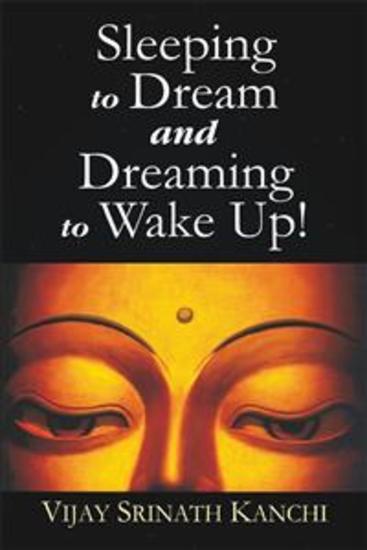
Sleeping to Dream and Dreaming to Wake Up! - cover

Sleeping to Dream and Dreaming to Wake Up!

Vijay Srinath Kanchi

Publisher: D.K. Printworld

  • 0
  • 0
  • 0

Summary

Dreams play a significant role in our life, meaningfully affecting us in the development of our personality and our spiritual journey. They are an everyday experience for any human being. Dreams have always been of great interest to poets and philosophers alike since ancient times and examples are aplenty in Indian and Western scriptures. However, it is an uphill task for an ordinary person to fully appreciate the intricacies and significance of dreams in the day-to-day life. It is here that this book proves as an invaluable guide providing deep understanding on the nature of dream and sleep.
This book is a repertoire of human wisdom – gathered for centuries and attested by the modern science – offering enormous insights into our dream and deep-sleep states. It asks, from a common man’s point of view, many a question that perturb us and provides answers to them from the scientific and spiritual perspectives in a captivating way. Some such questions include: 
• Do we see dreams in black and white or in colour? 
• What does a visually-challenged person see in his dreams?
• Why are some of our dreams extraordinarily vivid with electric colours, the clarity and brilliance of which, we may never encounter in our ordinary waking lives?
• Why are we non-reflective, irrational in our dreams?
• Are the dream time and waking time equal?
• How does our memory work in dream state? Why do we forget our dreams and is it possible to improve dream recall and cultivate awareness in dreams?
• Why do we fail to distinguish a dream object from the physical world object while we are dreaming?
• If the dream experience exactly feels like the real world and we fail to distinguish it from the waking world while we are dreaming, how can we be certain that we are not dreaming now?
• How does a dream contain various persons exhibiting opposite emotions at the same time when all the dream characters including the witnessing dreamer are produced out of single mind of the dreaming person?
• Can we intentionally transform the dream scenarios? If so, what would be the philosophical implications of it?
• Can dreams and sleeps be utilized for spiritual elevation?
... and many more questions we always wondered about the daily eight hours of our bed time, but never got the right answers to! We find new meanings and ways in dealing with our dreams in this volume, therefore, it is a must read for every dream enthusiast as well as any serious spiritual seeker. 
Available since: 11/08/2022.

Other books that might interest you

  • Pineal and Creativity - Opening the Mind to New Ideas - cover

    Pineal and Creativity - Opening...

    Lola Gonzalez

    • 0
    • 0
    • 0
    What if the secret to boundless creativity and limitless ideas lay deep within your brain? In this inspiring and practical audiobook, discover how the small but powerful pineal gland holds the key to unlocking your creative potential.
     
    From understanding the science behind this mysterious "third eye" to mastering techniques that nurture its function, this guide takes you on a journey to:
    
      Break through mental barriers like self-doubt and fear.
      Harness intuition to spark innovative ideas.
      Transform dreams into reality through actionable steps.
      Connect with deeper states of consciousness for spiritual and creative growth.
    
     
    With a blend of science, spirituality, and practical exercises, this audiobook provides tools to nurture your mind, activate your pineal gland, and illuminate the path to limitless creativity. Whether you're an artist, entrepreneur, or anyone seeking inspiration, this is your roadmap to a brighter, more imaginative future.
     
    Are you ready to unlock the full potential of your creative mind? The journey begins here.
    Show book
  • God's Own Gentlewoman - The Life of Margaret Paston - cover

    God's Own Gentlewoman - The Life...

    Diane Watt

    • 0
    • 0
    • 0
    The remarkable story of Margaret Paston, whose letters form the most extensive collection of personal writings by a medieval English woman. 
     
    Drawing on the largest archive of medieval correspondence relating to a single family in the UK, God's Own Gentlewoman explores what everyday life was like during the turbulent decades at the height of the Wars of the Roses. Covering topics including political conflicts and familial in-fighting; forbidden love affairs and clandestine marriages; bloody battles and sieges; fear of plague and sudden death; friendships and animosity; and childbirth and child mortality, Margaret's letters provide us with unparalleled insight into all aspects of life in late medieval England. 
     
    Diane Watt is a world expert on medieval women's writing, and God's Own Gentlewoman explores how Margaret's personal archive provides an insight into her activities, experiences, emotions and relationships, as well as the life of a medieval woman who was at times absorbed by the mundane and domestic, but who found herself caught up in the most extraordinary situations and events.
    Show book
  • Commander in Chief - Partisanship Nationalism and the Reconstruction of Congressional War Powers - cover

    Commander in Chief -...

    Casey B. K. Dominguez

    • 0
    • 0
    • 0
    The constitutional balance of war powers has shifted from Congress to the president over time. Today, presidents broadly define their constitutional authority as commander in chief. In the nineteenth century, however, Congress was the institution that claimed and defended expansive war powers authority. This discrepancy raises important questions: How, specifically, did Congress define the boundaries between presidential and congressional war powers in the early republic? Did that definition change? 


    Casey Dominguez's Commander in Chief systematically analyzes the authority that members of Congress ascribe to the president as commander in chief and the boundaries they put around that authority. 


    Dominguez shows that for more than a century members of Congress defined the commander in chief's authority narrowly. But in a wave of nationalism during the Spanish-American War, members of Congress began to argue that Congress owed deference to the commander in chief. They also tended to argue that a president of their own party should have broad war powers, while the powers of a president in the other party should be defined narrowly. Together, these two dynamics suggest that the conditions for presidentially dominated modern constitutional war powers were set at the turn of the twentieth century, far earlier than is often acknowledged.
    Show book
  • Jainism - The Path of Non-Violence Truth and Liberation - cover

    Jainism - The Path of...

    Amman Hirsch

    • 0
    • 0
    • 0
    Jainism, one of the oldest religions in the world, offers a profound philosophical and spiritual framework that emphasizes non-violence, truth, and the quest for liberation. Rooted in ancient Indian traditions, Jainism has significantly influenced the cultural and ethical landscape of India and beyond. With a rich history that dates back over two millennia, Jain teachings focus on the importance of individual responsibility, ethical conduct, and the interconnectedness of all living beings. 
    At the heart of Jainism lies the principle of Ahimsa, or non-violence, which extends not only to humans but to all forms of life, reflecting a deep commitment to compassion and respect for nature. This principle is not merely a passive refrain from harm; it is an active dedication to fostering well-being and harmony in all aspects of life. Alongside Ahimsa, Jains practice Satya (truthfulness), Asteya (non-stealing), Brahmacharya (chastity), and Aparigraha (non-possessiveness), forming a comprehensive ethical code that guides their daily lives and spiritual aspirations. 
    Jainism also emphasizes the significance of self-discipline and self-realization as pathways to liberation (Moksha) from the cycle of birth and death (Samsara). The teachings of the Tirthankaras, spiritual teachers who have attained enlightenment, serve as guides for followers on their spiritual journey. These enlightened beings exemplify the ideal virtues of Jain philosophy and provide practical insights for navigating the complexities of life.
    Show book
  • World Prehistory - The Basics - cover

    World Prehistory - The Basics

    Brian M. Fagan, Nadia Durrani

    • 0
    • 0
    • 0
    Written in a non-technical style by two archaeologists and experienced writers about the past, the story begins with human origins in Africa some six million years ago and the spread of our remote ancestors across the Old World. Then we return to Africa and describe the emergence of Homo sapiens (modern humans) over 300,000 years ago, then, much later, their permanent settlement of Europe, Eurasia, Asia, and the Americas. From hunters and foragers, we turn to the origins of farming and animal domestication in different parts of the world after about 11,000 years ago and show how these new economies changed human existence dramatically. The narratives chronicle the rise and fall of civilizations, and the devastating effects of long droughts on many of them. The closing chapter poses a question: Why is world prehistory important in the modern world? What does it tell us about ourselves? 


    Providing a simple, but entertaining and stimulating, account of the prehistoric past from human origins to today from a global perspective, World Prehistory: The Basics is the ideal guide to the story of our early human past and its relevance to the modern world.
    Show book
  • Conflicted Scars - An Average Player’s Journey to the NHL - cover

    Conflicted Scars - An Average...

    Justine Davis

    • 0
    • 0
    • 0
    An indispensable guide to parents of hockey hopefuls
    		 
    At a time of great change in hockey, Justin Davis exposes the dark underbelly of the journey from the minors to the big leagues 
    		 
    Hockey culture: it’s a commonly used phrase inside the game, glorifying sacrifice, toughness, loyalty, and a sense of identity. Justin Davis viewed this culture as something he was lucky enough to experience. After all, he’d won a Memorial Cup after leading the tournament in scoring, and he’d been drafted by the Washington Capitals. “In my mind,” he says, “I was the normal one.” Unfortunately, after stepping outside the game, he began to recognize the racism, sexual abuse and bullying that was so deeply ingrained in the sport. And then, as his own children grew into teenagers, the curtain was pulled back, the memories came rushing forward, and he was horrified: “Why was I naked in a bus bathroom for four hours with seven teammates? What happened to my brain, and why can’t I remember the simplest things? How did I end up living in a basement where the strangers upstairs were clearly engaged in domestic abuse?”
    		 
    As it navigates the sport’s darkest corridors, Conflicted Scars shares the story of the common Canadian player and offers a guide for parents who need to know how and why a typical teenager with NHL dreams, from a small town, now lives anxiously, introvertedly, and battling emotional detachment.
    Show book