Join us on a literary world trip!
Add this book to bookshelf
Grey
Write a new comment Default profile 50px
Grey
Subscribe to read the full book or read the first pages for free!
All characters reduced
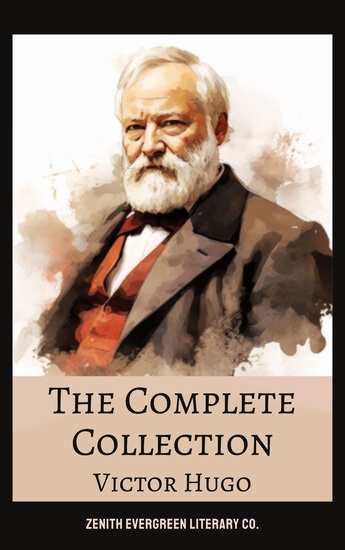
The Complete Collection of Victor Hugo - Les Misérables The Hunchback of Notre-Dame and More Timeless Masterpieces of French Literature - cover

The Complete Collection of Victor Hugo - Les Misérables The Hunchback of Notre-Dame and More Timeless Masterpieces of French Literature

Victor Hugo, Zenith Evergreen Literary Co.

Publisher: Zenith Evergreen Literary Co.

  • 0
  • 0
  • 0

Summary

Step into the grand world of 19th-century France with the powerful, poetic, and socially conscious works of Victor Hugo—one of the greatest literary minds of all time.

The Complete Collection of Victor Hugo brings together his most famous novels and lesser-known writings in one beautifully formatted Kindle edition. From the tragic redemption of Les Misérables to the sweeping romance and gothic grandeur of The Hunchback of Notre-Dame, Hugo's vision of justice, love, freedom, and the human condition remains as moving today as ever.

This collection is ideal for classic literature lovers, students, and readers seeking the soul of French literary history.

📘 This Collection Includes:
✔ Les Misérables
✔ The Hunchback of Notre-Dame (Notre-Dame de Paris)
✔ The Last Day of a Condemned Man
✔ Ninety-Three, Toilers of the Sea, and more
✔ Optimized for Kindle with active table of contents

💬 What Readers Say:
"Hugo's work is both epic and intimate—he speaks to the heart."
"This collection gives you everything you need to understand why Hugo is legendary."
"A must-read for lovers of history, romance, and human struggle."

📥 Download The Complete Collection of Victor Hugo now and explore the soul of 19th-century literature.
Available since: 05/02/2025.
Print length: 3668 pages.
Other books that might interest you

  • Have You Done Your Best? (Unabridged) - cover

    Have You Done Your Best?...

    Booker T. Washington

    • 0
    • 0
    • 0
    Booker Taliaferro Washington (April 5, 1856 - November 14, 1915) was an American educator, author, orator, and adviser to several presidents of the United States. Between 1890 and 1915, Washington was the dominant leader in the African American community and of the contemporary black elite. Washington was from the last generation of black American leaders born into slavery and became the leading voice of the former slaves and their descendants. They were newly oppressed in the South by disenfranchisement and the Jim Crow discriminatory laws enacted in the post-Reconstruction Southern states in the late 19th and early 20th centuries.
    HAVE YOU DONE YOUR BEST?: If you have not already done so-and I hope you have-I think that you will find this a convenient season for each one of you to stop and to consider your school-year very carefully; to consider your life in school from every point of view; to place yourselves, as it were, in the presence of your parents, or your friends at home; to place yourselves in the presence of those who stand by and support this institution; to place yourselves in the presence of your teachers and of all who are in any way interested in you.
    Show book
  • Last Words (Unabridged) - cover

    Last Words (Unabridged)

    Booker T. Washington

    • 0
    • 0
    • 0
    Booker Taliaferro Washington (April 5, 1856 - November 14, 1915) was an American educator, author, orator, and adviser to several presidents of the United States. Between 1890 and 1915, Washington was the dominant leader in the African American community and of the contemporary black elite. Washington was from the last generation of black American leaders born into slavery and became the leading voice of the former slaves and their descendants. They were newly oppressed in the South by disenfranchisement and the Jim Crow discriminatory laws enacted in the post-Reconstruction Southern states in the late 19th and early 20th centuries.
    LAST WORDS: We have come to the close of another school year. Some of you will go out from among us now, not to return. Others will go home for the summer vacation and return at the end of that for the next school year.
    Show book
  • Teddy Roosevelt The Rough Riders - Stories For Everyone - cover

    Teddy Roosevelt The Rough Riders...

    Teddy Roosevelt

    • 0
    • 0
    • 0
    The Rough Riders was a nickname given to the 1st United States Volunteer Cavalry, one of three such regiments raised in 1898 for the Spanish–American War and the only one to see combat. The United States Army was small, understaffed, and disorganized in comparison to its status during the American Civil War roughly thirty years prior. Following the sinking of USS Maine, President William McKinley needed to muster a strong ground force swiftly, which he did by calling for 125,000 volunteers to assist in the war. The U.S. had gone to war in opposition to Spanish colonial policies in Cuba, which was then torn by a rebellion.[1] The regiment was also nicknamed "Wood's Weary Walkers" for its first commander, Colonel Leonard Wood. This reflected their dissatisfaction that despite being cavalry, they ended up fighting in Cuba as infantry since their horses were not sent there with them. 
     
    Wood's second in command was former Assistant Secretary of the Navy Theodore Roosevelt, a strong advocate for the Cuban War of Independence. When Wood was promoted to become commander of the 2nd Cavalry Brigade, the regiment became known as "Roosevelt's Rough Riders." That term was borrowed from Buffalo Bill, who called his traveling Western show "Buffalo Bill's Wild West and Congress of Rough Riders of the World." 
     
    The original plan called for the regiment to be composed of frontiersmen from the Indian Territory, the New Mexico Territory, the Arizona Territory, and the Oklahoma Territory. However, after Roosevelt joined the ranks, it attracted an odd mixture of Ivy League athletes, glee club singers, Texas Rangers, and Native Americans. All accepted into the regiment had to be skilled horsemen and eager to see combat. The Rough Riders would receive more publicity than any other Army unit in that war, and they are best remembered for their conduct during the Battle of San Juan Hill.
    Show book
  • Gods in Exile - Heine pulls at many threads in this essay short story using the reincarnation of the famous Greek gods into medieval Christian Europe as his subject matter to do this - cover

    Gods in Exile - Heine pulls at...

    Heinrich Heine

    • 0
    • 0
    • 0
    Christian Johann Heinrich Heine was born in Düsseldorf, Germany on 13th December 1797 to assimilated Jewish parents. 
     
    Heine studied law at the universities of Bonn, Göttingen, and Berlin but his greater commitment was to studying poetry and literature.   
     
    He converted to Protestantism in order to obtain work as there were draconian anti-Jewish laws in force at the time.   
     
    He was part of the German Romantic movement but also responsible in part for ushering in the post-Romantic crisis and the presumed failure of art as unable to overcome or explain the growing traumas of modernity.  However, his literary reputation was cemented in the second half of the 1820’s with his poetry collection ‘The Book of Songs’ together with his collection of ‘Pictures of Travel’ stories that blended fact and fiction together into commercial and critical successes. 
     
    After the July 1830 Revolution in France, he went to live in Paris, where he remained until his death.  
     
    Here he wrote much in the way of essays discussing the political and cultural scene in France together with volumes of social criticism on Germany. 
     
    By 1835, his works had been banned by the German government.  His lifelong subsidised lifestyle ended in 1844 when his uncle died leaving him nothing.  He turned once more to lyric poetry and created perhaps his finest poetical works.  A trip to Germany resulted in the long satirical poem ‘Germany. A Winter's Tale’. His second volume of poetry, ‘New Poems’ in 1844, included poems that had originally appeared in Karl Marx’s newspaper ‘Forward’ and continued the satirical style he now preferred.   
     
    In May 1848, Heine, in poor health, fell and was paralyzed and confined to his bed.  He called it his ‘mattress-grave’ and only death would remove him from it.  He was also experiencing eye problems and suffering from chronic lead poisoning. 
     
    Heinrich Heine died on 17th February 1856.  He was 58.   
     
    ‘Gods in Exile’ is perhaps a prophetic piece on his own life.  The old gods are overthrown by the new novelty of Christianity.  What will be their role now?  Is there life after for them?
    Show book
  • Peter Pan - Peter and Wendy - The Classic 1911 Edition (UK Accent) - cover

    Peter Pan - Peter and Wendy -...

    J. M. Barrie, Classics by TFM

    • 0
    • 0
    • 0
    Peter Pan is a classic tale enjoyed by children for more than 100 years. This timeless tale of imagination, adventure, and friendship has captured the hearts of generations and remains a beloved classic to this day. 
    Refusing to grow up, Peter lives in the magical world of Neverland with pirates, fairies, and mermaids. With the help of the Lost Boys and the Darling children, Peter bravely battles the evil Captain Hook and his pirate crew in an endless chase around the magical island. 
    This book is for you if you love stories, podcasts, and audiobooks, such as Little Stories for Tiny People, bedtime stories for kids, Classic kids books, classic children's audiobooks, Wizard of Oz, Narnia, the adventures of Paddington, The Tiger Who Came to Tea, the Gruffalo, audiobooks by Roald Dahl, animated classics, Beatrix Potter, Disney audiobooks, and more. 
    Show book
  • Chimes The - A Goblin Story (Unabridged) - cover

    Chimes The - A Goblin Story...

    Charles Dickens

    • 0
    • 0
    • 0
    The Chimes: A Goblin Story of Some Bells that Rang an Old Year Out and a New Year In, commonly referred to as The Chimes, is a novella written by Charles Dickens and first published in 1844, one year after A Christmas Carol. It is the second in his series of "Christmas books," five novellas with strong social and moral messages that he published during the 1840s. In addition to A Christmas Carol and The Chimes, the Christmas books include The Cricket on the Hearth (1845), The Battle of Life (1846), and The Haunted Man and the Ghost's Bargain (1848).
    Show book