Join us on a literary world trip!
Add this book to bookshelf
Grey
Write a new comment Default profile 50px
Grey
Subscribe to read the full book or read the first pages for free!
All characters reduced
Napoleon the Little - cover

Napoleon the Little

Victor Hugo

Publisher: DigiCat

  • 0
  • 0
  • 0

Summary

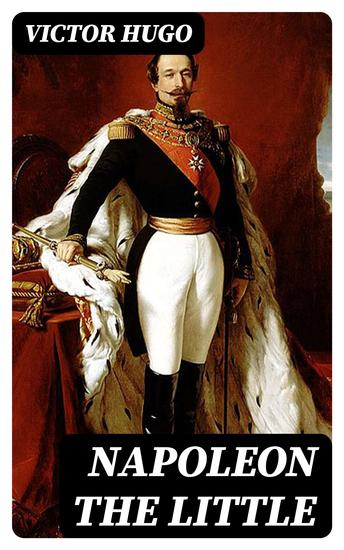
In "Napoleon the Little," Victor Hugo weaves a passionate and critical portrayal of Napoleon Bonaparte, exploring the complexities of his legacy through a blend of vivid prose and biting political commentary. Written in 1852, during Hugo's exile from France, the book serves both as a biography and a polemic, juxtaposing the grandeur of Napoleon's achievements with the moral impoverishment he perceived in his tyrannical rule. The literary style is marked by Hugo's characteristic lyricism and dramatic flair, infused with a powerful sense of justice that reflects the political turbulence of his time and the dichotomy between idealism and authoritarianism. Victor Hugo, an ardent republican, found himself in exile following the coup d'état of 1851, an event that galvanized his opposition to authoritarian regimes. This personal experience of displacement and political disenfranchisement profoundly influenced his writing, as he sought to expose the dangers of tyranny while advocating for democracy and individual rights. Hugo's earlier works, combined with his deep-seated love for France and its revolutionary ideals, culminated in the urgent need to document and critique Napoleon's impact on European society and politics. "Napoleon the Little" is recommended for readers interested in the intersection of history, literature, and political thought. Hugo's incisive analysis is not only a reflection of his era but also resonates with contemporary discussions regarding leadership, power, and moral responsibility. This work provides invaluable insights for anyone seeking to understand the complexities of one of history's most controversial figures.
Available since: 08/15/2022.
Print length: 190 pages.
Other books that might interest you

  • The Eurasian Century - Hot Wars Cold Wars and the Making of the Modern Century - cover

    The Eurasian Century - Hot Wars...

    Hal Brands

    • 0
    • 0
    • 0
    We often think of the modern era as the age of American power. In reality, we're living in a long, violent Eurasian century. That giant, resource-rich landmass possesses the bulk of the global population, industrial might, and potential military power. Eurasia is a strategic prize without equal—which is why the world has been roiled, reshaped, and nearly destroyed by clashes over the supercontinent. 


    Since the early twentieth century, autocratic powers have aspired for dominance by seizing commanding positions in the world's strategic heartland. Offshore sea powers, namely the United Kingdom and America, have sought to make the world safe for democracy by keeping Eurasia in balance. America's rivalries with China, Russia, and Iran are the next round in this geopolitical game. If this new authoritarian axis succeeds in enacting a radically revised international order, America and other democracies will be vulnerable and insecure. 


    Hal Brands argues that a better understanding of Eurasia's strategic geography can illuminate the contours of rivalry and conflict in today's world. The Eurasian Century explains how revolutions in technology and warfare, and the rise of toxic ideologies of conquest, made Eurasia the center of twentieth-century geopolitics—with pressing implications for the struggles that will define the twenty-first.
    Show book
  • Global and Historical Perspectives - Exploring the Past and Global Relations (4 in 1) - cover

    Global and Historical...

    Zoey Fraisers

    • 0
    • 0
    • 0
    Prepare to see world history and international dynamics through an entirely new lens. 
    This revealing collection examines the hidden forces that have shaped our past and continue to influence global affairs today. Drawing from declassified documents and scholarly research, this guide offers critical insights into history and international relations. 
    THE SHOCKING TRUTH ABOUT HISTORICAL EVENTS 
     How pivotal moments in history have been misrepresented in popular accounts. Uncover the concealed motivations behind famous conflicts, the suppressed perspectives of marginalized groups, and how historical narratives are crafted to serve political ends. 
    THE SHOCKING TRUTH ABOUT HISTORICAL FIGURES 
     The complex realities behind idealized or vilified historical personalities. Explore how cultural heroes often had troubling beliefs, supposed villains showed unexpected humanity, and how nuanced individuals are flattened into simplistic caricatures. 
    THE SHOCKING TRUTH ABOUT INTERNATIONAL RELATIONS 
     The hidden mechanisms driving nation-state behaviors beyond official diplomatic channels. Discover how economic interests frequently override stated values, the role of intelligence operations in shaping world events, and the power dynamics that determine which voices influence global policy. 
    THE SHOCKING TRUTH ABOUT INTERNATIONAL AID 
     The gap between humanitarian intentions and on-the-ground impacts. Learn how aid programs can perpetuate dependency, how funding is diverted from intended recipients, and which approaches actually deliver sustainable improvements versus those that primarily serve donor interests. 
    Knowledge creates informed citizens. 
    This essential guide transforms your understanding of history and global affairs, moving beyond simplistic narratives to reveal the complex truths that shape our world.
    Show book
  • Government by the Unelected - How It Happened and How It Might Be Tamed - cover

    Government by the Unelected -...

    Dr. R.J. Pestritto

    • 0
    • 0
    • 0
    “Much alarm has been raised among Establishment media and politicians about President Trump’s efforts to cut the federal bureaucracy and to force its top officials to be more loyal to him and to those who voted for him. How did we come to find ourselves in a situation where our top national administrators – who exercise immense governing power in our country – think of themselves as independent of the elected president? Why does it create alarm among our elites when the president expects those running the administrative state to carry out his political program? The roots of this entitled attitude go back many decades, and are part of the original Progressive project to comprehensively reshape American government. We are now in the midst of the first serious effort since the 1930s to restore some measure of democratic accountability to national administration. In this Provocation, Ronald J. Pestritto explains how we got to this moment, and what the prospects are for the current effort to turn things around.”  
    Show book
  • Living in the Future - Utopianism and the Long Civil Rights Movement - cover

    Living in the Future -...

    Victoria W. Wolcott

    • 0
    • 0
    • 0
    Living in the Future reveals the unexplored impact of utopian thought on the major figures of the Civil Rights Movement. 
      
    Utopian thinking is often dismissed as unrealistic, overly idealized, and flat-out impractical—in short, wholly divorced from the urgent conditions of daily life. This is perhaps especially true when the utopian ideal in question is reforming and repairing the United States’ bitter history of racial injustice. But as Victoria W. Wolcott provocatively argues, utopianism is actually the foundation of a rich and visionary worldview, one that specifically inspired the major figures of the Civil Rights Movement in ways that haven’t yet been fully understood or appreciated. 
     
    Wolcott makes clear that the idealism and pragmatism of the Civil Rights Movement were grounded in nothing less than an intensely utopian yearning. Key figures of the time, from Martin Luther King Jr. and Pauli Murray to Father Divine and Howard Thurman, all shared a belief in a radical pacificism that was both specifically utopian and deeply engaged in changing the current conditions of the existing world. Living in the Future recasts the various strains of mid-twentieth-century civil rights activism in a utopian light, revealing the power of dreaming in a profound and concrete fashion, one that can be emulated in other times that are desperate for change, like today.
    Show book
  • Ron Desantis: A Fascinating Biography - cover

    Ron Desantis: A Fascinating...

    Jordan Blake

    • 0
    • 0
    • 0
    Uncover the life and career of one of America’s most talked-about political figures with Ron DeSantis: A Fascinating Biography by Jordan Blake. This audiobook offers an in-depth exploration of Ron DeSantis’s journey from his modest beginnings to becoming a prominent leader on the national stage. 
    Blake’s biography provides listeners with a comprehensive look at DeSantis’s rise through the political ranks, from his education at Yale and Harvard, to his service as a U.S. Navy officer, and his subsequent entry into politics. The audiobook delves into his tenure as the Governor of Florida, highlighting his controversial policies, leadership during crises like the COVID-19 pandemic, and his role in shaping the future of the Republican Party. 
    Whether you’re interested in modern American politics, the dynamics of state leadership, or the personal story behind a rising political figure, Ron DeSantis: A Fascinating Biography offers a compelling and insightful portrait. This audiobook is essential listening for those who want to understand the man behind the headlines and his impact on contemporary American governance.
    Show book
  • Psychology of Peoples - Its influence on their evolution - cover

    Psychology of Peoples - Its...

    Gustave Le Bon

    • 0
    • 0
    • 0
    After receiving a doctorate in medicine, Le Bon travelled in Europe, North Africa, and Asia and wrote several books on anthropology and archaeology. His interests later shifted to natural science and social psychology. Gustave Le Bon is best known for his seminal work „Crowd Psychology“ where he describes the psychological effects in various group settings. In „Psychology of Peoples“ written in 1894 he utilizes his anthropological knowledge and cross-references it with social psychology. He developed a view that history is the product of racial or national character, with emotion, not intelligence, being the dominant force in social evolution. He attributed true progress to the work of an intellectual elite. As a product of its time and conditions, the content of this book is partly highly controversial and should be seen as an intellectual challenge. Some arguments should be outright rejected, cause they haven’t stood the test of time. To his credit, already back in 1894 Le Bon foresaw the dangers of the application of socialism, well before the Russian Revolution and Mao’s takeover of China. 
    Show book