

Rejoignez-nous pour un voyage dans le monde des livres!
Ajouter ce livre à l'électronique
Grey
Ecrivez un nouveau commentaire Default profile 50px
Grey
Abonnez-vous pour lire le livre complet ou lisez les premières pages gratuitement!
All characters reduced
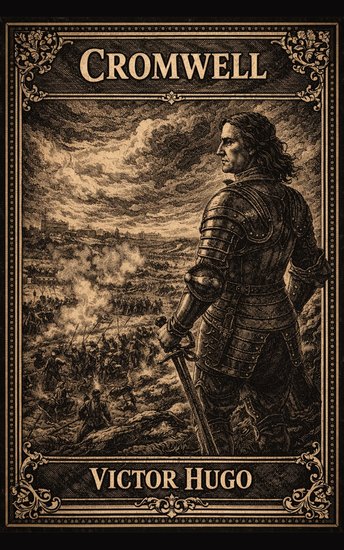
Cromwell - cover

Cromwell

Victor Hugo

Maison d'édition: CLXBX

  • 0
  • 0
  • 0

Synopsis

Victor Hugo's Cromwell is a monumental historical drama that marked a turning point in French literature and laid the foundation for the Romantic movement. Written in 1827, this ambitious play reimagines the life and inner turmoil of Oliver Cromwell, the controversial English leader who rose to power after the execution of King Charles I. More than a political chronicle, Cromwell is a profound exploration of ambition, conscience, destiny, and the fragile nature of authority.

Set in 17th-century England, the drama unfolds during a pivotal moment when Cromwell stands at the height of his power as Lord Protector. The crown of England is within his grasp, yet he hesitates. Around him swirl conspiracies, political intrigue, loyal supporters, hidden enemies, and royalist plots seeking to restore the monarchy. Hugo masterfully captures the tension of a nation suspended between republic and monarchy, revolution and tradition.

At its core, Cromwell is not merely about historical events but about the psychological struggle of a man torn between overwhelming ambition and haunting doubt. Hugo presents Cromwell as a complex, almost Shakespearean figure—both calculating and vulnerable, powerful yet uncertain. The play delves deep into themes of legitimacy, moral responsibility, and the corrupting influence of power. Is Cromwell a hero of liberty or a tyrant in disguise? Hugo leaves the reader to grapple with these questions.

One of the most remarkable aspects of Cromwell is its legendary preface, which became a manifesto of Romanticism. In it, Hugo rejects the rigid conventions of classical drama and champions artistic freedom, emotional depth, and the blending of the sublime with the grotesque. This bold declaration forever changed the course of French literature, making Cromwell significant not only as a dramatic work but also as a cultural milestone.

Rich in vivid characters, political tension, and philosophical reflection, Cromwell showcases Hugo's early genius and his ability to weave history with poetic grandeur. Though rarely performed in full due to its epic length, the play remains a powerful literary achievement—an exploration of leadership, revolution, and the human condition that continues to resonate with readers today.

For lovers of historical drama, political intrigue, and classic literature, Cromwell stands as a towering testament to Victor Hugo's visionary talent and enduring influence.
Disponible depuis: 18/02/2026.
Longueur d'impression: 364 pages.

D'autres livres qui pourraient vous intéresser

  • Red House Rising - cover

    Red House Rising

    Chris Côté, Dayle Kerry

    • 0
    • 0
    • 0
    Imagine you’re listening to the acclaimed WWII melodrama, Casablanca. But instead of Rick’s café in Vichy-occupied North Africa, you’re in the South Pacific, trapped on Truk Lagoon – island stronghold of the Japanese. Well, that’s exactly where this romantic World War II audiobook, Red House Rising, begins its story. It’s July, 1941. War is already raging in Europe. Japan has swallowed up Korea, and now terrorizes China. Pearl Harbor is about to explode. And three women, an ace transport pilot, a Chinese Intelligence officer and a local Island leader, must join forces to rescue young girls sexually enslaved by the Japanese Navy and its ruthless secret police, the Tokkeitai. As World War Two roils the Pacific, the story continues in the islands, in Hawaii, in China and Japan. There’s flying and spying and action galore. And the story calls out the fascism, racism and misogyny of that dark time. But this audiobook is most definitely about lovers – star-crossed or otherwise – finding their way in a world at war.
    Voir livre
  • Eunoia - The Upgraded Edition - cover

    Eunoia - The Upgraded Edition

    Christian Bok

    • 0
    • 0
    • 0
    Winner of the Griffin Poetry Prize (2002)
       
    Stunning and masterful in its execution, Eunoia is a five-chapter book in which each chapter is a univocal lipogram.
       
    The word ‘eunoia,’ which literally means ‘beautiful thinking,’ is the shortest word in English that contains all five vowels. Directly inspired by the Oulipo (l’Ouvroir de Littérature Potentielle), a French writers’ group interested in experimenting with different forms of literary constraint, Eunoia is a five-chapter book in which each chapteris a univocal lipogram – the first chapter has A as its only vowel, the second chapter E, etc. Each vowel takes on a distinct personality: the I is egotistical and romantic, the O jocular and obscene, the E elegiac and epic (including a retelling of the Iliad!).
       
    Stunning in its implications and masterful in its execution, Eunoia has developed a cult following, garnering extensive praise and winning the Griffin Poetry Prize. The original edition was never released in the U.S., but it has already been a bestseller in Canada and the U.K. (published by Canongate Books), where it was listed as one of the Times’ top ten books of 2008.
       
    This new edition features several new but related poems by Christian Bok and an expanded afterword.
       
    'Eunoia is a novel that will drive everybody sane.' —Samuel Delany
       
    'Eunoia takes the lipogram and rendersit obsolete.' —Kenneth Goldsmith
       
    'A marvellous, musical texture of rhymes and echoes.' —Harry Mathews
       
    'An exemplary monument for 21st century poetry.' —Charles Bernstein
       
    'Bök's dazzling word games are the literary sensation of the year.' —The Times
       
    'A resounding success ... brilliant.' —The Guardian
       
    'Brilliant ... beautiful and strange.' —Today Programme, BBC Radio 4
       
    'Impressive.' —Sunday Telegraph
       
    'No mere Christmas stocking filler for Countdown fans. Rather, it's an ingenious little novel ... playful and irreverent ... charming.' —Metro
    Voir livre
  • The Poetry of John Milton - Sparkling poems from the famed man behind Paradise Lost - cover

    The Poetry of John Milton -...

    John Milton

    • 0
    • 0
    • 0
    John Milton was born in Bread Street, London, on December 9th, 1608.  His early years were privately tutored before gaining a place at St Paul’s School and in 1625 he matriculated at Christ's College, Cambridge, earning a BA in 1629 and an MA in 1632. At Cambridge he had developed a reputation for poetic skill but also experienced alienation from his peers and university life as a whole.  
    The next 6 years were spent in private study. He read both ancient and modern works of theology, philosophy, history, politics, literature and science, in preparation for a poetical career.  Milton mastered Latin, Greek, Hebrew, French, Spanish, and Italian. To these he would add Old English (whilst researching his History of Britain) and also acquired more than a passing acquaintance in Dutch.  
    Although he was studying, some of his poetry from this time is remarkable; L’Allegro and Il Penseroso in 1631 and Lycidias in 1638. 
    In May 1638, Milton embarked upon a 15 month tour of France and Italy. These travels added a new and direct experience of artistic and religious traditions, especially Roman Catholicism.  He cut the journey short to return home during the summer of 1639 because of what he claimed were "sad tidings of civil war in England."  
    Once home, Milton wrote prose tracts against episcopacy, in the service of the Puritan and Parliamentary cause.  
    He married 16-year-old Mary Powell in June 1643 but she left him after only a few months during which he wrote and published several writings on divorce. Mary did return after 3 years and their life thereafter seemed harmonious.  Milton received a hostile response to the divorce tracts and drove him to write Areopagitica, his celebrated attack on pre-printing censorship.  
    With the parliamentary victory in the Civil War, Milton wrote The Tenure of Kings and Magistrates (1649) which defended popular government and implicitly sanctioned the regicide which led to his appointment as Secretary for Foreign Tongues by the Council of State.  
    On 24 February 1652 Milton published his Latin defense of the English People, Defensio Pro Populo Anglicano, also known as the First Defense. Milton's Latin prose and intellectual sweep, quickly gained him a European reputation.  
    Tragically his first wife, Mary, died on May 5th, 1652 following the birth of their fourth child.   The following year Milton had become totally blind, probably due to glaucoma.  He then had to dictate his verse and prose to helpers, one of whom was the poet Andrew Marvell. 
    He married again to Katherine Woodcock but she died in February 1658, less than four months after giving birth to a daughter, who also tragically died.  
    Though Cromwell’s death in 1658 caused the English Republic to collapse Milton stubbornly clung to his beliefs and in 1659 he published A Treatise of Civil Power, attacking the concept of a state-dominated church. Upon the Restoration in May 1660, Milton went into hiding for his life. An arrest warrant was issued and his writings burnt. He re-emerged after a general pardon was issued, but was nevertheless arrested and briefly imprisoned before influential friends, such as Marvell, now an MP, intervened 
    His third marriage was to Elizabeth Mynshull. Despite a 31-year age gap, the marriage seemed happy and Milton spent the remaining decade of his life living quietly in London, apart from a short spell in Chalfont St. Giles, during the Great Plague of London.  
    Milton was to now publish his greatest works, which had been gestating for many years.
    Voir livre
  • I Didn't Mean for That to Happen - cover

    I Didn't Mean for That to Happen

    Grace Weather

    • 0
    • 0
    • 0
    Before she turned thirteen, Tahiya became the life-line of her tribe. Everyone celebrated except her brother. Now, no matter how hard she tries, whatever Tahiya achieves, he steals all the attention. She wants it back. How far will she go? At what cost? Some things once done cannot be undone.
    Voir livre
  • Embark - cover

    Embark

    Sean O'Brien

    • 0
    • 0
    • 0
    A new collection by Sean O’Brien – ‘Auden’s true inheritor’, and one of our wisest poetic chronographers – is not just a literary event, but also, invariably, a reckoning of the times. Given the nature of our times, his voice is an essential one: there is no other poet currently writing with O’Brien’s intellectual authority, historical literacy and sheer command of the facts. Embark also registers our unique cultural climacteric, where the larger crises of the planet – the pandemic and the terrifying spectre of revanchist nationalism among them – impact all of us, and where the illusion of a church-and-state separation of the personal and political can no longer hold. As the poet turns seventy, he shows us how the inevitable absences that age brings are assuaged by how we furnish them; the result is not just a logic made from loss and pain, but a music, a metaphysic, and finally a redemptive art. Embark reminds us of the enduring consolations of love, of friendship, of the freedoms and possible futures still afforded by the imagination – and, through O’Brien’s own exemplary model, of poetry itself.
    Voir livre
  • George Bernard Shaw: MRS WARREN'S PROFESSION - cover

    George Bernard Shaw: MRS...

    George Bernard Shaw

    • 0
    • 0
    • 0
    .Mrs. Warren's Profession is a play written by George Bernard Shaw in 1893, and first performed in London in 1902 but was banned after two performances because of the profession talked about. The play is about a former prostitute, now a madam (brothel proprietor), who attempts to come to terms with her disapproving daughter. It illustrates Shaw's belief that the act of prostitution was not caused by moral failure but by economic necessity. It also has a lot to say about the hypocrisy of English society that profited from many despised and illegal professions and used people in despicable ways but pretended to look down on them. This was probably why it was banned, not because of the 'profession' of Mrs. Warren, but because it exposed very highly placed people doing nasty things to make money
    Voir livre
