Join us on a literary world trip!
Add this book to bookshelf
Grey
Write a new comment Default profile 50px
Grey
Subscribe to read the full book or read the first pages for free!
All characters reduced
Soap Clean Revolution - cover

Soap Clean Revolution

Victor Healey

Translator A AI

Publisher: Publifye

  • 0
  • 0
  • 0

Summary

"Soap Clean Revolution" unveils the captivating history of soap, tracing its journey from ancient concoctions to a ubiquitous tool in modern hygiene. The book highlights soap's pivotal role in public health, revealing how this seemingly simple substance has dramatically reduced infectious diseases and improved overall quality of life.

 
Readers will discover how the understanding of germ theory revolutionized soap's purpose, transforming it from a mere cleaning agent to a critical weapon against microbial threats. Learn how, around 2800 BC, Babylonians used rudimentary mixtures, a far cry from the mass-produced soaps available today thanks to the Industrial Revolution.

 
The book explores soap's historical, chemical, and social dimensions, explaining the saponification process in accessible terms and examining the evolution of soap-making techniques across centuries.

 
By integrating historical analysis with scientific insights and public health implications, "Soap Clean Revolution" provides a complete picture of soap's impact on civilization.

 
The narrative progresses chronologically, starting with ancient civilizations, moving through the medieval period, and culminating in discussions about antibacterial soaps and their environmental impact, offering a unique perspective on this often-overlooked aspect of our daily lives.
Available since: 02/27/2025.
Print length: 72 pages.
Other books that might interest you

  • Summary of Jeffrey D Sachs's The End of Poverty - cover

    Summary of Jeffrey D Sachs's The...

    Falcon Press

    • 0
    • 0
    • 0
    Buy now to get the main key ideas from Jeffrey D. Sachs's The End of Poverty 
      
    Can extreme poverty be eradicated in our lifetime? Jeffrey D. Sachs offers a detailed analysis of poverty in the world and proposes solutions in The End of Poverty (2005). He runs an economic diagnostic of the problem and offers practical solutions, integrating misconceptions and countering them. The End of Poverty is built on Sachs’ rich background in development economics and his professional expertise in the field. Though it is clear that extreme poverty will not be eradicated by 2025, as he once thought possible, The End of Poverty is a valuable read for anyone working in the field of development and sustainability.
    Show book
  • Pandemic Perspectives - A filmmaker's journey in 10 essays - cover

    Pandemic Perspectives - A...

    Howard Burton

    • 0
    • 0
    • 0
    Directly inspired by award-winning author, physician and self-professed “biology watcher” Lewis Thomas, Howard Burton takes us on a thought-provoking tour of a wide range of social and scientific issues which he encountered through the process of making the documentary film, Pandemic Perspectives. Howard provides unique and fresh insights into a wide range of issues ranging from biology to politics to contemporary morality weaving together his interaction with a diverse array of international experts who participated in his film and his personal experiences as a physicist-turned-filmmaker.
    Show book
  • Grandfather's Robin - cover

    Grandfather's Robin

    Gillian Bickley

    • 0
    • 0
    • 0
    Grandfather's Robin offers poems about People, Fellow Creatures, Society, Ekphrasis, Scenes and Moods, Survival, and Short Poems. They were written over several years, in response to people seen, read about, or known, and in response to creatures seen, read about, or known. Other poems respond to group and social behaviour, and reflect responses to works of art. Some poems are prompted by the natural world, urban and village life, and thoughts about the survival of all beings. The short poems offer instants both serious and humorous. 
    “So many reasons to enjoy Gillian Bickley’s luminous poetry – humour, depth and wisdom. ... Lovely and evocative, Bickley’s powers of observation and precise, selective description lend many of these poems the power of fine portraiture, a sepia photograph, where we see into the eyes, where we discover essence.” 
    — Jack Mayer, poet (Poems from the Wilderness) 
    “In this work, Gillian Bickley affords us a glimpse into her perspective. She invites us to reflect on the rich tapestry of life and our shared human experience. Why should you read this collection? Because there is no greater privilege than intimacy.” 
     —Mary-Jane Newton poet (Of Symbols Misused, Unlocking) 
      
     “... poems as moments of tranquility in which we can encounter lives unrolling in times that ... are anything but. To make a record such as this is a good resolution indeed, and I am pleased that Gillian has chosen for the cover a moment of tranquility I painted. As Mrs. Dorothy Collins might have said, reflecting, as these poems do, the quietness of a life-long practice, ‘Very well!’” 
    —Steven Schroeder, Chicago
    Show book
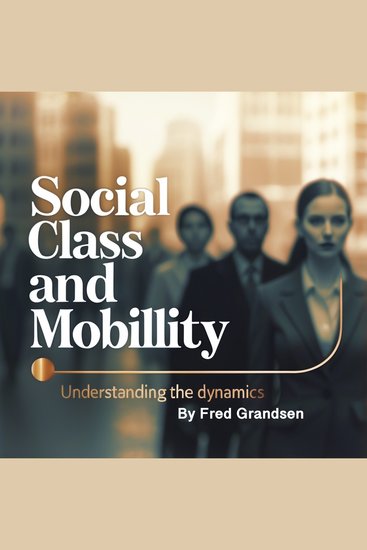
  • Social Class and Mobility - Understanding the Dynamics - cover

    Social Class and Mobility -...

    Fred Grandsen

    • 0
    • 0
    • 0
    Social class and mobility are central concepts in understanding how societies function and evolve. The classification of individuals into different social classes based on income, occupation, education, and wealth shapes life experiences, opportunities, and access to resources. At the same time, social mobility—the ability of individuals or groups to move within a social hierarchy—determines whether societies remain rigidly stratified or allow for upward and downward movement. These dynamics influence economic stability, political structures, and cultural identities, making the study of social class and mobility essential for comprehending broader social patterns. 
    Social class is typically divided into broad categories such as the upper class, middle class, working class, and lower class. Each class has distinct characteristics that define access to wealth, education, job opportunities, and social networks. For example, the upper class often benefits from inherited wealth and exclusive professional opportunities, while the working and lower classes may experience financial instability and limited career advancement. These disparities create divisions that influence daily life, from the quality of healthcare received to the neighborhoods people can afford to live in. 
    Social mobility refers to changes in an individual’s or family’s social position over time. Mobility can be upward, where individuals improve their socioeconomic status, or downward, where they experience a decline. It can also be intergenerational, occurring across multiple generations, or intragenerational, happening within an individual’s lifetime. Various factors influence mobility, including education, economic conditions, public policies, and structural barriers such as discrimination or unequal access to opportunities.
    Show book
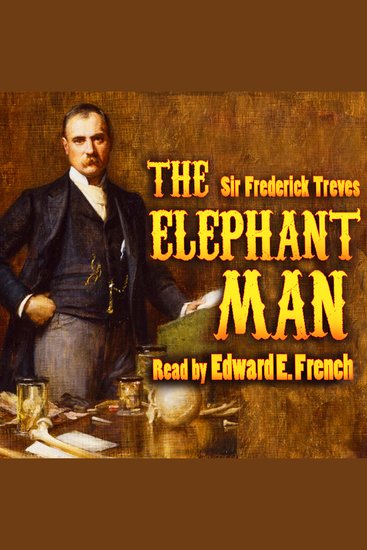
  • The Elephant Man - cover

    The Elephant Man

    Frederick Treves

    • 0
    • 0
    • 0
    This is a story in Victorian England of how in 1884 Frederick Treves, Surgeon and Lecturer in Anatomy at the London Hospital arranged for the "Elephant Man" (whose distorted grotesque face and deformed body made him a "freak") to visit the medical college next to the hospital for the purpose of a lecture.  They would later become friends and Treves the savior of the man named John Merrick. This is Treves' memoir.
    Show book
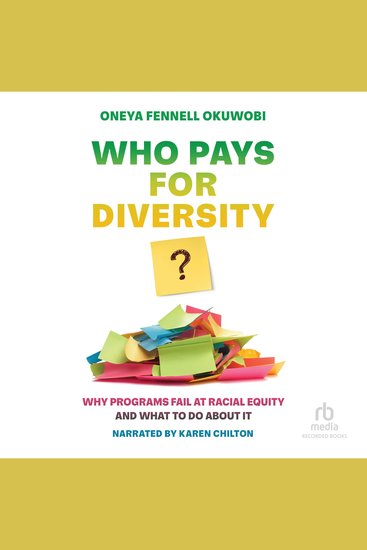
  • Who Pays for Diversity? - Why Programs Fail at Racial Equity and What to Do about It - cover

    Who Pays for Diversity? - Why...

    Oneya Fennell Okuwobi

    • 0
    • 0
    • 0
    How diversity initiatives harm employees of color by turning them into workplace commodities. 
      
    Diversity programs are under attack. Should those interested in racial justice fight to keep them, or might there be another way forward? Who Pays for Diversity? reveals the costs that employees of color pay under current programs by having their racial identities commodified to benefit white people and institutions. Oneya Fennell Okuwobi proposes fresh and thoughtful ways to reorient these initiatives, move beyond tokenism, and authentically center marginalized employees. 
      
    Drawing on accounts of employees from across the workplace spectrum, from corporations to churches to universities, Who Pays for Diversity? details how the optics of diversity programs undermine employees' competence while diminishing their well-being and workplace productivity. Okuwobi argues that diversity programs have been a costly detour on the path to racial justice, and getting back on track requires solutions that provide equity, dignity, and agency to all employees, instead of defending the status quo.  
      
    "Oneya Fennell Okuwobi brilliantly uncovers the hidden costs of diversity initiatives, challenging the superficiality of such programs and the burdens they place on people of color within so-called 'diverse' environments with a powerful, evidence-backed critique. This book is an essential read for anyone committed to creating genuine racial equity in workplaces and institutions."—Mary Murphy, Herman B. Wells Endowed Professor, Indiana University
    Show book