Join us on a literary world trip!
Add this book to bookshelf
Grey
Write a new comment Default profile 50px
Grey
Subscribe to read the full book or read the first pages for free!
All characters reduced
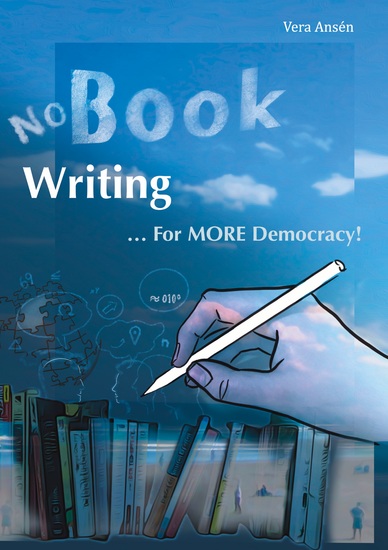
No Book Writing - For MORE Democracy! - cover

Sorry, the publisher does not allow users to read this book from the country from which you are connecting.

No Book Writing - For MORE Democracy!

Vera Ansén

Publisher: BoD - Books on Demand

  • 0
  • 0
  • 1

Summary

Writing? ... This painstakingly acquired skill - not for you, you say? But reading, well, that's fine? Let's rethink this.
Writing has shaped how we share knowledge, challenge ideas, and build the world we live in. Let's not leave the narratives to others - especially those who seek to control them.
It's not just what we experience, everything we read shapes our awareness, our ability to listen, and the decisions we make. Writing is how we pass on knowledge, question authority, and imagine new possibilities. What we write today influences not just AI models but also future writers and thinkers, helping them discover new solutions.
Human feedback has always been and remains the key to a future where we can thrive together.
Think along. Speak up. Get involved. And WRITE!
That's how we keep stories alive. That's how we shape the future.
Available since: 03/21/2025.
Print length: 100 pages.

Other books that might interest you

  • Captivating Minds: Secrets to Engage Readers Instantly - "Elevate your reading game! Experience 'Captivating Minds' audio lessons that captivate and engage readers effortlessly" - cover

    Captivating Minds: Secrets to...

    Caspian Fawkes

    • 0
    • 0
    • 0
    Captivating Minds: Secrets to Engage Readers Instantly 
    ⭐⭐ Simplified Guide & Explanations Included ⭐⭐ 
    Are you eager to advance in your career and deepen your understanding by mastering the art of storytelling? 
    Looking for a thorough resource that equips you with everything you need to captivate any audience? 
    Your search ends here! 
    This guide is your ultimate resource for enhancing your storytelling abilities, applying your skills, and engaging in practical exercises. With this knowledge at your disposal, you are set for success. 
    Updated to reflect the latest in storytelling techniques. 
    Key features of this enhanced guide: 
    - In-depth insights into the art of storytelling 
    - Comprehensive explanations of strategies to captivate your audience 
    - Effective approaches for preparing and delivering compelling narratives 
    Our guide stands out for its thorough coverage, crucial for your success in captivating audiences. Concepts are explored in depth, ensuring a rich understanding rather than a superficial overview. 
    Please keep in mind that this guide is an independent resource and is not affiliated with any official storytelling entity. 
    Crafted with a straightforward structure and easy-to-understand language, our guide ensures smooth transitions between topics. Say farewell to confusing jargon and welcome content that is clear, precise, and technically accurate. 
    So, why wait? Click the BUY NOW button, secure your guide, and embark on your journey to storytelling mastery!
    Show book
  • Revolution and Terror - cover

    Revolution and Terror

    Graeme Gill

    • 0
    • 0
    • 0
    This book is a study of the relationship between revolution and terror. Historically many have claimed that revolution inevitably devolves into terror, best reflected in the way in which after coming to power the revolutionary elite turns on itself, and one section of it uses terrorist means to eliminate another section. Graeme Gill argues that in order to understand the relationship between revolution and terror, it is necessary to distinguish between different types of terror. There are three such types: revolutionary terror, in which the aim is to destroy enemies and thereby consolidate the regime; transformational terror, designed to drive the politico-socio-economic transformation of society that is the purpose of the 'great' revolutions; and inverted terror, which is when terror is turned against part of the elite and regime more broadly. The analysis explains how these different types of terror are related to the revolutionary seizure of power, showing that revolutionary and transformational terror are organically connected to revolution while for inverted terror the connection is mediated through the leader. The argument is prosecuted through detailed analysis of the French, Russian, and Chinese revolutions. The study ends by assessing the contemporary salience of the lessons of the great revolutions in the light of the low level of violence in the negotiated revolutions of 1989.
    Show book
  • Matilda by Roald Dahl (Book Analysis) - Detailed Summary Analysis and Reading Guide - cover

    Matilda by Roald Dahl (Book...

    Bright Summaries

    • 0
    • 0
    • 0
    Unlock the more straightforward side of Matilda with this concise and insightful summary and analysis!This engaging summary presents an analysis of Matilda by Roald Dahl, the story of a young girl with a passion for reading, something which her parents simply cannot understand. She discovers that she has incredible powers and decides to use them to save her favourite teacher, and the whole school, from their terrifying head teacher, Miss Trunchbull. It has been considered one of the best children's novels of all times, and its popularity has led to it being turned into a hugely successful feature film starring Danny DeVito, as well as a Broadway musical. Find out everything you need to know about Matilda in a fraction of the time!This in-depth and informative reading guide brings you:• A complete plot summary• Character studies• Key themes and symbols• Questions for further reflectionWhy choose BrightSummaries.com?Available in print and digital format, our publications are designed to accompany you in your reading journey. The clear and concise style makes for easy understanding, providing the perfect opportunity to improve your literary knowledge in no time.See the very best of literature in a whole new light with BrightSummaries.com!
    Show book
  • The Burma Wars - 1824-1886 - cover

    The Burma Wars - 1824-1886

    George Bruce

    • 0
    • 0
    • 0
    Between 1824 and 1885 Britain and Burma fought in three deadly struggles. 


    The first was the longest and most expensive war in British Indian history, the second was criticized at the time as being caused by gunboat diplomacy, and the third led to the removal of Burma's Konbaung dynasty and the incorporation of Burma into the British Raj. 


    These wars were fraught with military blunders and incompetence. 


    Why did the tensions arise initially and how did the first battles begin? How were Burmese forces able to resist the powerful armaments of their opponents for so long? And what were the implications of this controversial war for the British? 


    The Burma Wars: 1824–1886 uses a vast assortment of contemporary sources to build up a vivid picture of the clashes, highlighting the courage and perseverance of the men who fought for both sides in difficult conditions. 


    The Times described Bruce's books as "well researched, with a keen eye for historical detail." 


    The Burma Wars: 1824–1886 is a brilliant account of one of the conflicts that led to the formation of the British Empire. It is part of the series Conflicts of Empire, which also includes Retreat from Kabul and Six Battles for India.
    Show book
  • Mythic Plants - Potions and Poisons from the Gardens of the Gods - cover

    Mythic Plants - Potions and...

    Ellen Zachos

    • 0
    • 0
    • 0
    In this beautifully illustrated book that's Song of Achilles meets Secret Life of Trees, readers will discover the plants cultivated by the Greek Gods–many of which can still be experimented with today–for a myriad of uses.  In Greek mythology, plants were used for tools, intoxication, warfare, food, medicine, magic, and rituals. When Prometheus stole fire from the Olympian gods and gave it to mankind, he hid it in a stalk of giant fennel. Ancient Greeks waiting to question the oracles were given cannabis as part of their cleansing rituals. A quince fruit started the Trojan war. The goddess Demeter was so distraught when Hades kidnapped her daughter that she caused winter to blanket the earth, killing all plants. Mythic Plants focuses on how the ancient Greeks used plants in their lives and loves and conquests—some of which we can still use. Includes tips throughout for bringing these ancient plants into your garden.  
    Show book
  • Judeophobia - A History - cover

    Judeophobia - A History

    Shlomo Sand

    • 0
    • 0
    • 0
    Throughout the history of the Western world, Jews have suffered various forms of exclusion, stigmatization, and discrimination that have forced them always to be aware of their particular situation. The Jews became a community under siege and, as Shlomo Sand argues, Judaism was shaped by the hostile gaze of Christian civilization. While the forms of hostility endured by the Jews have varied over the centuries, it is impossible to understand twentieth century anti-Judaism, or Jewish identity itself, without taking account of the sediments of mental hatred, fueled by religious belief, which have survived the passage of time. 
     
    While antisemitism is the term commonly used today, Sand prefers 'Judeophobia', which predates the appearance of 'antisemitism' and is more precise. Looking back over the centuries, he seeks to identify some of the stages in the age-old, incandescent hatred of the Jews and tries to understand what remains today of this trenchant hostility. He also questions whether Zionism, born as a distressed response to modern Judeophobia, has ended up mirroring it. To what extent has Zionism inherited the ideological foundations that have always been characteristic of the persecutors of the Jews? This history of anti-Jewish hatred will be of interest to anyone concerned with one of the most insidious and persistent features of Western civilization.
    Show book