Join us on a literary world trip!
Add this book to bookshelf
Grey
Write a new comment Default profile 50px
Grey
Subscribe to read the full book or read the first pages for free!
All characters reduced
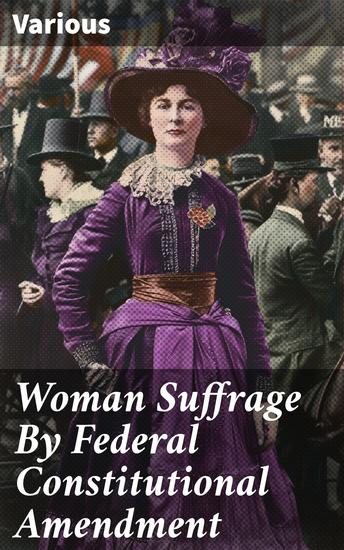
Woman Suffrage By Federal Constitutional Amendment - A Call for Equality: Advocating for Women's Voting Rights - cover

Woman Suffrage By Federal Constitutional Amendment - A Call for Equality: Advocating for Women's Voting Rights

Various Various

Publisher: Good Press

  • 0
  • 0
  • 0

Summary

In "Woman Suffrage By Federal Constitutional Amendment," a compilation of seminal essays and documents emerges as a pivotal literary work that chronicles the tireless struggle for women's voting rights in the United States. This anthology boasts a rich diversity of voices and perspectives, offering historical context for the suffrage movement against the backdrop of early 20th-century America. With a literary style that blends passionate rhetoric and legal argumentation, the book reflects a growing societal awareness and evolving concepts of democracy, justice, and equality pertinent to the feminist discourse of the time. The various contributors include prominent suffragists, legal scholars, and reformers, whose own experiences and activism underscore the urgency of the cause. Their collective efforts forged a narrative rooted in both personal stories and strategic political maneuvers, illuminating the intersections of race, class, and gender that shaped the movement. This critical anthology not only exemplifies the zeitgeist of the era but also serves as a testament to the enduring fight for women'Äôs rights, echoing throughout the history of American social movements. This book is an essential read for anyone interested in American history, women's studies, or the legal implications of constitutional amendments. It offers invaluable insight into the fundamental principles of democracy and a clarion call for justice that resonates even today. Readers will find themselves not only informed but also inspired by the resolute voices advocating for equality.
Available since: 08/12/2023.
Print length: 52 pages.

Other books that might interest you

  • Today's Authors Series: A Q&A with David Kushner and Jon "Jonny Magic" Finkel - Today's Authors Series - cover

    Today's Authors Series: A Q&A...

    David Kushner

    • 0
    • 0
    • 0
    If you think a gang of real-life geeks can’t take on the world and win big...think again. And whatever you do, don’t sit down across a gaming table from Jon Finkel, better known as Jonny Magic. Jonny Magic and the Card Shark Kids is his amazing true story: the jaw-dropping, zero-to-hero chronicle of a fat, friendless boy from New Jersey who found his edge in a game of cards–and turned it into a fortune!
    Show book
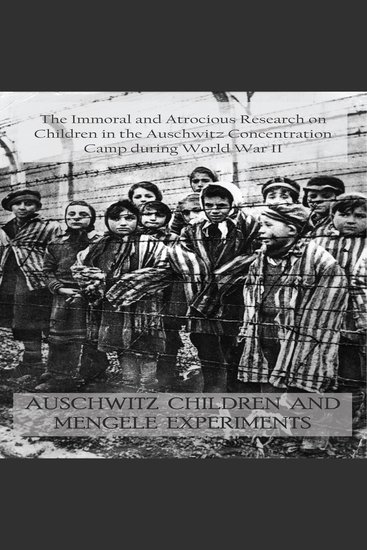
  • AUSCHWITZ CHILDREN AND MENGELE EXPERIMENTS - The Immoral and Atrocious Research on Children in the Auschwitz Concentration Camp during World War II - cover

    AUSCHWITZ CHILDREN AND MENGELE...

    Jack Stew Barretta

    • 0
    • 0
    • 0
    In the name of humanity, that was the explanation of Dr. Claus Karl Schilling for the execution of malaria experiments on 1,200 inmates of the Dachau concentration camp during the Second World War. The reputable Schilling had come to Dachau with the personal permission of the Reichsführer-SS Heinrich Himmler in 1942 because he could use the prisoners as research subjects without the restriction of obtaining their consent. Schilling was not an exception.  
    Many Nazi doctors seized the unique opportunity to execute human experiments without legal and ethical restrictions during the war. The SS and the Wehrmacht either initiated or supported the research of the Nazi doctors. The central question that puzzled jurists and scientists is how these doctors, who were educated to heal people, could execute human experiments and deliberately harm and even kill people. To some scientists, their acts stand out as ‘exemplars of evil.’ This judgment is based on the fact that prisoners did not give their informed consent, the cruel and sometimes sadistic character of the experiments, and because never before in medical experiments was the death of the research subjects a central element of the research design. Many people think that ‘science went mad’ in the Third Reich and that Nazi doctors who committed these crimes were pseudo-scientists, sadists, and even monsters. However, thinking these perpetrators were madmen or monsters is a false explanation.  
    It is confronting to know that physicians belonging to the most advanced medical community in the world at the time, who had sworn to ‘do no harm, ' could commit these crimes. 
    On this trail, Dr. Josef Mengele’s pseudo-scientific research at the Auschwitz concentration camp during World War II led to immeasurable suffering among the camp’s children.
    Show book
  • Mauryan Empire - cover

    Mauryan Empire

    Saurabh Kumar

    • 0
    • 0
    • 0
    The Mauryan Empire was established in 322 B.C. by the great king Chandragupta Maurya. The era of the Mauryas is a milestone throughout the entire existence of Ancient India. The Mauryan Empire was broad and the most powerful in the realm of old Indian history in the ruling from 322 BC to 185 BC.
    Show book
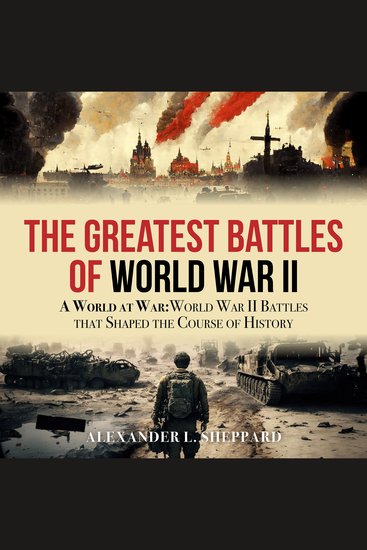
  • The Greatest Battles of World War II - A World at War:World War II Battles that Shaped the Course of History - cover

    The Greatest Battles of World...

    Alexander L. Sheppard

    • 0
    • 0
    • 0
    Harrowing stories of Auschwitz, Pearl Harbor, and D-Day continue to live on, but this unbridled look at The Greatest Battles of World War II explores the lesser-known monstrosities unlike other World War 2 books. 
    World war II did more than just change the fate of world history—in just six years, every corner of the globe became involved in some of the most violent crimes against humanity to ever occur. 
    Whether you have a great fascination for history, or you’re just looking to uncover new facts, The Greatest Battles of World War II paints a picture of the battles of World War 2 and the impact of each on the course of the war and the future of global affairs. 
    Inside The Greatest Battles of World War II, you will discover: 
    ●      major events and battle from the invasion of Poland and Dunkirk to Operation Overlord and the fateful day of June 6, 1944, when Nazi efforts all came crashing down. 
    ●      the intricately planned military and intelligence efforts on the part of the US and its allies, which were key to the victory and end of the war. 
    ●      what the fate of the war might have been if these battles had gone differently, and how even the minutest details enabled the takedown of Hitler and the Nazi Party. 
    ●      how each and every event contributed to the drawn-out war, the eventual victory of the Allied Powers, and their far-reaching impact on the world, politics, and modern history. 
    …plus key facts of every battle and military move for a well-rounded WWII education without the distracting and unnecessary details.
    Show book
  • Rise and Fall of the Third Chimpanzee The: Book Summary & Analysis - cover

    Rise and Fall of the Third...

    Briefly Summaries

    • 0
    • 0
    • 0
    This is a concise summary and analysis of The Rise and Fall of the Third Chimpanzee, by Jared Diamond.
     
    It is not the original book and is not affiliated with or endorsed by Jared Diamond.
     
    Ideal those seeking a quick and insightful overview.
     
    The Rise and Fall of the Third Chimpanzee examines the fascinating and unsettling story of humanity's evolution, achievements, and self-destructive tendencies. This thought-provoking book delves into our species' shared ancestry with chimpanzees, exploring what makes us uniquely human while shedding light on the cultural, biological, and environmental factors that have shaped our civilizations. From art and language to war and environmental collapse, this work offers a sweeping analysis of human behavior and history, prompting readers to reflect on our future as a species.
    Show book
  • Four Thousand Weeks: Book Summary and Analysis - cover

    Four Thousand Weeks: Book...

    Briefly Summaries

    • 0
    • 0
    • 0
    This is a concise summary and analysis of Four Thousand Weeks, by Oliver Burkeman.
     
    It is not the original book and is not affiliated with or endorsed by Oliver Burkeman.
     
    Ideal those seeking a quick and insightful overview.


    "Four Thousand Weeks: Time Management for Mortals" is a transformative exploration of our relationship with time, urging readers to rethink traditional concepts of productivity and efficiency. Through insightful reflections and practical advice, the author delves into the paradoxes of time management, highlighting the limitations of our finite existence and encouraging a shift towards a more meaningful and intentional life. This book challenges the relentless pursuit of busyness and offers a compelling argument for embracing our mortality, simplifying our lives, and focusing on what truly matters.
    Show book