Join us on a literary world trip!
Add this book to bookshelf
Grey
Write a new comment Default profile 50px
Grey
Subscribe to read the full book or read the first pages for free!
All characters reduced
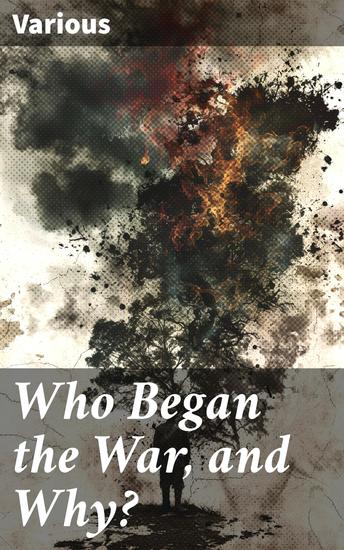
Who Began the War and Why? - New York Times Current History - cover

Who Began the War and Why? - New York Times Current History

Various Various

Publisher: Good Press

  • 0
  • 0
  • 0

Summary

In "Who Began the War, and Why?", a collection of essays authored by various historians and scholars, readers are invited to explore the complex origins and motivations behind one of the most pivotal conflicts in history. This meticulously crafted anthology combines diverse perspectives, employing a scholarly tone that balances rigorous analysis with accessible prose, thus catering to both academic audiences and general readers. Through a rich exploration of political, social, and economic factors, this compilation elucidates how historical narratives have been shaped, challenged, and redefined over time, inviting a critical re-examination of accepted truths. The contributors to this volume are esteemed figures in the field of history, each bringing a unique voice and expertise to the discussion. Many have spent years researching various aspects of war, geopolitics, and national identity, influenced by interdisciplinary approaches that range from sociology to international relations. Their collective insights offer a comprehensive understanding of the multifaceted nature of warfare, which remains relevant in contemporary global affairs. This book is essential for anyone interested in grasping the intricate layers of causation surrounding conflicts. It challenges preconceived notions and encourages critical thinking about history and its implications for the present. For students, educators, and history enthusiasts alike, "Who Began the War, and Why?" serves as both a foundation for further study and a compelling read that sparks important conversations about the past and its bearing on today's world.
Available since: 08/12/2023.
Print length: 357 pages.

Other books that might interest you

  • Japan and World War II: The History of the Imperial Japanese Empire during the War - cover

    Japan and World War II: The...

    Anonymous

    • 0
    • 0
    • 0
    All Americans are familiar with the “day that will live in infamy.” At 9:30 a.m. on Sunday, December 7, 1941, Pearl Harbor, the advanced base of the United States Navy’s Pacific Fleet, was ablaze. It had been smashed by aircraft launched by the carriers of the Imperial Japanese Navy. All eight battleships had been sunk or badly damaged, 350 aircraft had been knocked out, and over 2,000 Americans lay dead. Indelible images of the USS Arizona exploding and the USS Oklahoma capsizing and floating upside down have been ingrained in the American conscience ever since. In less than an hour and a half the Japanese had almost wiped out America’s entire naval presence in the Pacific. 
    Despite fighting in North Africa and the Atlantic, the United States still had the resources and manpower to fight the Japanese in the Pacific. Though the Japanese had crippled the American fleet at Pearl Harbor, its distance from Japan made an invasion of Pearl Harbor impossible, and Japan had not severely damaged important infrastructure. Thus, the United States was able to quickly rebuild a fleet, still stationed at Pearl Harbor right in the heart of the Pacific. This forward location allowed the United States to immediately push deeply into the Pacific theater. 
    In fact, the turning point in the Pacific theater took place in 1942 near Midway Island. The Japanese had moved a sizable fleet intending to occupy Midway Island and draw the American navy near. Instead, American aircraft flying from three aircraft carriers that had been away from Pearl Harbor in December 1941 got a bearing on the Japanese fleet and sunk four Japanese aircraft carriers, permanently crippling Japan’s navy. The Battle of Midway was one of the first naval battles in history where the enemy fleets never saw or came into contact with each other.
    Show book
  • How to Become a Special Education Teacher Career Professional Development Planning Audio Book - With Job Interview Preparation & Coaching Guide for Men Women Teens & Young Adults - cover

    How to Become a Special...

    Brian Mahoney

    • 0
    • 0
    • 0
    End Money Worries! 
    How to Become a Special Education Teacher Career Professional Development Planning Audio Book 
    With Job Interview Preparation & Coaching Guide for Men, Women, Teens & Young Adults 
    by Brian Mahoney 
           Discover... 
    * What a Special Education Teacher does 
         * How to Become a Special Education Teacher 
          * What is the salary of a Special Education Teacher 
             * What is the Special Education Teacher Work Environment like 
                 * What is the future Job outlook for a Special Education Teacher 
             * how long does it take to become a Special Education Teacher 
          * How to Prepare for Your Job Interview 
       * Tips the pros use to Ace their Job Interview 
    * You'll be confident with the best answers for the toughest job interview questions 
    The knowledge and ability to change your life all for less than the cost of 1 movie ticket! 
     If you are ready to get started & want the knowledge, help & motivation to change your life now!... 
    Then this Book is for you!!! 
                         So Don't wait. You'll wait your life away...
    Show book
  • The Way We Are - cover

    The Way We Are

    Hugh Mackay

    • 0
    • 0
    • 0
    Australia's leading social psychologist examines our society today and asks timely and urgent questions about its future 
     
    Life is messy. Relationships are complex. Outcomes are uncertain. Yet none of our differences-whether based on ethnicity, politics, religion, cultural tastes and preferences, or gender-are nearly as significant as the humanity we share. 
     
    Amidst our epidemics of loneliness, anxiety and depression, and the impacts of entrenched poverty and ubiquitous technology, The Way We Are examines the major trends that are shaking the foundations of the Australian way of life. 
     
     
    Drawing on thousands of interviews over a lifetime of research, Hugh Mackay, much loved and highly respected social psychologist, presents a compelling portrait of Australia today. He celebrates the march towards gender equality and explains the stubborn persistence of misogyny, the anti-social consequences of social media, the complex legacy of the Baby Boomers, and the 'fake wisdom' that guides too much of our thinking. Exploring the steady decline in religious faith and practice, Hugh identifies the many gods we continue to worship, and points to the positive role that dreaming can play in our lives. Though some of his observations may not be easy reading, Hugh's analysis is suffused with affection for our country. 
     
     
    Inspiring, provocative and powerfully argued, The Way We Are is the most important-and uplifting-book you'll read all year. It will encourage you to reflect deeply on the question: What kind of society do we want to become? 
     
     
    'Hugh Mackay is one of this country's most perceptive social commentators.' - Sydney Morning Herald 
     
     
    'Mackay is something of a national treasure.' - Canberra Times
    Show book
  • Daily Life in Ancient Egypt - Society Culture and Customs - cover

    Daily Life in Ancient Egypt -...

    Omar Khalil

    • 0
    • 0
    • 0
    Ancient Egyptian society was highly structured, with a rigid hierarchy that defined people’s roles and responsibilities. At the top of this social order was the pharaoh, considered both a political ruler and a divine figure. Below the pharaoh were the nobility and officials who managed the kingdom’s affairs. The middle class consisted of scribes, artisans, and merchants, while the majority of the population comprised farmers, laborers, and slaves. Each social group played a crucial role in maintaining Egypt’s stability and prosperity. 
    The pharaoh was the central authority in Egypt, believed to be the living embodiment of a god. His rule was absolute, and his primary duty was to maintain ma’at, the divine balance of order and justice. He oversaw military campaigns, religious ceremonies, and massive building projects, including temples and pyramids. The royal court and government officials assisted the pharaoh in administration. These officials, often chosen from the nobility, held positions such as viziers, tax collectors, and governors, ensuring the kingdom functioned efficiently. 
    Scribes, artisans, and merchants formed the middle class, contributing to Egypt’s economy and culture. Scribes were essential for maintaining records, writing official documents, and preserving religious texts. Their education was rigorous, requiring years of training in hieroglyphic writing. Artisans, including sculptors, painters, and metalworkers, created the intricate decorations found in tombs and temples. Merchants facilitated trade both within Egypt and with foreign lands, bringing valuable goods such as gold, spices, and precious stones. Although they did not hold political power, the middle class enjoyed a stable livelihood and social respect.
    Show book
  • The Shocking Truth about Modern Warfare - cover

    The Shocking Truth about Modern...

    Zoey Fraisers

    • 0
    • 0
    • 0
    The nature of warfare has drastically evolved over the centuries, and in the modern age, it has reached unprecedented levels of complexity, technology, and global impact. The battles fought today are not just confined to physical battlegrounds, but stretch across the cyber world, through the air with drones, and into the very fabric of political and social systems. Understanding the shocking truth about modern warfare means acknowledging how it has fundamentally changed and the far-reaching consequences it has on global security, human lives, and the future of warfare itself. 
      
    Unlike the traditional wars of the past, where armies fought on clearly defined battlefields, modern warfare is multifaceted. Conflicts today often involve a mix of conventional military forces, covert operations, cyber-attacks, and the use of advanced technologies like drones and artificial intelligence. The lines between combatants and non-combatants are increasingly blurred, and civilians are often the most affected by the consequences of war. The tools and tactics employed in modern warfare raise important questions about the ethics of conflict, the responsibility of nations, and the role of technology in shaping the future of armed engagement. 
      
    One of the most significant shifts in modern warfare is the central role technology now plays. The advancements in weapons systems, surveillance capabilities, and the rise of autonomous machinery have fundamentally altered how wars are fought. With the introduction of drones and cyber warfare, military strategies are less about physical dominance and more about information control, precision strikes, and disrupting an enemy's infrastructure without direct confrontation. This change has made warfare faster, more efficient, and, in many ways, less personal.
    Show book
  • Mandarin Made Easy - Beginner - Volume 2 of 3 - cover

    Mandarin Made Easy - Beginner -...

    Lingo Wave

    • 0
    • 0
    • 0
    We broke our new series on learning Chinese [Mandarin] down into different learning stages. Start with the "Lower Beginner" books followed by the "Beginner" and "Upper Beginner" books. Next, progress to the "Intermediate" series, then test and reinforce your knowledge with the "Conversations" series. 
    This audiobook is divided into units.While it provides different learning patterns and accommodates various needs, this audiobook focuses on helping you improve your ability to understand, speak, and memorise Chinese [Mandarin]. 
    In Unit 1 you will hear Chinese [Mandarin] decoded with each syllable spoken very slowly and clearly with repetition. Immediately before each sentence is spoken, you will hear the translation, so you will always understand what is being said. 
    Unit 2 focuses solely on increasing your listening ability, which will improve your abilities to engage in dialogue with a native Chinese [Mandarin] speaker. This chapter requires you to listen very carefully to nuances in the language. 
    By Unit 3 you will already notice progress in your abilities to speak and understand Chinese [Mandarin]. The spoken translation is followed by two repetitions in Chinese [Mandarin] at a completely natural speed. While you are learning to process naturally spoken Chinese [Mandarin], Units 3 and 4 will help you memorise new vocabulary and full sentences. 
    In Unit 5 you can test yourself on how much you have learned. If you are having difficulties, we suggest you revisit the listening, speaking, or memorisation section of Units 1, 2 3 or 4, according to what you need more help with. 
    Topics covered in this book: 
    1. Asking about family 
    2. Asking about relationship status 
    3. Expressing frequency 
    4. Talking about spare time activities and hobbies 
    5. Using quantifiers/determiners 
    6. Talking about preference 
    7. Talking about abilities 
    8. Talking about location of places 
    ...
    Show book