Join us on a literary world trip!
Add this book to bookshelf
Grey
Write a new comment Default profile 50px
Grey
Subscribe to read the full book or read the first pages for free!
All characters reduced
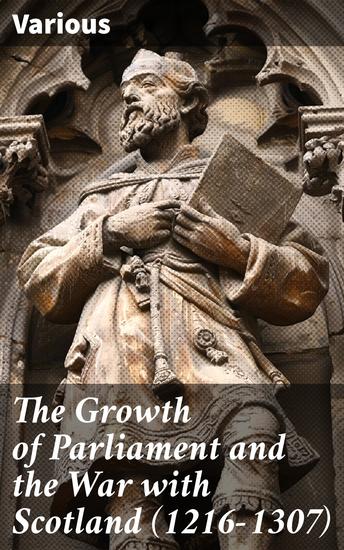
The Growth of Parliament and the War with Scotland (1216-1307) - Parliamentary Power and Scottish Conflict in Medieval England - cover

The Growth of Parliament and the War with Scotland (1216-1307) - Parliamentary Power and Scottish Conflict in Medieval England

Various Various

Publisher: Good Press

  • 0
  • 0
  • 0

Summary

In 'The Growth of Parliament and the War with Scotland (1216-1307)', a collective of esteemed historians delves into the complex interplay between the development of the English parliamentary system and the protracted conflicts with Scotland during the late medieval period. The volume expertly interweaves political narratives with social and cultural contexts, employing a rich tapestry of primary sources, contemporary chronicles, and analytical essays that illuminate pivotal events such as the Barons' Wars and the struggles for Scottish independence. Its scholarly style is both accessible and rigorous, making it a vital contribution to the field of medieval studies and political history. The authors, a diverse group of specialists in medieval history, bring their extensive knowledge and passion for the subject to bear on this project. Each author'Äôs background reflects a commitment to uncovering the intricate relationships of power, resistance, and governance that shaped Britain during this tumultuous period. Their collective insight sheds light on how warfare influenced parliamentary evolution and vice versa, providing a nuanced understanding of medieval political dynamics. This book is highly recommended for scholars, students, and history enthusiasts alike, as it not only offers a thorough exploration of its subjects but also inspires new discussions regarding the foundations of modern governance. Its depth and breadth make it an indispensable resource for those seeking to understand the significance of this critical period in British history.
Available since: 10/26/2023.
Print length: 111 pages.

Other books that might interest you

  • Why Do We Stay? - How My Toxic Relationship Can Help You Find Freedom - cover

    Why Do We Stay? - How My Toxic...

    Stephanie Quayle, W. Keith Campbell

    • 0
    • 0
    • 0
    Read by the authors. 
    Change your life when you learn how to spot a toxic relationship, how to get out, and how to heal. 
    You or someone you love may be in a toxic relationship, but it doesn't have to stay that way. In this compassionate and practical resource, Stephanie Quayle shares her powerful story alongside psychologist Dr. W. Keith Campbell's professional insights to give you the help and hope you need—and remind you that you are not alone. 
    When Stephanie lost her boyfriend in a plane crash, she faced intense grief and pain. Nothing compared, though, to the shock of discovering she had not been the only woman in his life. As her world unraveled around her, Stephanie realized that it had actually been unraveling from the start of their relationship—back when he promised her everything. 
    In Why Do We Stay? Stephanie draws on her story to explain how to spot a toxic relationship, how to get out, and how to heal. Mental health expert Dr. W. Keith Campbell joins her in helping you see that:You can make a change in your lifeThere are warning signs to look for and ways to spot an unhealthy relationshipYou don’t have to be a victim to narcissism or gaslighting or lose years of your lifeWhether you stay in or leave your relationship, healing and freedom are possible 
      
    Why Do We Stay? is ideal for:Those who feel trapped in an unhealthy relationshipThose who are recovering from a toxic relationshipListeners searching for a resource—for themselves or for a friend—on narcissism, gaslighting, compulsive lying, and other destructive behaviors 
      
    With a powerful blend of clinical research, gripping storytelling, and unvarnished hope, Why Do We Stay? empowers you to make changes in your life. You are not alone. 
    Discover a way forward. 
    The glossary can be found in the audiobook companion PDF download.
    Show book
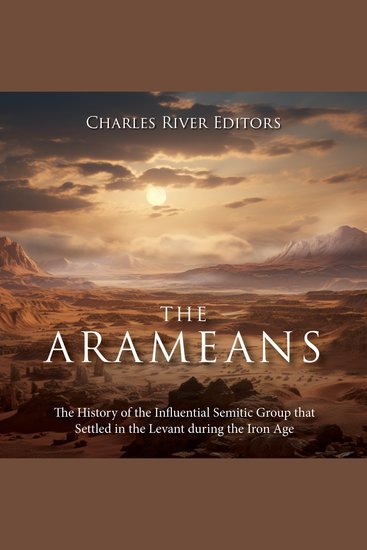
  • Arameans The: The History of the Influential Semitic Group that Settled in the Levant during the Iron Age - cover

    Arameans The: The History of the...

    Editors Charles River

    • 0
    • 0
    • 0
    When the Late Bronze Age system of the Near East collapsed around the year 1200 BCE, the empires and kingdoms that had ruled the region for hundreds of years were replaced by new dynasties and peoples. In some cases – such as in Egypt, Assyria, and Babylon – new dynasties came to power that followed the culture and styles of previous generations. However, alongside them new ethnic groups also came to power, some of whom took advantage of the general chaos following the Bronze Age collapse to migrate to the region. Some of these new waves of migrants entered the Near East from Europe via the Mediterranean Sea and Anatolia, while others came from Arabia. They all brought with them new weapons, ideas, and plenty of new people that eventually helped establish a new, early Iron Age order in the Near East. Among these new groups that came to prominence in the early Iron Age Near East, the Arameans were arguably the most important. 
    	The Arameans entered the historical record just after the collapse of the Bronze Age, and although they were once thought to be one of the factors in the Bronze Age collapse, most scholars now see them as taking advantage of the situation more than bringing it about. Once the Arameans entered the Levant and Mesopotamia, they influenced their new homes to varying degrees, ranging from having little influence in southern Mesopotamia to being a major geopolitical player in the inland Levant. An examination of Aramean history and culture reveals that the Arameans were a people who were not so easy to define, as they had no central leadership, and they often adopted the cultural attributes of their neighbors. With that said, historians, archaeologists, and philologists have identified a definite Aramean culture that at times played a major role in the wider cultural events of the Near East.
    Show book
  • The Will to Power - An Attempted Transvaluation of All Values - cover

    The Will to Power - An Attempted...

    Friedrich Nietzsche

    • 0
    • 0
    • 0
    "The Will to Power: An Attempted Transvaluation of All Values" by Friedrich Nietzsche delves into the profound philosophical exploration of power as the fundamental driving force in human life. Compiled from Nietzsche's notes, this work presents his radical ideas on morality, culture, and the nature of existence. Nietzsche challenges conventional values, advocating for the re-evaluation of societal norms and the embracement of individual strength and creativity. This provocative text remains a cornerstone of existential and philosophical thought, inspiring deep reflection on the essence of human ambition and purpose.
    Show book
  • Day of Reckoning - How the Far Right Declared War on Democracy - cover

    Day of Reckoning - How the Far...

    Mike Wendling

    • 0
    • 0
    • 0
    The United States has become an almost unrecognizable country—with millions in thrall to conspiracy theories, toxic populism, and the far right edging closer to total power—a dire threat to civil society and democratic institutions. While the MAGA movement was in remission due to Donald Trump's defeat in 2020, the fascist fringes have not just survived but have continued to thrive and burrow into the mainstream. The January 6th Capitol Riot prosecutions have done little to curb their enthusiasm for mayhem. 


    Trump's base in the Republican Party is committed to their candidate like never before. The institutionalization of racist voter suppression and the outdated logic behind the Electoral College means he could take back the White House. Apocalyptic messaging ensures the alt-right, anti-government, anti-LGBT, and white nationalist groups see the next election as a life-or-death struggle and are uniting to back the one person they can all agree on—guaranteeing another chaotic election. 


    In this chilling exposé, Wendling encounters Capital rioters, Covid deniers, QAnon supporters, and Proud Boys and uncovers the roots of a movement that threatens to shatter the foundations of democracy.
    Show book
  • The World War II History Journals:1945 - cover

    The World War II History...

    Liam Dale

    • 0
    • 0
    • 0
    Do you want to learn more about World War II, but don’t have time to read/listen to huge, long books? Then let The History Journals take you on an hourly history tour of each year of the war with The World War II History Journals series which includes one book per year from 1939 to 1945. 
     
    Throughout this series of journals released to acknowledge 80 years since the beginning of WW2, we will be looking at the seven years of that conflict on an annual basis. The conflict, the buildup to war, the major battles, the strategies and technological developments, the effect on civilians, and most importantly of all we’ll consider the role of the soldiers, sailors, and airmen who gave their lives fighting for the freedom of others. 
     
    Although the Allied nations faced the New Year of 1945 with a huge sense of hope, there was still a great deal of work to be done if world peace was to become a reality. Adolf Hitler and his Axis powers were finally facing defeat after seven years at war, but just like any wounded animal in the wild, they continued to pose a very real and dangerous threat. Follow us onward into the history of WW2 in 1945 – and the end of the war. 
     
    You will learn about: 
     
    A retreating Japan responds with Kamikaze pilots, Russian push to Warsaw 
    Hitler’s suicide 
    German army withdraws after Battle of the Bulge, American forces target Iwo Jima 
    The last rush for Berlin, VE Day, Truman authorizes nuclear bomb testing 
    Hiroshima, Nagasaki, America drops the atomic bomb, Japan surrenders, VJ Day 
     
    Be sure to read/listen to all the books in the series - one for each year through the end of the war in 1945!
    Show book
  • Scotland - A History of Wars Ghosts Heroes and Villains - cover

    Scotland - A History of Wars...

    Kelly Mass

    • 0
    • 0
    • 0
    This bundle consists of 2 titles: 
    1: Knowing everything we do about siege warfare and the medieval way of conquering and being conquered, this book sheds more light on the series of wars that formed the initiative to become independent as a Scottish nation. There is much confusion about the Scottish wars of independence, and in this book, we will clarify some of that. In the late 13th and early 14th centuries, the Wars of Scottish Independence were a series of army fights performed between the Kingdom of Scotland and the Kingdom of England. This is a significant event in Scottish history. 
    2: Whether you believe in the supernatural elements or not, it is fascinating to see how the idea of ghosts happened, and how it developed over the ages. Even if they're really there, it can be said that many individuals have been totally wrong about them. And so, it is pretty much up to us to study them and sort out what the most credible, spiritual truths could be, based upon our own beliefs blended with the stories and testaments of others. A ghost is the soul or spirit of a departed individual or animal who can appear to the living in folklore. Ghosts are defined in numerous ways in folklore, varying from an unnoticeable presence to clear or hardly noticeable wispy shapes to reasonable, realistic forms. Mysticism, or a séance in spiritism, is the purposeful effort to get in touch with the spirit of a departed individual. Part, haunt, phantom, poltergeist, shade, specter, ghost, alarm, wraith, devil, and evil spirit are some of the other titles used to define it.
    Show book