Join us on a literary world trip!
Add this book to bookshelf
Grey
Write a new comment Default profile 50px
Grey
Subscribe to read the full book or read the first pages for free!
All characters reduced
Short story classics: French II - cover

Short story classics: French II

Various Various

Publisher: Good Press

  • 0
  • 0
  • 0

Summary

Short Story Classics: French II is an anthology that offers readers a curated selection of remarkable short stories from revered French writers. This collection showcases a diverse range of voices, from the poignant realism of Guy de Maupassant to the whimsical surrealism of Alfred Jarry, encapsulating the evolution of French literature across various social and historical contexts. The literary style varies from detailed prose to lyrical narrative, allowing readers to immerse themselves fully in the rich tapestry of French storytelling, marked by elaborate character studies and profound explorations of the human condition. The authors featured in this volume have shaped the landscape of French literature, each bringing distinct personal experiences and cultural influences to their work. The tradition of storytelling in France has deep roots, with these writers drawing from their intimate understanding of societal dynamics, existential themes, and philosophical questioning, often reflecting the tensions of their time. This anthology not only illuminates their artistic contributions but also contextualizes the broader literary and cultural movements that shaped the late 19th and early 20th centuries. "Short Story Classics: French II" is a must-read for literature enthusiasts, scholars, and anyone intrigued by the nuances of human experience. It serves as both an introduction to French literary heritage and a delightful exploration of universal themes, making it an essential addition to any literary collection.
Available since: 03/02/2025.
Print length: 110 pages.

Other books that might interest you

  • Charles Dickens: The Complete Christmas Collection - cover

    Charles Dickens: The Complete...

    Charles Dickens

    • 0
    • 0
    • 0
    This Audiobook contains The Complete Christmas Collections of Charles Dickens:1. A Christmas Carol Start at Chapters 12. A Message From The Sea Start at Chapters 73. Doctor Marigold Start at Chapters 154. Going Into Society Start at Chapters 175. Mrs Lirripers Legacy Start at Chapters 186. Mugby Junction Start at Chapters 217. No Thoroughfare Start at Chapters 258. A Christmas tree Start at Chapters 389. Nobody's Story Start at Chapters 3910. The Child's Story Start at Chapters 4011. The Poor Relation's Story Start at Chapters 4112. The Schoolboy's Story Start at Chapters 4213. What Christmas is as We Grow Older Start at Chapters 4314. Somebodys Luggage Start at Chapters 4415. The Battle of life Start at Chapters 4816. The Chimes Start at Chapters 5417. The Cricket on the Hearth Start at Chapters 6018. The Haunted Man and the Ghosts Bargain Start at Chapters 6619. The Holly Tree Start at Chapters 7220. The Perils Of Certain English Prisoners Start at Chapters 7521. The Seven Poor Travellers Start at Chapters 8022. The Wreck of The Golden Mary Start at Chapters 8323. Tom Tiddlers Ground Start at Chapters 85
    Show book
  • Ghost in a Coach - A Short Story Collection - A tale of classic Victorian and Edwardian ghost stories taking place in and around the mode of transport of the time - cover

    Ghost in a Coach - A Short Story...

    Amelia Edwards

    • 0
    • 0
    • 0
    Men and women have many wild fears that are very unlikely to ever come true except perhaps in a dream that lurches into a nightmare that seems so real that it must be real. 
     
    Perhaps being a fellow traveller in a coach or a train carriage and realising, whether in a sudden jolt or a slowly rising uneasy feeling of horror, that your fellow occupants might not actually be from this world, but more probably from the next, would be such a situation. 
     
    We delighted to now put you in such good company!  Indeed Amelia Edwards, E F Benson, Violet Hunt, Rudyard Kipling and the incisive talents of many others would definitely like you along for the ride.
    Show book
  • Twenty-Six Men and a Girl - From their pens to your ears genius in every story - cover

    Twenty-Six Men and a Girl - From...

    Maxim Gorky

    • 0
    • 0
    • 0
    Alexei Maximovich Peshkov was born on 28th March 1868, in Nizhny Novgorod, Russia. 
    Better known as Maxim Gorky he was orphaned at 11 and ran away from home at 12.  At 19 he had already attempted suicide and thereafter travelled, by foot, across the Russian Empire for 5 years. 
    His first book ‘Essays & Stories’ in 1898 was a sensation and so began a long career as an author of short stories, novels and plays.  Gorky saw writing as a moral and political act that would help to change the unjust world around him.  He was an ardent early advocate of the emerging Marxist movement and publicly opposed the Tsarist regime leading several times to his arrest.  
    In 1904 he began his own theatre but the censor banned every play and Gorky was forced to abandon the project. 
    But Gorky was a financially successful author, editor, and playwright and gave monies to political parties as well as for civil rights and social reform.  The brutal shooting of workers, which set in motion the Revolution of 1905, pushed Gorky more decisively toward radical solutions.  
    In 1906 he went to the United States to raise funds for the Bolsheviks. Those experiences including a scandal over travelling with his lover and not his wife deepened his contempt for the ‘bourgeois soul.’ 
    Gorky now moved to Capri in Italy, both for health reasons and to escape the increasingly repressive times in Russia.  
    An amnesty for the 300th anniversary of the Romanov dynasty saw him return to Russia in 1914. His politics remained close to the Bolshevik cause.  But soon, after the 1918 revolution, his essays referred to Lenin as a tyrant for his senseless arrests and repression.  He was soon appealing to the outside world for food aid after the catastrophic crop failure. 
    In October 1921 Gorky returned to Italy, now in Fascist hands, and settled in Sorrento until 1932.  His health worsened with the onset of tuberculosis. 
    He wrote several successful books there but now decided to find an understanding with the communist regime. Stalin invited him home and his return was hailed as a major propaganda victory.  He was decorated with the Order of Lenin, and a province, a park, and various streets re-named in his honour. 
    But he had his faults too.  In 1933, Gorky co-edited a book on the White Sea-Baltic Canal and denied even a single prisoner died during its construction, but thousands had. As well, knowing that some Nazis were homosexual, a phrase was attributed to him that said ‘exterminate all homosexuals and fascism will vanish’.  Although he was himself was quoting another he was decidedly homophobic. 
    With the increase of Stalinist repression in 1935 Gorky was placed under unannounced house arrest. 
    Maxim Gorky died on the 18th June 1936 from pneumonia.  He was 68. 
    Stalin and Molotov were among those who carried Gorky's urn of ashes at his funeral.
    Show book
  • 3 Stories - Madness to Murder - A trio of classic tales perfect for a commute walk or quiet night in - cover

    3 Stories - Madness to Murder -...

    Edgar Allan Poe, Arthur Conan...

    • 0
    • 0
    • 0
    There is something about the number 3.    
     
    The Ancient Greeks believed 3 was the perfect number, and in China 3 has always been a lucky number, and they know a thing or two.   
     
    Most religions also have 3 this and 3 that and, of course, in these more modern times, three’s a crowd may be too many, except when it’s a ménage à trois.  It seems good things usually come in threes. 
     
    Whatever history and culture says WE think 3, a hat-trick of stories, is a great number to explore themes and literary avenues that classic authors were so adept at creating. 
     
    From their pens to your your ears.  
     
    01 - 3 Stories - Madness to Murder 
    02 - A Pastoral Horror by Arthur Conan Doyle 
    03 - The Lie by Leonid Andreyev 
    04 - The Tell Tale Heart by Edgar Allan Poe
    Show book
  • The Horla - cover

    The Horla

    Guy de Maupassant

    • 0
    • 0
    • 0
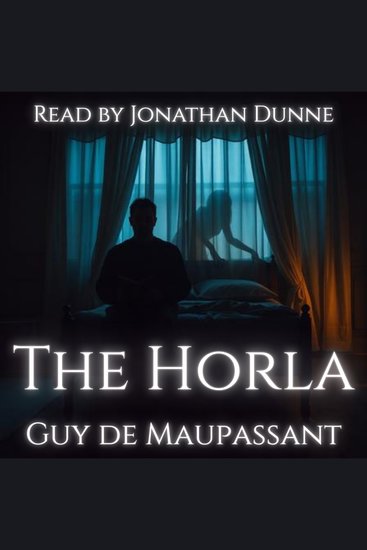
    Title: The Horla 
    Author: Guy de Maupassant 
    Narrator: Jonathan Dunne 
    Original Publication: 1887 
    Public Domain: Yes 
    Series Placement: Timeless Terrors No. 64 
    Description: 
    The Horla is one of Guy de Maupassant’s most unsettling tales — a study of madness, obsession, and the invisible forces that may govern our lives. Told in the form of a diary, the story follows an unnamed narrator whose calm, orderly life gradually unravels as he becomes convinced that an unseen, supernatural being is haunting him — controlling his thoughts, his desires, and even his will to live. 
    Maupassant blends psychological horror with the uncanny, crafting a story where fear grows not from gore, but from the creeping realization that the human mind may be powerless against what it cannot perceive. The ordinary becomes sinister: windows seem to watch, the air feels heavy with presence, and the night is filled with a silent, inescapable dread. 
    Narrated by Amazon-bestselling horror author Jonathan Dunne, this performance captures the mounting terror and disorientation of Maupassant’s masterpiece. While the text itself is fully in the public domain, this narration and production are copyright © 2025 Jonathan Dunne. 
    Part of Timeless Terrors, a series devoted to reviving the classics of horror, The Horla is a chilling reminder that some fears are real — and some presences are beyond comprehension. 🕯️
    Show book
  • Forgotten Authors The - Women - Volume 2 - Maud Diver to Mary Elizabeth Hawker - cover

    Forgotten Authors The - Women -...

    Maud Diver, Mollie Frank Bloch,...

    • 0
    • 0
    • 0
    Throughout the long centuries of human history is the want, and the need, to share information, to exchange ideas and for that knowledge and experience, for curiosity and learning, to be the basis of a civil society. 
    In literature the ambition is much narrower.  In order to be known, to be popular, you had to be published.  And for that people had to know you existed and your ideas worth reading.  Obviously for most of humanity’s time people couldn’t read and texts couldn’t be published in any great number. 
    In the 15th Century Gutenberg’s printing press began the revolution to address the second and by the 19th century had gathered pace with startling speed and mass distribution.  Education for the many was brought in to help people understand more of their world and, with new skills, how to have a better place within it.  Now, if the powers that owned the presses and means of distribution agreed an audience would now be able to avail themselves of your ideas, your printed words.  
    All too often the talents of women have been scorned, mocked and laughed at.  In reality that was more usually by those who’s own talents were hardly fit to even grace their shadows.   
    But society in general still connived and set women to one side in almost everything that men considered their rightful territory.  And literature was one such territory.  Remarkably resilient as well as talented these women strove to be published, to show themselves as equals.  The results more often than not proved that they were.   
    Sadly, in the thirst for the new, the recent and the past fell from sight, relegated to dark corners and dusty shelves.    
    But the printed word is rarely without someone, somewhere busying themselves through piles of papers and books rediscovering what a good story is, whatever its age. 
    In this volume we offer up a small selection of talents whose time has now come again.
    Show book