Begleiten Sie uns auf eine literarische Weltreise!
Buch zum Bücherregal hinzufügen
Grey
Einen neuen Kommentar schreiben Default profile 50px
Grey
Jetzt das ganze Buch im Abo oder die ersten Seiten gratis lesen!
All characters reduced
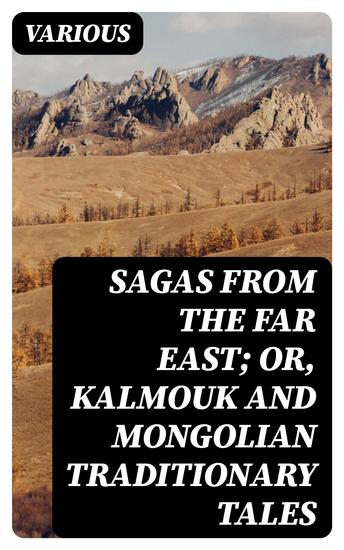
Sagas from the Far East; or Kalmouk and Mongolian Traditionary Tales - cover

Sagas from the Far East; or Kalmouk and Mongolian Traditionary Tales

Various Various

Verlag: DigiCat

  • 0
  • 0
  • 0

Beschreibung

In "Sagas from the Far East; or, Kalmouk and Mongolian Traditionary Tales," various authors compile a rich tapestry of folklore that encapsulates the vibrant oral traditions of the Kalmouk and Mongolian peoples. The book features a collection of narratives, often characterized by their lyrical style and mythical elements, which reflect a unique worldview where nature intertwines with the human experience. Each tale serves not only as entertainment but also as a vehicle for moral lessons and cultural preservation, inviting readers into the profound spiritual and cultural landscapes of Central Asia. The authors behind this remarkable compilation are scholars and enthusiasts of Mongolian history and literature, deeply influenced by their studies and interactions with nomadic cultures in the region. Their immersive exploration into these traditions sheds light on themes of identity, resilience, and the intrinsic connection between humanity and the environment. The work stands as a testament to the power of storytelling in bridging generational gaps and preserving the ethos of a rapidly changing world. This anthology is highly recommended for readers seeking to delve into the lesser-known mythologies of the East, providing not only entertainment but also critical insights into the values and beliefs that shape these cultures. Whether approached as a scholarly resource or as a source of inspiration, "Sagas from the Far East" invites readers to appreciate the richness of Mongolian and Kalmouk heritage.
Verfügbar seit: 16.09.2022.
Drucklänge: 915 Seiten.

Weitere Bücher, die Sie mögen werden

  • Little Women Podcast: Meg Goes To Vanity Fair - cover

    Little Women Podcast: Meg Goes...

    Niina Niskanen, Emily Lau

    • 0
    • 0
    • 0
    In this engaging episode of Little Women Podcast, Niina and Emily delve deep into the thought-provoking chapter "Vanity Fair" from Louisa May Alcott's classic novel Little Women. Join them as they explore Meg's transformative experience at the ball, where she’s swept into the dazzling world of wealth and glamour. As the rich girls dress her up in their finest attire, Meg is faced with an internal conflict that challenges her values and ambitions. 
    In this lively discussion, Niina and Emily reflect on Meg’s journey of self-discovery, revealing her struggles with vanity, materialism, and the pursuit of societal approval. What does it mean to stay true to oneself in the face of luxury and outward appearances? Meg's emotional journey offers timeless insights that resonate with listeners today. 
    Tune in to hear a thoughtful, in-depth conversation about one of the most pivotal moments in Little Women, as well as fascinating reflections on character development, values, and personal growth. Whether you're revisiting the novel or experiencing it for the first time, this episode will make you see Meg’s story in a whole new light.
    Zum Buch
  • The Socratic Dialogues - Alcibiades and Other Attributed Dialogues - cover

    The Socratic Dialogues -...

    Plato

    • 0
    • 0
    • 0
    The influence of Plato, his Dialogues and his ‘Academy’, cast a long shadow. Around 35 Dialogues, almost all featuring Socrates as the principal figure, are generally ascribed to Plato and form one of the most important threads in Western philosophy  These four Dialogues may fall into the ‘Attributed Texts’ category, but they are of sufficient interest to warrant study in our time and when set against the principal canon.  
     
    The recording opens with Alcibiades I. Socrates’ interlocuter is well known as a young, charismatic figure of the time, and appears in the Symposium and Protagoras. The subject under discussion is justice and injustice. Socrates questions the over-confident Alcibiades about his understanding of these issues, which is crucial for someone about to play an active role in public life. It is the longest Dialogue of the four. 
     
    Hippias is another young man. A Sophist, brimming with the confidence of youth to the extent of being vain and boastful. He appears in two Dialogues on this recording, the Lesser Hippias and the Greater Hippias. The Lesser Hippias is a witty and lively conversation in which Hippias is keen to display his abilities only to be shaken by patient questioning by the astute Socrates. The Greater Hippias, a discussion about beauty, contains some interesting elements, while also showing how the form became diluted in the hands of lesser followers of Plato.  
     
    The final Dialogue, Menexenus is a special case. It was an important form in Athenian society and this is a rare surviving example. It has been included here in a new recording so it can be listened to in the context of ‘Attributed Dialogues’, rather than a fully accepted work by Plato. The background to each Dialogue is set by Benjamin Jowett. David Rintoul continues his persuasive characterisation of the masterful Socrates.
    Zum Buch
  • Journey Through Shadows: The Mind of a Troubled Family - Dive deep into 'Journey Through Shadows' with captivating audio lessons enhancing your family's story experience - cover

    Journey Through Shadows: The...

    Jared Falconer

    • 0
    • 0
    • 0
    Journey Through Shadows: Understanding a Troubled Family 
    Are you searching for ways to advance personally and professionally through a profound understanding of familial dynamics? 
    Looking for an in-depth resource that offers all the essential insights into navigating familial challenges? 
    Your search is over! 
    This guide is your essential companion for delving deeply into family complexities, skill application, and engaging discussions. With this, you're prepared for understanding. 
    Updated to reflect the most relevant insights into family dynamics. 
    Key features of this comprehensive guide: 
    - Deep insights into resilience within chaos, healing within pain 
    - Thorough explanation of coping with familial struggles 
    - Effective strategies for navigating personal and family challenges 
    Our guide sets itself apart with its extensive coverage, crucial for gaining profound understanding. Concepts are explored in-depth, not just at the surface level. 
    Please note that while this guide is independent, it serves purely for your benefit and is not affiliated with any official entity. 
    Created with a clear structure and easily understandable language, our guide ensures seamless transitions between topics. Say farewell to confusing jargon and welcome clear, precise, and therapeutic content. 
    So, why wait? Click the BUY NOW button, secure your guide, and start your journey towards understanding and healing.
    Zum Buch
  • Rise of Classical Greece The: The History of the People and Events that Brought Ancient Greece to the Peak of Its Power - cover

    Rise of Classical Greece The:...

    Editors Charles River

    • 0
    • 0
    • 0
    When people think of ancient Greece, images of philosophers such as Plato or Socrates often come to mind, as do great warriors like Pericles and Alexander the Great, but hundreds of years before Athens became a city, a Greek culture flourished and spread its tentacles throughout the western Mediterranean region via trade and warfare. Scholars have termed this pre-Classical Greek culture the Mycenaean culture, which existed from about 2000-1200 B.C., when Greece, along with much of the eastern Mediterranean, was thrust into a centuries long Dark Ages. Before the Mycenaean culture collapsed, it was a vital part of the late Bronze Age Mediterranean system and stood on equal footing with some of the great powers of the region, such as the Egyptians and Hittites. 
    If anything, the collapse of the Mycenaeans was a drawn-out affair, and while the early centuries of the Dark Ages might be seen as a continuation of this trend, even in the worst years, there was a degree of continuity and even some innovations. These changes including the beginnings of the use of iron as an alternative to bronze and some religious practices that continued to be observed. Furthermore, enough remained to form the basis of a recovery in economic, cultural, and artistic aspects of life in the later stage of the era, and in the political sphere, changes necessitated by the collapse in the economic system certainly paved the way for the rise of the polis 
    During the Greek Renaissance of the 8th century the Greek alphabet developed and the earliest surviving Greek literature was composed, while in terms of art and architecture, sculptures and red-figure pottery began. Warfare changed significantly as well when the hoplite became the core infantry. Put simply, none of these developments could have occurred if the basis for these changes had not been secured during what came to be known as the Greek Renaissance.
    Zum Buch
  • The Darby School of Art - A Forgotten Chapter in the History of American Impressionist and Modern Painting - cover

    The Darby School of Art - A...

    Mark W. Sullivan

    • 0
    • 0
    • 0
    This first full-length account of the Darby School of Art overturns Philadelphia’s long-held unwarranted reputation and demonstrates that Philadelphia was a hub of avant-garde painting in the early twentieth century.
    
    This first full-length account of the Darby School of Art overturns Philadelphia’s long-held unwarranted reputation as artistically stodgy—unwilling and unable to embrace Impressionism, post-Impressionist, and abstract art—and demonstrates that Philadelphia was more avant-garde in the early twentieth century than previously thought.
    
    This is the story of an almost completely forgotten summer art school that flourished first in Darby, PA, and then in Fort Washington, PA, between 1898 and 1918. The Darby School of Art was founded and operated by Thomas Anshutz and Hugh Breckenridge, two artists who taught during the academic year at the Pennsylvania Academy of the Fine Arts. Anshutz and Breckenridge brought a lot of new ideas about painting back to Philadelphia after their European sojourns, and introduced those ideas to a public that was initially not very responsive to Impressionism, Post-Impressionism, and semi-abstract art. But an appreciation for modern styles of painting began to slowly grow among Philadelphia artists and collectors, and Anshutz and Breckenridge were in the forefront of this development. They also sympathized with what some have called the "New Woman" movement, which backed women who wanted to pursue careers outside of the home.
    
    In this new history, expert Mark Sullivan argues that the Philadelphia area was a genuine hub of avant-garde painting in the early twentieth century, even though it has earned the reputation of lagging far behind New York City in its openness to new styles of painting. It also discusses how the Darby School should be recognized as an institution that got behind the idea of women as professional artists at a time when that concept was quite radical.
    Zum Buch
  • From The Accession Of Henry The Third To The End Of The Reign Of Richard The Second AD 1216—1399 - cover

    From The Accession Of Henry The...

    Gilbert Abbott A'Beckett

    • 0
    • 0
    • 0
    "A fun introduction to English history for those who may find conventional history books dry and tedious... it offers an accessible and enjoyable alternative to more traditional texts." 
    "a delightful blend of history, humor, and art. It provides readers with an entertaining way to learn about England’s past while enjoying the wit and creativity of A. Beckett. Whether you are a history buff or someone looking for a lighthearted approach to learning, this book offers something for everyone." 
    In the third drily hilarious volume of A Comic History Of England, we move forward to the thirteenth century, when a succession of Edwards and Henrys gain the throne and immediately use it to steal everything they can from the population, in order to fund attempts to conquer France (or pay their debts from conquering England). Along the way we get the fabled Black Prince, one of the greatest battles in English history, a queen far more powerful than her king or sons, and a consideration of the manners and condition of the English period up to this point in the history. 
    Covers: 
    Henry The Third, Surnamed Of Winchester. 
    Edward The First, Surnamed Longshanks. 
    Edward The Second, Surnamed Of Caernarvon. 
    Edward The Third. 
    Richard The Second, Surnamed Of Bordeaux. 
    On The Manners, Customs, And Condition Of The People.
    Zum Buch